Category: Sermons

  • Child of destiny

    Feast of the Holy Family (C)
    St Paul’s Church, Ipswich
    29 December 2024

    video ]

    Last Sunday I encouraged people to take the time to read the whole of Luke’s story about the birth of Jesus, which we find in the first two chapters of his Gospel.

    As they left the church a few people mentioned their intention to do just that, so I hope we now we have at least a few people in the congregation who have a fresh sense of what a beautiful story Luke created as he wove together episodes about John and others about Jesus.

    There is a series of seven episodes, as follows:

    • Scene 1 – John’s miraculous conception (Luke 1:5-25)
    • Scene 2 – Jesus’ miraculous conception (Luke 1:26-38)
    • Scene 3 – Mary visits Elizabeth (Luke 1:39-56)
    • Scene 4 – John’s birth and naming (Luke 1:57-80)
    • Scene 5 – Jesus’ birth and naming (Luke 2:1-21)
    • Scene 6 – Presentation in Temple (Luke 2:22-40)
    • Scene 7 – 12-year old Jesus in Temple (Luke 2:41-52)

    This Sunday we have heard the seventh and final of those episodes, as Luke makes it clear that Jesus would be the one chosen by God to bring the good news of salvation to everyone in the world.

    Luke was promoting a perspective that would have sounded familiar to his readers in the Roman Empire.

    When Luke chooses to tell the Christmas story his way and not to follow the model found in Matthew, Luke is seeking to engage the attention of his Roman readers.

    He is not simply playing with the Roman legend of Romulus and Remus. He was being far more contemporary, and playing with the recent trend of celebrating the birth of Octavius (later Augustus) as the start of a new era of divine blessings for all humankind. Since August was the emperor at the time of Jesus’ birth, this was both bold move and a clever one.

    Just a few years before the birth of Jesus, the Greeks in Eastern Mediterranean were celebrating the birthday of the Roman Emperor Augustus as the beginning of a new age in human history when God was blessing them with a saviour whose arrival among them was good news for all people.

    Here is an excerpt from the longer text, which dates to 9 BCE:

    It seemed good to the Greeks of Asia, in the opinion of the high priest Apollonius of Menophilus Azanitus: ‘Since Providence, which has ordered all things and is deeply interested in our life, has set in most perfect order by giving us Augustus, whom she filled with virtue that he might benefit humankind, sending him as a saviour, both for us and for our descendants, that he might end war and arrange all things, and since he, Caesar, by his appearance (excelled even our anticipations), surpassing all previous benefactors, and not even leaving to posterity any hope of surpassing what he has done, and since the birthday of the god Augustus was the beginning of the good tidings/news for the world that came by reason of him which Asia resolved in Smyrna.

    [Frederick W. Danker, Benefactor: Epigraphic Study of a Graeco-Roman and New Testament Semantic Field(St. Louis, MO.: Clayton Pub. House, 1982), 217.]

    The opening two chapters of Luke’s gospel function as a kind of overture to the Gospel as a whole and indeed to the whole double story through Luke and Acts. Luke concludes this overtures with the climactic scene of the child of destiny appearing in the temple at Jerusalem, where the experts in Jewish law are amazed at his knowledge and his wisdom.

    Finally, this series of delightful episodes ends with the following note:

    Then he went down with them and came to Nazareth, and was obedient to them. His mother treasured all these things in her heart. And Jesus increased in wisdom and in years, and in divine and human favor. [Luke 2:51–52]

    The next time Luke tells us anything about Jesus he was already a grown man. Augustus has been dead for 15 years, and John is making quite a name for himself down by the Jordan River.

    During the intervening 30 years, Jesus was a child and then a young man in Nazareth.

    Luke tells us nothing about those years, or indeed anything else about the family of Jesus. He certainly tells us nothing about Nazareth in the early decades of the first century.

    Considerable efforts have been made in the past few decades to understand the archaeology of Nazareth in the time of Jesus, and at various points in time since then.

    I draw your attention to the photograph on the front cover of our service booklet today.

    PHOTO: The venerated first-century house below the Sisters of Nazareth Convent. © Gregory C. Jenks, 2013.

    It looks like a jumble of rock, stones and masonry—with a few modern power cables to add to the confusion.

    It is indeed a mess, but it is a mess created by people over hundreds of years who venerated an ancient cave at the heart of this location as the home when Jesus lived with his parents and his siblings.

    Whether or not this was the home of Jesus and his family, he would have lived in a cave house of this type. If it is not his home, it is the home of one of his friends from the village.

    Some other time we can unpack this picture and tidy up the confusion, but for now let’s just take on board the idea that in the time of Jesus people from Nazareth lived in caves, rather than in neat little free standing homes such as we see in Sunday School pictures.

    In the area of modern Nazareth that has been identified as the ancient village from the time of Jesus, there are a large number of these cave houses. They were interspersed with underground silos for storing grain and other supplies, and many of them were linked via a network of tunnels that also provided a place to hide from bandits (or tax collectors).

    PHOTO: Passages linking caves on the northern edge of ancient Nazareth with the caves in the centre of the village. © Gregory C. Jenks, 2012.

    While Luke is evoking the universal destiny of Jesus in ways that both echo and rival the great emperor August, life was much more humble for the holy family in Nazareth.

    The village was quite small, perhaps fewer than 500 people and maybe only 15 or so families.

    It was an agricultural settlement from the time of Herod the Great, with a Jewish population transferred north from Judea to increase the Jewish character of the region.

    It was an observant Jewish community with quite distinct cultural traits from the nearby city of Sepphoris.

    It most likely did not have a dedicated building for its sabbath gatherings, but the menfolk will have gathered for prayers and other community consultations.

    There was almost certainly no school.

    Apart from agriculture, the village seems to have quarried stone for use by wealthier settlements nearby.

    Typically people occupied caves and over time they added modest stone structures at the entrances to their caves.

    In that humble home in a very small village with no special pedigree and few public facilities, Mary and Joseph nurtured their children. First Jesus, but later at least 4 brothers—James, Joses, Judas and Simon—as well as a few sisters, whose names were sadly never remembered.

    Both Jesus and James went on to become significant spiritual leaders in the first-century Jewish community. And both were killed by the authorities in Jerusalem.

    Luke was working with a grand canvas, but God was working with more everyday materials.

    That same God is at work in our families, our homes and in our workplaces.

    That same God is at work here in this parish.

    When we are faithful in the small everyday things, then God can use us to achieve great things for those who need to hear the good news.

  • Not the palace but a cave

    Not the palace but a cave

    Christ Mass 2024
    St Paul’s Church, Ipswich
    25 December

    IMAGE: Public domain. https://commons.wikimedia.org/wiki/File:Herodium_02.jpg

    [ video ]

    For those familiar with the geography of Bethlehem there is a powerful theological message hidden in plain sight every time the Christmas story is rehearsed.

    As one stands down the street from the Church of the Nativity and looks towards Jerusalem, there is an odd-shaped hill about 5km away from the place where Jesus was born.

    That unusual looking hill is in fact an artificial mound created to disguise and protect the personal palace of Herod the Great, ruler of Jerusalem around the time that Jesus was born.

    In the centre of the artificial hill was a multi-story fortress which offered Herod and his guests luxurious accommodation and desirable security.

    SOURCE: Archaeology Illustrated. Used under licence.

    The top of the palace was 758m above sea level, so just a few metres above the highest point in Jerusalem some 12 km to the north.

    Herodion could be seen from all directions, and it offered surveillance over everything in its neighbourhood.

    At the base of this secure desert palace, Herod created a precinct described by the Jewish historian, Josephus, as a pleasure park with water features in the desert and structures that displayed Herod’s wealth.

    Such were the powers that be around the time that Jesus was born in Bethlehem.

    But the angels were not sent to Herodion.

    In the limestone hills around Bethlehem, there were groups of shepherds eking out a living for their families by running goats and sheep in the semi-desert landscape.

    They had no grand structures, just a few rows of field stones at the entrance to the natural caves where they kept their flocks of an evening.

    SOURCE: https://hdl.loc.gov/loc.pnp/matpc.03289

    There were no aqueducts bringing water from mountain top reservoirs to these simplest of dwellings.

    There was no ostentatious display of wealth and power. 

    Some of the shepherds could see the desert palace of the murderous king, and on a still night the sounds of his parties would drift across the hillsides to their dark caves.

    In one of those caves, on the edge of the little village of Bethlehem overlooking an area now called Beit Sahour, a child was born.

    A child whose birth we celebrate some 14,000km away and 2,000 years later today.

    His mother had retired to the area of the cave where the animals were kept. She was seeking some privacy while she gave birth to her first child.

    She and Joseph were not seeking a place to stay, but for some privacy while Mary gave birth.

    In a cave with only the animals as witnesses to this most amazing moment.

    As Mary laboured to bring Jesus into the world, I wonder if she could hear the sounds of night time celebrations from Herod’s party palace just 5km away?

    For sure, Herod was oblivious to the birth of the child who would later hold sway over the hearts of millions of people across time and space, cultures and ethnicities.

    As he enjoyed the dancing girls, Herod missed the biggest moment of his entire career.

    But the angels did not go the Herodion.

    The angels went to motley shepherds who were keeping watch over their flocks safely tucked away in the caves behind them.

    The good news of Emmanuel, God coming among us to save and to transform our world, was given to the shepherds, not the tyrant in the palace.

    The angels came to the shepherds and sent them to another cave on the edge of Bethlehem where they would find a babe wrapped in swaddling cloths and lying in a stone food trough.

    Many years later, the adult Jesus would say to the crowds:

    What did you go out into the wilderness to look at? A reed shaken by the wind? What then did you go out to see? Someone dressed in soft robes? Look, those who wear soft robes are in royal palaces. What then did you go out to see? A prophet? Yes, I tell you, and more than a prophet. [Matthew 11:7-9]

    He was speaking of John the Baptist, but the image works for us tonight as well.

    Where do we look for Emmanuel?

    We shall not find him in the palace, but in those places where powerful people least expect to see God at work among us.

    May this church be such a place here in the heart of Ipswich.

    And may our homes be such places—ordinary places—where love abounds and the Christ Child is to be found.

  • Be like Luke

    Be like Luke

    Advent 4C
    St Paul’s Church, Ipswich
    22 December 2024

    IMAGE: http://www.wildwinds.com/coins/ric/city_commemoratives/_thessalonica_RIC_187_arrowhead

    Listening to Scripture and reading our context

    [ video ]

    Throughout this year we shall especially focus on the Gospel tradition attributed to Saint Luke. 

    This is year C in a three-year cycle for the ecumenical lectionary shared by all the major Christian churches. During the past twelve months we have been especially listening to how Mark told the Jesus story, and when we start Advent all over again next November we shall refocus on Matthew’s telling of the Jesus story. But for the next twelve months we listen to Luke.

    Who was Luke?

    Each of the Gospels in the New Testament are traditionally attributed to a particular apostle or close associate of the apostles.

    There is no historical basis to those attributions, and they really do not add anything to our understanding of the documents. We are better advised to pay close attention to the narrative that each Gospel offers us and then discern the different theological emphases that each provides. In other words, we read between the lines as we seek wisdom for everyday life.

    There is an added twist in that the Gospel of Luke and the Acts of the Apostles seem to be volumes one and two of an original continuous account that has been separated into different parts as the NT took shape. The first half was eventually collected and transmitted in the set of Gospels, while the second part was often attached to the collection of Paul’s letters.

    The author/editor is never named, although they speak in the first person in the opening paragraph of each volume.

    Whoever crafted these two documents (which comprise more than 25% of the New Testament), seems to have been a Gentile (i.e., not a Jewish follower of Jesus) and yet someone who was deeply influenced by the Greek version of the Jewish Scriptures, the Septuagint. Whoever this person was, they wrote more of the New Testament than any other person in the early church. Even more than Paul!

    Let’s adopt as a listening strategy the idea that we are listening to the words of a Gentile Christian during the earliest stages of the Jesus movement. This will be somewhere during the last 25 years of the first century and the first 25 years (or so) of the second century. I would suggest later rather than earlier.

    By the time “Luke” is writing his account of things, several people have already written accounts of Jesus. Luke is aware of Mark and Matthew, and perhaps also the Gospel of John. None of this is 100% certain, but it is a reasonable set of assumptions to help us understand what we are going to be hearing in the coming year.

    Interestingly, Luke thinks the earlier accounts were incomplete or inaccurate and he writes to set the record straight!

    What did Luke do?

    Without delving too deeply into the details in a sermon, let me suggest that Luke was doing two things at the same time. Let me also suggest that he is offering us a model that we might well choose to follow.

    Luke is listening to Scripture, and he is also paying attention to his contemporary culture.

    I think that is exactly what we need to be doing as well.

    We see Luke listening to Scripture when he draws on the ancient stories of Samuel to provide colour and detail for his story of Jesus.

    This is especially the case today as we ready the Song of Mary, the Magnificat. This powerful prophetic song which Luke has Mary sing spontaneously after she meets her cousin, Elizabeth, is itself inspired by the song of Hannah from 1 Samuel 2. We read that prophetic song for our psalm portion on 17 November, as we began to turn our minds towards the Kingdom themes during the Sundays after All Saints Day.

    Any ancient reader familiar with the Jewish Scriptures would have easily recognised how Luke’s description of John the Baptist and Jesus echo the biblical stories of Samuel.

    Luke was not alone in searching the Scriptures when seeking to understand their experience of God in and through Jesus. All the early followers of Jesus did the same thing. For example, Matthew’s story of Jesus’ birth draws on themes related to Joseph the dreamer, Moses and the escape from a murderous king.

    But Luke does something that most of his peers failed to do. Luke also paid attention to the cultural context in which he and his readers were located.

    To express that in more contemporary terms (even if slightly outdated now): Luke did not just read the Bible, he also read the newspaper.

    For Luke and everyone else in the Mediterranean world around the end of the first century, the dominant reality was the Roman Empire.

    Rome had its foundation myth, its national story: the legend of Romulus and Remus.

    Luke is writing his account of the Jesus story for people living inside the Roman world.

    Instead of the legend of Romulus and Remus—two brothers—one of whom would become the founder of Rome; Luke tells a story about two boys—John and Jesus—one of whom would become the saviour of the whole world.

    As you prepare for Christmas this week, take the time to read the first two chapter of Luke in one sitting. It is not a very long read, but we mostly hear the story in isolated chunks. Read the whole story as told by Luke in one go, and imagine how his original audience living in the Roman empire around 100 CE would have understood Luke’s message.

    This outline I prepared some time back may be helpful …

    Be like Luke

    The challenge for us is to be like Luke: to be people who read the Scriptures but also pay attention to the cultural world in which we live.

    That is something that comes naturally to us as Anglicans, since our tradition has always valued culture (fine arts, music, scholarship) while remaining firmly grounded in Scripture.

    To repeat the metaphor I used earlier, we need to have the Bible in one hand and the newspaper in the other hand.

    The Scriptures teach us how best to recognise God in everyday life, and our world invites us to express the good news in ways that transform lives and communities.

    That is our task this Advent, and during the year ahead.

  • Joy to the World

    Joy to the World

    IMAGE: https://media-cldnry.s-nbcnews.com/image/upload/t_fit-860w,f_avif,q_auto:eco,dpr_2/rockcms/2024-12/241211-syria-ted-turner-mb-0648-4b734b.jpg

    Advent 3C
    St Paul’s Church, Ipswich
    15 December 2024

    [ video ]

    On this third Sunday in Advent, we are invited to reflect on JOY as an essential attribute of our lives.

    So far this season we have done a little thinking about HOPE and PEACE, but today we shift our focus to JOY.

    It was certainly central to the various passage of Scripture that we heard just a few minutes ago. As Saint Paul puts it:

    Rejoice in the Lord always; again I will say, Rejoice.

    It is a bit harder to find much joy in the Gospel reading this week, where Luke offers a thumbnail sketch of the message proclaimed by John the Baptist. As Luke tells the story, John was not calling people to celebrate, but to turn their lives inside out as they prepared for the coming of the Messiah, for the coming of God’s kingdom.

    The time to celebrate would come, he assured then, but first there were some serious spiritual exercises needing to be completed.

    ———

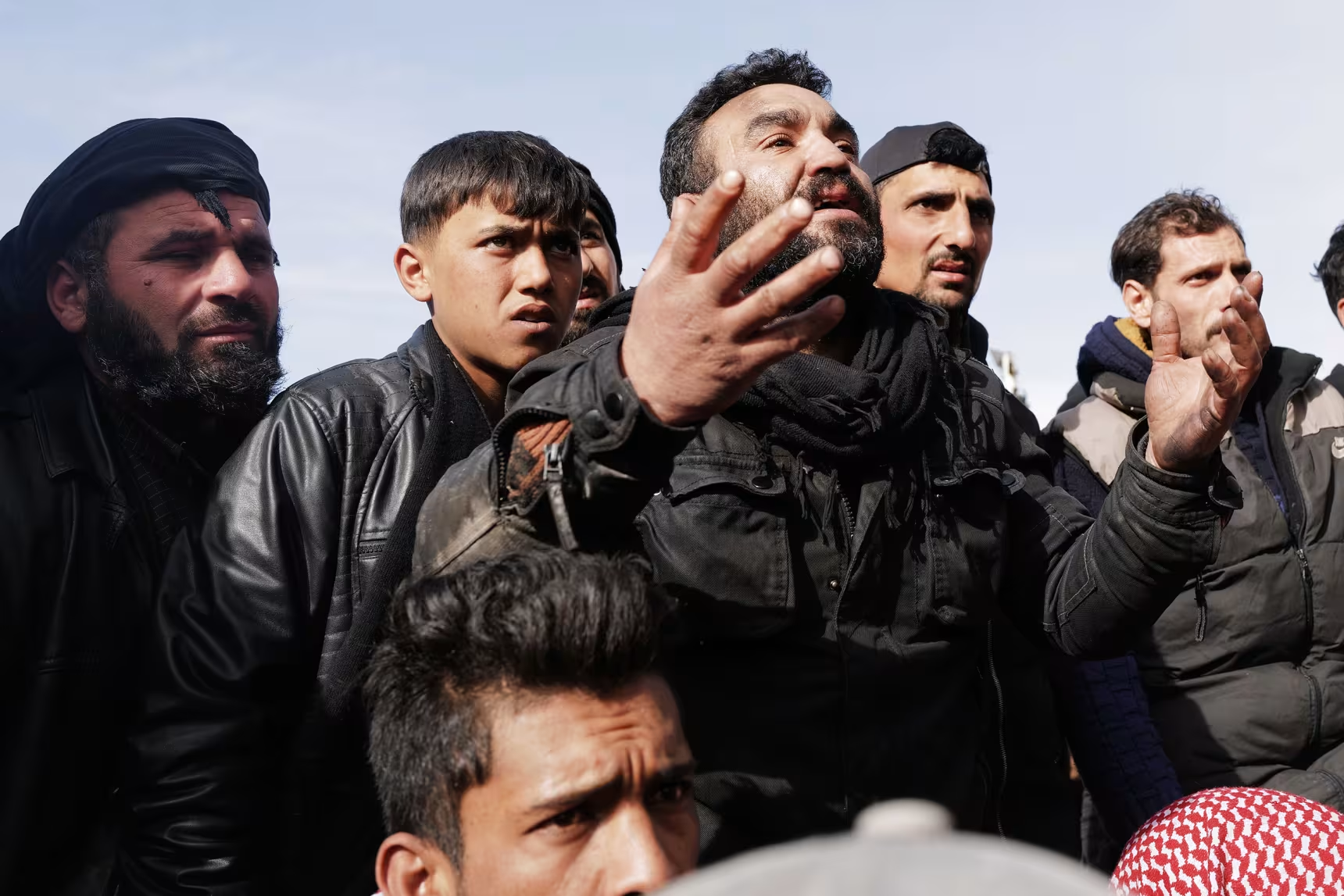
    If you were following the news from Syria this week, there were multiple scenes of joy.

    Despite the 2,000-year time difference, those events in Syria echo the message of both John and Jesus. They proclaimed the kingdom of God in a world dominated by the Roman empire and its local proxies: Herod and his sons.

    John and then Jesus assured people that God’s kingdom was about to arrive. For John, that seems to have been imagined as the arrival of the Messiah, but when John—who was already in prison—sent messengers to check whether or not Jesus was the Messiah for whom they were waiting, Jesus replies as follows:

    Go and tell John what you have seen and heard: the blind receive their sight, the lame walk, the lepers are cleansed, the deaf hear, the dead are raised, the poor have good news brought to them. And blessed is anyone who takes no offense at me. [Luke 7:22-23 NRSV]

    In describing what the arrival of God’s kingdom looks like, Jesus was drawing on the words of prophet Isaiah who inspired both John and Jesus, and whose words have had their own echo again in Damascus this week:

    The spirit of the Lord GOD is upon me, because the LORD has anointed me; he has sent me to bring good news to the oppressed, to bind up the broken hearted, to proclaim liberty to the captives, and release to the prisoners; to proclaim the year of the LORD’S favour, and the day of vengeance of our God; to comfort all who mourn; to provide for those who mourn in Zion— to give them a garland instead of ashes, the oil of gladness instead of mourning, the mantle of praise instead of a faint spirit. They will be called oaks of righteousness, the planting of the LORD, to display his glory. They shall build up the ancient ruins, they shall raise up the former devastations; they shall repair the ruined cities, the devastations of many generations. [Isaiah 61:1-4 NRSV]

    In Damascus this past week and in Capernaum 2,000 years ago, these words capture what JOY looks like.

    Those prophetic lines sketch what the world looks like when God is active among us.

    This is the JOY that erupts when the impossible is achieved, when the unthinkable happens, when the mighty are indeed cast down from their thrones, and when the humble and meek are fed.

    This JOY is exuberant, as we have seen on our TV screens these past few days.

    Yes, it may all end in tears, but for now there is celebration and delight. JOY.

    The people who stumbled out of Assad’s prisons blinking in the bright light of the sun, understood what JOY is.

    Indeed, the people who walked in darkness have seen a great light; those who lived in a land of deep darkness— on them light has shined.  [Isaiah 9:2 NRSV]

    This week we hear words about JOY, but we have also witnessed scenes of great JOY as the ancient words of the prophets find an echo in the events of our own time.

    ———

    While we celebrate with the Syrians who have been surprised by joy and rediscovered hope after decades of tyranny and almost 15 years of civil war, we must not forget that there are people still incarcerated unjustly much closer to home.

    To our shame, Australia turns away people seeking safety.

    Equally to our shame, we pick and choose who we assist, based on the colour of their skin or the way they worship God. 

    We were generous with assistance to Europeans fleeing Ukraine after the Russians invaded. That is a cause for celebration. But we turned our backs on the people of Gaza when they attempted to find safety while Israel destroyed every hospital, school, university and mosque; not to mention water systems, sewerage systems, electricity plants and almost every single home for 2.4 million people.

    Were Mary and Joseph to be seeking refugee with the baby Jesus here today, I fear that our government would reject their application and send them to offshore detention.

    As we enjoy the outpouring of joy and hope in Damascus, let’s also have the courage to be more generous as a people.

    As we do that, may we give others cause for JOY and may we find deep JOY ourselves.

  • people of hope

    people of hope

    Advent Sunday
    St Paul’s Church, Ipswich
    1 December 2024

    [ video ]

    Here we are: 

    • 1 December
    • Advent Sunday
    • the beginning a new year of faith and mission here in the heart of Ipswich.

    Over these four Sundays we are asked to reflect on key themes:

    • Hope
    • Peace
    • Love
    • Joy.

    I have no idea who chose those 4 themes or determined their order.

    However, I am glad that someone did. 

    They are great themes for us to reflect on over these 4 Sundays.

    I am not interested in them as abstract ideas, but I am very interested in them as real-life challenges for us as a faith community:

    1. How do we be(come) a community of hope?
    2. How do be a community of peace?
    3. How can we make love the spiritual DNA in our life together?
    4. And what about joy? How do we as a church move beyond fake smiles to genuine happiness?

    We can work our way through those 4 sets of questions over the next few weeks, but for now let’s focus on HOPE.

    How hope can flourish here

    Sometimes hope gets squeezed by all the awful stuff happening in our lives, in our community, or around the world.

    Yet hope can flourish when it is grounded in faith and love. 

    Maybe that is why St Paul concludes his powerful Hymn to Love in 1 Corinthians 13 with the line:

    And now faith, hope, and love abide, these three …

    If we stick with that triple list for a moment longer, we might think of faith as the soil in which the seed of hope is planted; and love as the sunshine that ensures the plant (in this case, faith) is healthy and abundant.

    If someone has not experienced much love in their life, then their capacity for hope is going to be diminished.

    And if they are not sure that life is a precious gift to be enjoyed and lived to the full, then their capacity for hope is going to be diminished.

    There we have a first clue as to how this church can be a community that grows hope.

    As a first step we need to stop talking so much about evil, sin and guilt. Instead, we should affirm repeatedly that life is a precious gift from God. Every life. All of life. Even the tough bits.

    Faith is not the art of believing 16 impossible things before breakfast (as someone once said), but rather the confidence that life is good; even when it seems far from good some of the time. Even much of the time.

    As a church we proclaim our faith that God is good, that our world is inherently good because that is how God caused it to be. Indeed, one way to talk about God, is to use the phrase “the love at the heart of the cosmos.” 

    If we connect people with that love at the very heart of the cosmos, then they will discover the deep truth of creation:

    God saw everything that he had made, and indeed it was very good. [Genesis 1:31]

    There is always much to learn as we travel along the road of faith, but the most important thing is not how many things we know but rather whether we have understood this one truth: life is good, and it is a blessing to be here.

    From the ground of that confidence grows the seed of hope.

    As that seed grows, we can say YES to God. Here I am, Send me.

    Our role as a faith community is to nurture that seed of hope as it grows within each person who comes within our circle of faith.

    This is not to ignore the need for us to overcome blindspots, moral and spiritual injuries, and plain old nastiness at times.

    There are weeds in even the best-kept gardens, and there is a need for renewal and transformation in each and every person within this community.

    Conversion is a lifelong process, but it need not begin with shame. It can begin with delight and the joy of being loved .

    The profound truth that we have to offer our world is this message of hope.

    Because God brought us all into being in the first place, there is hope.

    Because Jesus shows us that love overwhelms fear, there is hope.

    Because the Spirit of God is at work in us, there is hope.

    Because we discern the Word of the Lord when the Scriptures are opened, there is hope.

    Because we affirm the faith of the church, there is hope.

    Because we pray for the world and the church, there is hope.

    Because we gather around the Table of Jesus, there is hope.

    Because we baptise babies and adults, there is hope.

    Because we feed the hungry, there is hope.

    Because we are church, there is hope.

    This Advent, let’s pray for God’s help to become the kind of people who inspire hope in others, and the kind of church that nurtures hope in the heart of everyone who walks through our doors.

  • It’s complicated

    It’s complicated

    Pentecost 26B
    St Paul’s Church, Ipswich
    17 November 2024

    [ video ]

    From widows to rival wives

    Last week we had readings that featured several women whose husbands had died, leaving them in particularly vulnerable situations as widows in ancient societies where there was no public social security system.

    Today the first reading features the rivalry between two wives: one of whom was the mother of several children, while her rival was unable to have any children.

    To use a modern catchphrase: It’s complicated!

    Some of us—perhaps most of us—come from families that are a bit complicated at times. For sure I do.

    I have been told that were the story of my family offered to a TV studio, it would be rejected as too far-fetched.

    Yes, sometimes life is complicated.

    Life is complicated. Families are often far from story book perfect. And we are complex people as well.

    Even church families.

    Last week we had the story of Ruth and Naomi. It was set at Bethlehem, and in the fields of Ephrathah. Echoes of Christmas reaching across the lectionary, since Ruth was not only identified as the great grandmother of King David but—in the Gospel of Matthew—becomes a direct ancestor of Jesus!

    That was one complicated family story indeed.

    As is the story of Jesus’ immediate family, for that matter.

    This week we have two rival wives—Hannah and Peninnah—who were both married to Elkanah son of Jeroham.

    There are lots of families like that in the Old Testament. Indeed, King Solomon—supposedly the wisest man ever to live—had 700 wives and 300 concubines (1 Kings 11:4).

    Such families were complicated, as we often see in the biblical narratives.

    Elkanah comes across as a caring and compassionate husband, even if Hannah had to share her husband with another woman. But the other (perhaps younger) rival was cruel and Hannah found her life was both complicated and bitter.

    We all know stories like that. Some of us may have families like this, and the cruel control games may be played by men just as much as by women, not to mention intergenerational abuse.

    And, yes, it happens even in church families.

    As the story unfolds this nasty plot is resolved when Hannah does eventually have a child—Samuel—who she promptly donates to the elderly priest at the temple! 

    Another complication.

    Not to worry: God gives Hannah 2 more sons as well as 2 daughters, while Samuel stays at the temple with Eli the priest.

    Yes, it is definitely complicated.

    It all ends well, but a happy ending does not take away the pain and the abuse in the middle of the story.

    Not then and not now.

    So where do we find holy wisdom in stories such as this?

    For me, that wisdom is especially to be found in the raw faithfulness of Hannah.

    Hannah comes across as a woman who lives with domestic and family violence, and yet keeps her dignity because she has such a strong faith.

    Elkanah also emerges as a good character in this complicated story. He supports, protects and loves Hannah. He even allows her to donate the long-awaited child to the temple.

    Their personal situation was complicated but they were there for each other, and they were people who practised their faith.

    As the story goes, their faith did not waver.

    In real life—and not just in this archetypal story—their faith may have been a bit more complicated as well. We shall never know.

    But the storyteller added to this story the beautiful Song of Hannah that we read together a few minutes ago. That song was fashioned by countless anonymous women from ancient Israel who discovered that God was with them, with the powerless and the vulnerable. It comes from a later time when there were kings and princes in Israel, but its message of hope is timeless.

    Yes, life can be complicated.

    Yes, our faith can gives us hope and enable to survive and thrive.