Lent 4C
St Paul’s Church, Ipswich
30 March 2025
[ video ]
We’ve just heard one of the great stories of our faith, and indeed, one of the great stories of the Western world. I guess, of our whole culture. Stories have the power to shape the world. The stories we tell each other not only tell us who we are, but they form the lens through which we experience each other and interact with the world around us.
And as we step into a five week federal election campaign, we’re going to hear a lot of stories, stories about them, stories about us, stories about you, and some of them might even be true, but as we’ve learned in the last several years, we’ve moved, sadly, into a post fact world where this power of the story is more important than its actuality and its truthfulness.
And in a sense, it’s always been like that with important stories, the stories that really matter are not stories whose truth is mortgaged to their historicity, and that is never more so than with the parables of Jesus. Of course, they’re true, but they’re made-up stories. We don’t mortgage their spiritual value to their historicity.
So we’ve just heard one of the great stories. It is a story about love and compassion and good parenting, and it’s a great combination, as it happens, for Mothering Sunday, except it’s not about a mother, it’s about a father! But then it’s pretty hard to find stories in the Bible that celebrate Mothers, actually, because the Bible was mostly written by and for men.
So here we have this amazing story which Luke has gathered up and which would otherwise have been completely forgotten. This story is not remembered in Matthew or Mark or John, and of course, there’s not a peep of it in the letters of Paul.
If we didn’t have the Gospel of Luke in our Bible, we would never have heard this story. So imagine a Christianity without the parable of the prodigal son.
What Luke has done in this part of his gospel is to gather together three stories about lost things: a lost sheep in the first paragraph, a lost coin and then a very lengthy story about a lost son.
Or is it two lost sons?
The first parable—the one with 100 sheep, 99 are doing the right thing, and one goes astray—we also know from Matthew’s Gospel. But the story of the lost coin and the story of the lost boys is only known to us in Luke.
This year, we particularly listen to the Gospel of Luke because it’s the focus during this third year of our three-year lectionary cycle.
So spare some time this week to say thank you to God for Luke and for the incredible riches we have in the Gospel of Luke and the Acts of the Apostles.
The story seems so familiar to us, and yet it is, of course, a story from another place and another time. While it makes sense to us in our culture and in our time, it doesn’t have quite the same impact when taken out of the cultural context in which it was first given.
The gifted biblical scholar Kenneth Bailey, who sadly died just a few years ago, has given us a powerful interpretation of this parable, indeed of the whole of Luke chapter 15, that invites us to see and hear what Jesus is saying through ancient Palestinian or peasant eyes and ears. In fact, Ken kept coming back to this chapter in Luke and to the prodigal son in particular. He’s written several books on just this one portion of Luke’s gospel, and has given countless talks on his interpretation of the prodigal I had the privilege of hearing one of those presentations in Bethlehem some years ago now and then over the next few days during the conference, engaging with Ken in conversation. We disagree about all sorts of things, but he was an awesome scholar, and I was particularly impressed with his mastery of Arabic and early Arabic commentaries on the Bible.
If you look up the web version of this sermon later, there’ll be a link to one of his videos so you can see and hear the kind of wisdom that Ken Bailey offered us. Instead of taking multiple volumes and several hours of videos, let’s try and do it in five minutes. Let’s try and catch an insight into this amazing story of the prodigal father.
The key character in this parable is, of course, not the younger son, but the father.
Repeatedly in the parable, it is the farther who plays the role of God, just as the shepherd who goes looking for the one lost sheep and the housewife who goes searching for the one lost coin are metaphors for the God who goes searching for the lost soul.
The father in this story is the compassionate rock around whose strong presence we see the ebb and the flow of his two dysfunctional sons.
The father is constantly acting in ways that are contrary to the culture of the time, although that’s not immediately obvious to us. And so I think we’re right to think of this as really the parable of the loving father, rather than the prodigal.
The parable begins. You will recall when the younger son makes a request that is designed to break the father’s heart and bring shame on him and the whole family. He wants his future inheritance right now, why wait for the old guy to die? Let me have it now! That, of course, is not just an ancient dynamic, is it?
Those of us who live in properties that are accumulating in value and have children and grandchildren that are struggling to pay their mortgages know something of that pressure as well.
When I was a locum for a period at Byron Bay this was a real thing. People who bought a house at the Bay in the 1950s for a few hundred dollars were now living in properties worth millions and the grandchildren were really keen for them to move into a nursing home.
In our world today, we don’t see it, sadly, as such a shameful thing, but in the ancient world and in the Middle East, still, it could not get much worse than what the younger son does to his father.
In their world, everything is about honor and shame. Honor and shame. The father loses his honor, and the son brings shame, not only on himself, but on his father and on the family, and indeed, on the whole village.
It was like that in the palace in the eastern Mediterranean. It remains. So today. Identity is not so much the individual, but the family to which the individual belongs. So even today, in Nazareth, if a Palestinian is meeting somebody for the first time, they won’t ask, “So what’s your name and what do you do?” or even, “Where do you live?”—which in Ipswich might give us a sense of what kind of person you are. Rather, they’re going to say who’s your grandfather? Because if I know your grandfather, I know you. I know where you fit in. I know whether you come from a family with honor or riffraff.
I had my own taste of that many years ago on the edge of Byron Bay parish, in a little church at a place called Broken Head. My family had gone there one Sunday when we were on holidays. It was a tiny little chapel, a timber chapel. Later on, as I said, I found myself as the locum, and that was one of the churches where I took services. But it was obvious on that first visit that everybody in the building—apart from my family, the four of us—everybody else in the building were obviously from the same family, and it wasn’t our family. They were all a little group of Armstrongs, as it turned out. So after the service, we’re taken across to meet old Mrs. Armstrong. That’s how she was referred to when I met her. So I was introduced to Mrs. Armstrong: “And what’s your name? Where are you from?” And I said, “Well, my name is Greg Jenks. I’m Rector of Holy Trinity Church in Fortitude Valley.” She said, “We had a Jenks in our family once, but he moved to Brisbane and he died.” And I said, “Well, that was my dad.” Old Mrs Armstrong continued: “So your grandmother and me, we used to walk to Coopers School together, and we used to play under the railway line. Welcome.”
I was slotted in. I belonged. Okay? I possessed an identity and experienced the welcome and the honor of being connected.
So back to the story of the man with two sons.
Rather than retreat into wounded honor and a persistent sense of shame, the father waits expectantly for the day when the troubled boy will come back.
More public shame is about to befall this old man, but he brings it on himself.
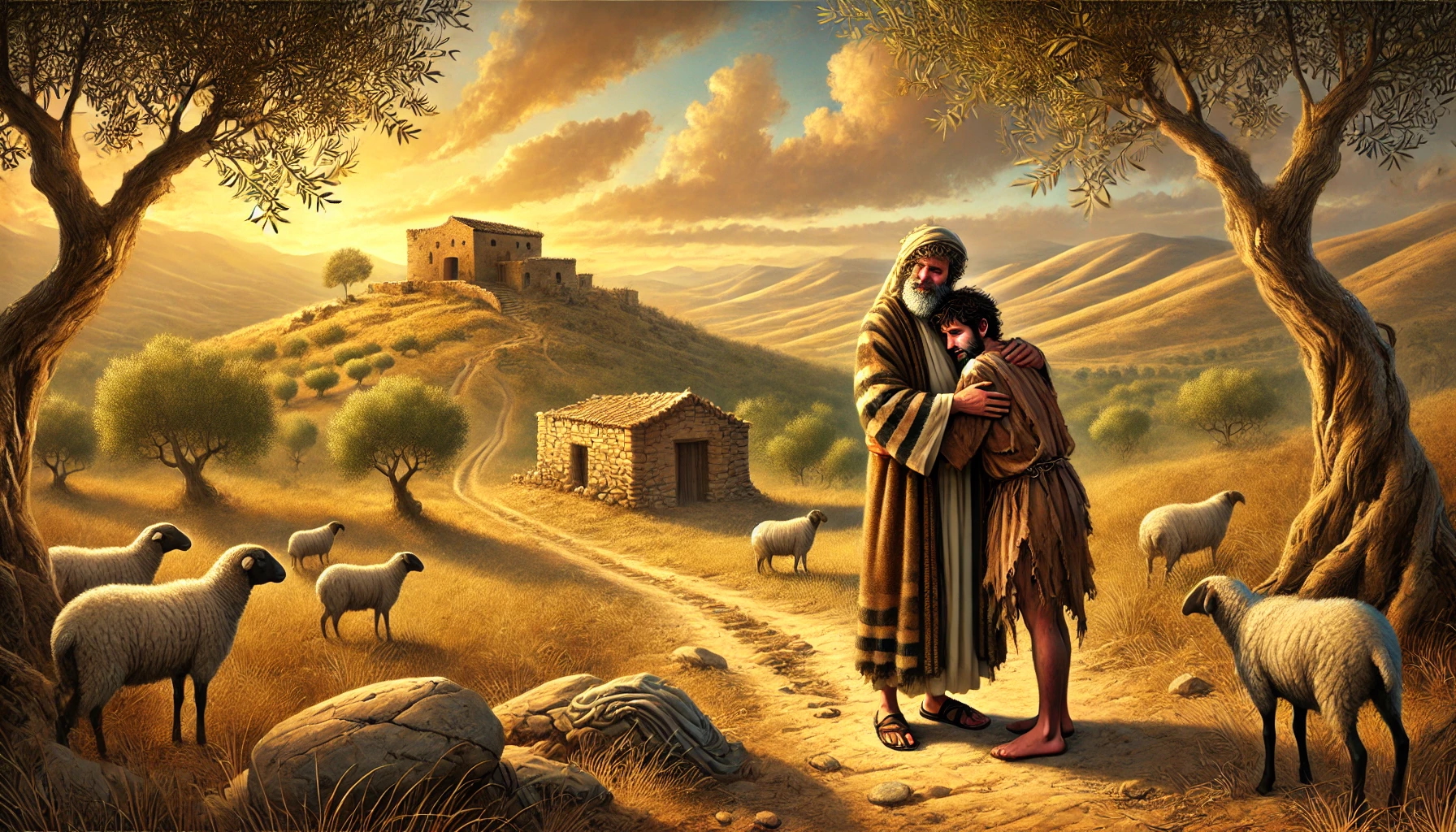
There comes the day when he spots the bedraggled form of his younger son, barefoot and in rags, creeping through the streets of the village, making his way home. He runs down the street to embrace the boy who had treated him as dead.
Oh, that sounds nice, doesn’t it, we think, but in that village and in that culture, and at that time, what the father did was shocking.
Right there in the streets of the village, in front of the neighbors, he runs to the son who has treated him so shamefully. In the peasant world of the eastern Mediterranean—then and now—senior men do not run anywhere. Thank you very much. They walk with dignity and slowly.
We can easily miss that detail, because that’s not the world we live in. We’re hearing the story, but it’s told for people with different ears and different eyes. You see to run towards his son, the old man has to hitch up his robes because—no more than I can run to the front door with all this gear on—the old farmer can’t run to his son unless he hitches up his robes.
Shock, horror, he then exposes his legs.
That’s a serious costume fail in the villages of the ancient Levant in front of the neighbors. It’s not elegant, and worse, it’s shameful. But the old man doesn’t care. His only concern is for the son who had been dead, but now is alive, back safe and sound.
In that frail old man running awkwardly down the village street. Jesus paints a picture of God, but he’s also sketching the outlines of what his community of disciples would be like: people of compassion, not holding grudges, not clinging to status, compelled by love.
So in this story—this familiar, beautiful, misunderstood story—we see a different world, a new world, fashioned and sustained by divine love.
And that new world is the reality we are called to create as a community of Jesus people here in the heart of Ipswich. Amen.




You must be logged in to post a comment.