Category: Sermons

  • Emmanuel

    Christ Church Cathedral Grafton
    Christmas Eve
    24 December 2018


    [ video ]

    Well, here we are …

    In the middle of the night—when we should all be tucked up in bed—we are sitting in the Cathedral and celebrating the birth of a Jewish baby born in a very small village in Roman-occupied Palestine just over 2,000 years ago.


    It’s a birth story

    Like every other birth, the arrival of Mary’s boychild was an occasion of joy, accompanied by a sense of awesome responsibility, and profound hope.

    Like us, as Mary and Joseph held their newborn baby in their arms, they must have wondered what life would be like for this wee fellow in the years ahead.

    What would he be like? What gifts would he have? How would the people of the village and the wider family welcome this new person into their circle. Would he be famous? How would he make the world a better place? What can we do as parents to ensure he becomes all that God intends him to be?

    Those are questions we have all asked ourselves as we hold newborn children in our arms.

    The families who bring their children for Baptism in the Cathedral have similar thoughts in their minds and similar hopes in the hearts.


    It’s the birth of Jesus

    At Christmas we celebrate the birth of a most remarkable person.

    Today the focus is on his birth. He was a real person. He arrived in this world the same way we all do. Incarnation. God taking flesh and entering into the stuff of this blue planet.

    From small beginnings in a village in Palestine, not far from the palaces of kings and wannabe rulers, this vulnerable infant developed into an adult of courage, vision and passion.

    This is not the time to talk about his death. Today we celebrate his life: his birth, his childhood and his ministry as the prophet of God’s active presence among us. Emmanuel. Through the life of Jesus God was active in our world, reconciling all things to himself and inviting us to embrace life.

    Although Mary and Joseph could not imagine what was to come, this child was to have a huge impact all around the world, and during the past 2,000 years millions of people have been touched by his life and have reflected on what it all means.

    In music, art, architecture, literature and compassionate action people who have been touched by Jesus has made their response to the deepest message of Christmas: Emmanuel.

    God is not far away. God is here among us, within us and between us—as Jesus himself would say.

    Christmas shows us where to look for God: right here and among our own circle of people we know best.

    This is a simple idea, but it is also a very big idea.

    It changes everything.

    It is worth getting up in the middle of the night to celebrate!


    Thin people

    The child whose birth we celebrate tonight grew to become a person of the Spirit, a holy person.

    When we talk about holy places, we sometimes describe them as ‘thin’ places; places where it seems the gap between our reality and the deeper reality of God has all but vanished.

    We might also describe Jesus as a ‘thin’ person.

    He most likely was physically thin, due to the diet of Jewish villagers in ancient Palestine and the active lifestyle of someone walking from place to place across Galilee. But I am referring to something else: his capacity to transform people.

    What changed people was their discovery that when they met Jesus they also encountered God.

    Jesus proclaimed the coming of God’s rule.

    Jesus himself was the arrival of God, present among us in a new way. Emmanuel.

    In the Gospel of John this mystery is expressed in words put onto the lips of Jesus by the later tradition: “Whoever has seen me has seen the Father.” (John 14:9)

    Christmas invites us to embrace the possibility that our world is really a crowd of thin people.

    Others encounter God when they meet us, and we encounter God when we meet them. Emmanuel.

    Of course, this also means that how we treat others is also how we treat God.

    Jesus said exactly that in his parable of the last judgment. The punch line for that story is: “When you did this (or failed to do this) for another person, then you did it (or failed to do it) to me.” (Matt 25:31–46)

    If we embrace that possibility in the year ahead, then our lives and our world may well be transformed.

    Christmas time is an opportunity to practice how we want to act for the rest of the year. This is a time when we naturally focus on things like:

    • Community
    • Generosity
    • Compassion
    • Love


    When we make those things central to our lives, then we are transformed, the people around us are touched, and the world draws closer to God’s dream for us all.

    May that be our experience this Christmas and throughout the year ahead.

    Happy birthday, Jesus

    Happy Christmas, Grafton.

    Happy 2019, world!


  • Rejoice in the Lord always

    Christ Church Cathedral Grafton
    Advent 3 (C)
    16 December 2018


    [video]

    As we know, each week during Advent has a particular thematic focus.

    As we make our way through these four Sundays prior to Christmas this year we are considering in turn the themes of hope, peace, joy and love.

    These are not only great Advent themes, they are also deeply significant elements in lives that are satisfying and deeply meaningful.

    So today we are focusing on joy and we see that being reflected very clearly in today’s epistle from Paul’s letter to the Philippians. ‘Rejoice in the Lord always,’ Paul says. ‘And again I will say, rejoice!’

    In a moment we shall come back to tease out this concept of joy using the excerpt from Paul’s letter as the basis for our reflections, but first I’d like us to set aside some common misconceptions about joy.

    So let me simply list—without any detailed discussion—a whole series of examples where joy is sometimes mistaken for something else, or conversely some other aspect of life is as mistakenly believed to guarantee joy if we can just achieve or possess it.

    Joy is not the same as happiness

    Joy is not the same as being amused or entertained

    Joy is not always expressed in laughter or a cheery face

    Joy does not mean we are carefree or untroubled

    Joy is not a result of alcohol, drugs and medication

    Joy is not having the latest consumer products

    Joy is not about lots of sex

    Based on how advertising is designed, one could be forgiven for thinking that a profound sense of contentment and well-being in all kinds of circumstances is indeed generated by one or more of these attributes. The more the better, it seems.

    But we also know from own our experience—as well as from observation of those who enjoy an abundance of these attributes—that influence, power, status and wealth do not ensure joy.  Indeed, sometimes these sadly become demons that destroy lives and even drive people to self-harm.

    So let’s focus on the brief passage from Philippians that we heard earlier:

    Rejoice in the Lord always; again I will say, Rejoice. Let your gentleness be known to everyone. The Lord is near.  Do not worry about anything, but in everything by prayer and supplication with thanksgiving let your requests be made known to God.  And the peace of God, which surpasses all understanding, will guard your hearts and your minds in Christ Jesus. [Philippians 4:4–7]


    As we focus on this excerpt from a letter written about 25 years after Easter, let’s remind ourselves why we do this.

    It is not because grabbing a few words from the Bible will provide us with a recipe for joy, or the answers to life’s questions. We are not hearing words spoken by God, but words written by Paul.

    I am now going to recycle here what I wrote online a few days ago:

    We read the texts not to hear what God has said in the past, but to hear how other people of faith have spoken about God in the past so that we are better equipped to listen to God in the present.

    So we reflect on these words as words from Paul, and therefore words from someone with a deep insight into the dynamics of faith and life. As we do so, we are opening our hearts and minds to discern the whisper of the Spirit who makes the human words of the Bible a sacrament of invitation to live more deeply and more truly. When that happens then the ‘word of the Lord’ has been proclaimed and heard among us.

    In this short paragraph, Paul offers us several ideas for contemplation. Let’s take them one by one.


    Rejoice in the Lord always, and again I say rejoice!

    The underlying Greek word used here was also the everyday greeting when people met in the street or sent a letter: χαιρε [chaire]. It was the word on the lips of Judas as he greeted Jesus in the garden, and the words used by the soldiers as they mocked Jesus, “Hail, king of the Jews!”

    As used by Paul here, we note that he adds “… in the Lord …”.

    We are to wish one another—and also ourselves—happiness, health, peace, success and well-being in the Lord.

    Our joy finds its roots in Jesus himself. The blessings we wish for others come from Jesus. What we hope for ourselves comes from Jesus, and is grounded in all that he means to us.

    That makes joy an appropriate theme for reflection today as we get closer to Christmas Day. Joy to the world, the Lord has come!


    Let your gentleness be known to everyone. The Lord is near. 

    If we have a deep sense of joy and if we are truly at peace within ourselves, then others should experience us as gentle people.

    Gentle people?

    That almost seems like a quaint old-fashioned idea. But it invites us to think more deeply about how we conduct ourselves.

    Are religious people known for our gentleness?

    Do we have reputations as gentle people among our families and friends?

    Or do we kick heads and push others around, just like everyone else?

    Worse still, are we seen as people trying to push our religion down other’s throats?

    Are we really people who want to the right to discriminate against students and teachers in Christian schools because of their gender or their sexuality?

    Paul suggests that joyful people, as people who realise that the Lord is near, will be gentle and that everyone else will recognise that about us. If only that were so!


    Do not worry about anything, but in everything by prayer and supplication with thanksgiving let your requests be made known to God.

    Now Paul shifts the focus: from how others experience us, to how we handle the adversities that inevitably come our way.

    Note that Paul assumes ‘stuff will happen’.

    When ‘stuff happens’ in our lives we are not to worry about it, but rather bring everything that is happening to God, letting God know how we feel about the situation and seeking grace to deal with it. Things that might otherwise cause us to be anxious can now become something we bring to God with thanksgiving; in an attitude of gratitude.

    Paul is going beyond the “don’t be anxious” advice we find in the Gospels, and urging his readers to bring their worries to God with thanksgiving. When we can do that, then we have found a sweet spot indeed, and our trust in the Lord is sustaining us through times when we might otherwise meltdown.

    We will not get this right every time. Sometimes we will complain loudly and let God know exactly how unfair life seems. And that is OK as well.

    But sometimes we will get it right.

    When we trust God enough to be grateful even for the bad stuff—as it is happening, and not only with the benefit of hindsight—then we are getting very close to having found real joy.


    And the peace of God, which surpasses all understanding, will guard your hearts and your minds in Christ Jesus.

    Paul wraps up this section with words that are very familiar to us, even though when he wrote them in his short letter to the Philippians no one else had ever quite put it that way before.

    When we find our deepest meaning in Jesus, the human face of God …

    When others find us to be gentle people …

    When we can set aside our natural instinct to worry …

    When we bring our troubles to God with thanksgiving …

    Then the peace of God which passes all understanding guards our hearts and minds.


    When our hearts and our minds are guarded by God’s peace, we have joy.

    May the hope and the peace that we celebrated these past two Sundays in Advent, mean that this week we find real joy.


  • Hope, not fear

    Advent Sunday
    Christ Church Cathedral, Grafton
    2 December 2018

    [video]

    Here we are on the threshold of a new year of witness and service.

    It is Advent Sunday, and Christmas is just around the corner.

    Between now and then we have an opportunity to reflect on the core spiritual values that shape our preparation for the Christ Child and our mission to this city and region.

    Over each of the next few Sundays we will focus on these core values:

    • Hope
    • Peace
    • Joy
    • Love

    They sound strangely familiar, and yet rather out of place in our contemporary world.

    Hope! Our world and our nation seem hope-less at the present time. There is clearly a hope deficit. Trust is low. Fear is on the rise. More on that in a moment.

    Peace? Words fail. Violence continues to tear apart families, villages, cities and nations. Camellia will guide our reflections on peace when we gather next Sunday.

    Joy. The carols are playing on the muzak but road rage in the car parks at our shopping centres indicates that joy is often only skin deep, and below the surface we are angry and aggressive. Just try merging in the traffic leading to the Grafton bridge. What joy abounds. Not.

    Love. ‘What the world needs now’ is sadly lacking in so many of our everyday transactions with one another. Yet this is to be the hallmark of those who follow Jesus. We are not called to be correct, but we are called to love one another, turn the other cheek, to help the needy, and to go the second mile.


    HOPE

    Our focus this morning is hope.

    Hope is an attitude of the heart and it lies somewhere between wishful thinking and certainty.

    It is not whistling in the dark to keep our fears at bay.

    Nor is it a cocky self-confidence that acts as if we have the answers.

    It is easy enough to list words that describe the absence of hope or the opposite of hope:

    • Confusion
    • Despair
    • Disbelief
    • Doubt
    • Fear
    • Hatred
    • Pessimism
    • Tiredness

    There is no shortage of those things in our world, among our family and friends, in our neighbourhood, and in our workplaces.

    As Jesus people we overturn those grim realities and Advent is a time to recall that we are first of all people of hope.

    The readings set for today do not really help all that much. They tend to focus on the great reversal at the end of time, and perhaps even encourage us to derive some degree of hope from our perverted anticipation of how God is going to punish those who make us afraid for the future.

    That is what apocalyptic literature is designed to do: raise the hopes of victims who are suffering from more powerful opponents. But that literature trades on violence and simply imagines ‘them’ getting a serious dose of what ‘they’ have been dishing out to ‘us’.

    Apocalyptic texts offer spiritual steroids for critical moments, but not a long-term dietary supplement for a healthy life.

    Such violent images of divine retribution are deadly when matched with spiritual or military power. Look how the violent apocalyptic images of Revelation turned into state violence against the Jews once the Christian religion gained access to imperial power.

    We do not derive our hope from imagining the destruction of those with whom we disagree.

    And we do not ‘sell’ hope to ourselves and our neighbours by spreading fear.

    That is not the way of Jesus.

    We proclaim hope, not fear.

    We invite, rather than impose our values on others.

    We create safe places to explore grace, rather than define the boundaries to keep people out.

    Our doors are open. Our hearts are open. Our minds are open.

    Such a mindset is the ground of hope: for us and for others.

    We want to multiply hope, to see it spread beyond us to others. We want to see hope go viral. We do not seek to control it, define it, limit it, or restrict it. The more people who have some real hope the better our world will be: less fearful, more compassionate, more generous and less violent.

    We don’t build walls in a hopeful world. Not in Palestine and not on the Mexico border. Those walls will fall; because they represent fear, not hope. As do the off-shore detention centres.

    When God’s kingdom comes, as we ask each time we say the Lord’s Prayer, there will be no room for fear or violence.

    When Mary sings the Magnificat on that day, we shall celebrate that the mighty have been cast down from their thrones and that the humble and meek have been raised up. But there will be no walls and no eternal detention centres. Even Hell itself will be empty. Its gates will be ripped off by the victorious Christ, and all its inmates will be freed.

    And the church will no longer exploit the fear of death and judgment to coerce compliance with its views of how other people should live their lives. The forgiveness racket will be broken.

    Imagine a world like that.

    Imagine a church like that.

    Such is the shape and the power of hope.

    So today we ask God to nurture the seed of hope within us.

    Let it grow and let hope transform our lives, our church, our community and our world.


  • The precious in-between time

    Christ Church Cathedral Grafton
    Admission of Children to Holy Communion
    18 November 2018


    In our first reading this morning we heard the opening scene of an ancient set of stories about Samuel, one of the great figures in the biblical narrative.


    We will not go into the whole narrative in the live sermon, but for those reading the online version of this sermon the following graphic might be of interest.

    Telling-stories-about-Samuel

    In that table, I am mapping the stories about Samuel prior to the story of Saul, with which Samuel’s story overlaps. I am applying to the opening chapters of 1 Samuel a proposal by Old Testament scholar, Thomas Thompson, about one of the ways in which ancient Israel constructed complex stories by linking episodes of traditional material together like a chain.

    [see Thompson, T. L. (1987). The Origin Tradition of Ancient Israel: The literary formation of Genesis and Exodus 1–23(Vol. 55). Sheffield: JSOT Press.]

    In brief, Thompson suggested these ‘chains’ often began with a set of three episodes that establish the basic direction of the story, indicate a problem or challenge, and hint at the final resolution. This opening triplet is then followed by a series of episodes which develop the story, before a final climactic episode in which everything is resolved in a manner that echoes the hints in the third of the opening episodes. While Thompson developed his proposal for Genesis and the first half of Exodus, I have found that this model can also be applied to many other narrative texts in the great ‘primary history’ of ancient Israel: Joshua, Judges, Samuel and Kings. It is way of ‘seeing the forest’ and not simply the trees.


    This opening scene in the story of the prophet Samuel begins with a poignant personal situation.

    A woman named Hannah (Anne) is married to a man named Elkannah, and she is having trouble conceiving her first child.


    Again, as an aside for those reading this text rather than listening to the sermon, we need to note that Elkannah had two wives at the time. We note in passing that ‘biblical marriage’ rarely involved one man being married to one woman, and that there are many different forms of sexual relationships described in these ancient stories. But this text is not offering us a model for marriage. Its focus lies elsewhere.

    Of course, in the nature of things, the other woman was not having any trouble producing several children for their shared husband. This is not just a meme from some TV soap opera, but is also a familiar motif in several OT narratives. For the ancient storytellers—and their audiences—such a detail in the story tells us nothing about the gynaecological health of the women. Rather, it is a ‘sign’ that God is at work, and that the child who will eventually be born to the woman who struggles to conceive naturally is going to be a very special person when he grows up.

    Just as the ‘three bears’ into whose house Goldilocks stumbles is not a number but a plot scheme, so the barren woman is a set up so that the storyteller can proceed to tell us how God solved that little problem and brought this very special person into the world. So, back to the sermon …


    There are a couple of unusual features of this story that we might note in passing before we focus on the main point I want us to consider today.

    First of all, this is essentially a woman’s story. That is unusual in the Bible, where most of the stories are told about men and told by men.

    Hannah’s story has been shared and remembered by women, no doubt surviving in the oral tradition.

    Like the story of Ruth that we have listened to during the last couple of weeks, this story reminds us that women have always had their own perspective on the God story, and men mostly are unaware of it or else undervalue women’s perspective on life and faith.

    Hannah not only tells her story but gets her name into the tale. Again, that makes her different from many of the women whose names were not remembered along with their stories. Hannah demands that we hear her story and that we know about her.

    Secondly, this is not only a story about and by a woman, but it is about a matter that is central to female identity.

    Yes, Hannah has a husband. But he plays a very minor role in the story. She is in charge of her fertility and he is depicted as surprisingly tender and supportive for a Middle Eastern patriarch. This is ‘herstory’, not his-story.

    Again, issues of fertility and rivalry with other women rarely get named in church, even though they are a significant part of the lived experience of many women.

    So this story of Hannah and her precious baby, Samuel, is unusual and we pay close attention to it for that reason.

    Hannah wants a child.

    Many people can relate to Hannah’s dilemma.

    Increasingly couples in our society are struggling with fertility. All of us have friends who have wrestled with this demon and perhaps pursued IVF as one option to resolve it. Some of us here may have been down that road. We may even be ‘IVF babies’ ourselves.

    There were no fertility clinics in Iron Age Palestine, so women went to holy places and holy people, seeking a solution. Indeed, they still do, as William Dalrymple records in his beautiful book, From the Holy Mountain (1997). One of the most poignant stories he tells is about the Muslim women from one region in Syria who come to an ancient Christian monastery to pray for the blessing of a child when they seem unable to conceive.

    Hannah goes to the national shrine at Shiloh, a site not far from Jerusalem.

    There is an old priest serving there.

    Eli lacks critical pastoral skills, and perhaps should have been sent off for a Clinical Pastoral Education course. But he is wise enough to listen to the distressed woman he had mistaken as drunk and disorderly. In chapter three he will prove to be a wise mentor when Samuel needs some spiritual advice, but here he is dealing with a distressed woman. And a strong woman. And a woman with her own faith. She will not be turned aside.

    So Eli sends Hannah home with a blessing. She falls pregnant. She gives birth to a baby boy, who she named ‘Samuel’, a Hebrew word with a vague pun on the idea that God listens.


    Once again, for those reading the online text, the explanation of the name works better if the child is named, Shaul/Saul. Some scholars think that the birth legend of Saul has been hijacked by scribes who preferred Samuel the prophet over Saul the failed first king, but we can set that fascinating historical and textual morsel aside for now, and just go with the final version of the story as we have it in the Bible.


    Picking a name for a child is a significant moment, and sometimes a long and complex process. Let’s pause and reflect on that for a moment. Do we know why our own parents chose our name for us? Have we shared with our children the reasons why we chose the names they now have?

    Faith at home can be built from sharing such simple yet profound stories.

    Then Hannah does something we might not expect and would hopefully never choose to do ourselves. While praying in the temple she made a deal with God: give me a child and I will give him back to you.

    This is not to suggest you might like to donate your children to the Cathedral! Even if that is a tempting option at times when the going gets tough. For those times we have CVAS and Mr Oates!

    There is a deeper truth in this twist to the story.

    Hannah senses that her child is a gift from God.

    That is a simple and profound truth for us all.

    Our children are gifts. We nurture and shape them, but they do not belong to us. They are bound to us and we to them, but we do not own them.

    As parents we are preparing our children to leave—and to become all that God has in store for them; in addition, we are also preparing ourselves to let them go.

    We have perhaps seen the tragedy of a person whose parents could never let them go, never let them become free agents living into their own destiny. With God’s grace we can avoid that mistake.

    Finally, I want us to think about the in-between time for Hannah and Samuel.

    Samuel’s birth will have been a unique and special moment for Hannah and her husband. It is for each us when we hold a newborn in our arms, and wonder what the future holds for this precious little person.

    Sooner than any of us, Hannah lets Samuel go. He moves into the life to which he has been called by God and to which his mother releases him.

    I am at that point right now with my youngest child, who has just finished her university studies and landed her dream job. It is a poignant moment. A moment of deep joy and hope for the future.

    But what about the in-between time, the time between the birth of the child and the departure of the young adult?

    During that in-between time we nurture, we love, we shape, we support, we educate and we empower our children so that they can become all that God offers them and all that we wish for them.

    What we are doing here this morning is one step through that ‘in-between’ time.

    As they claim their place at the Table of Jesus, we celebrate the journey they are making and we rededicate ourselves as parents, family, school and church to be there for them as they become the people God is calling them to be.

  • A sure and certain hope

    Christ Church Cathedral Grafton
    All Saints & All Souls
    4 November 2018


    [video]

    At some time in the past twelve months almost everyone here this morning will have heard a priest say these words:

    Almighty God, our heavenly Father, you have given us a sure and certain hope of the resurrection to eternal life. In your keeping are all those who have departed in Christ.

    In my reflections this morning, I would like to tease out a little what we might mean by those familiar words.

    For the most part, I suspect they are not matters we spend a lot of time considering. Our culture is so death-averse that conversations about dying and serious thinking about ‘resurrection’ are rare things.

    But today death is on the agenda because we are here to remember loved ones who have died, and especially those who have died in the past year. These departed ones still matter to us. They continue to be part of who we are. We are shaped by their impact on us during their lives.

    Like most humans throughout the 300,000+ years that our species has been on this planet, we find it impossible to believe that what emerges seemingly from nowhere simply ends up nowhere.

    The fact that we exist is perhaps the greatest miracle of all, and it gives us ground to think that nothingness is not the final state. If it were, this world would most likely not exist even for a short 15 billion years!

    The God who calls the universe into being has also called us into being, and God will continue to call us into life even on the other side of death. Such is the nature of God. She cannot help herself.

    When we carefully examine the biblical texts, it is clear that this confidence took some time to develop. But for us as Christian people it has been crystallised at Easter. Our hope for the future is not derived from natural processes or philosophical reflection. It has a simple base that we rehearse in this and every Eucharist:

    Christ has died.
    Christ is risen.
    Christ will come again.

    We can reframe that statement of the core mystery of the faith so that it reads:

    We all shall die.
    We shall all be raised.
    We shall all come again.

    When we place ourselves inside the Christ experience, we acknowledge the reality of our deaths—but we also claim the truth that God’s loving purposes for us is not yet complete, and that in God’s keeping our continuity is assured.

    We exist—and we shall continue to exist—because that is the essence of God’s character.

    You may have noticed that I am choosing my words carefully here.

    In the first place, we really do not have words for whatever it means to continue forever in God’s love on the other side of death. Our carefully crafted words are like the burning bush that caused Moses to go aside and see what this strange thing might be. We have to use words, but the words are never adequate to the task.

    Secondly, most of the traditional Christian images for life after death no longer work for us. Let’s recall some of the most common images:

    • Up there … and perhaps even an ascension (or a rapture) to get us there
    • Pearly gates, and streets paved with gold
    • Paradise garden
    • Banquet that lasts forever
    • Large house with space for everyone
    • Never ending church service (!!!)

    Interestingly, the second reading this morning offered us a very different image for renewed and reconstituted life on the other side of death and destruction.

    Then I saw a new heaven and a new earth; for the first heaven and the first earth had passed away, and the sea was no more. And I saw the holy city, the new Jerusalem, coming down out of heaven from God, prepared as a bride adorned for her husband. And I heard a loud voice from the throne saying, ‘See, the home of God is among mortals. He will dwell with them; they will be his peoples, and God himself will be with them; …

    Rather than imagining a damaged and decaying world being left behind, John the Seer has a vision of a new heaven and a new earth. Life as we know it is renewed, not replaced with some ethereal spiritual existence outside of our bodies.

    Such a vision is a renewal of creation rather than a shift to some other kind of reality.

    Of course, this too is a metaphor, an image. But notice how this unfamiliar image works.

    Rather than encourage us to discount the value of life in this world, this vision invites us to imagine our world renewed and something even more significant: God relocates from heaven to earth.

    This world matters.

    Our life here matters.

    How we care for and sustain this world matters.

    Even after our death, our future is inextricably linked with the future of this world.

    Our future in the presence of God is not because we escape this world, but because God chooses to make this world—and our company—the place where God is to be found.

    Yes, this is just another metaphor, another image.

    But metaphors shape the way we see reality, and I hope this metaphor changes the way you think about our loved ones who have already gone before and also changes the way we think about how we choose to live here and now.

    We do not treat the world as a single-use plastic bag, but as a precious thing called into existence by love, sustained every day by the love that pulses at the very heart of the universe, and beloved by God who chooses to become a part of this word: Emmanuel, God with us, God among us.

    That is a truth to live by, on both sides of death. Emmanuel.

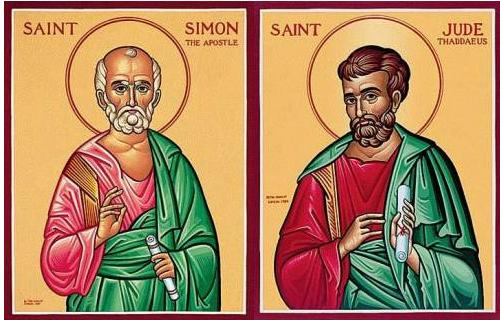
  • Saint Simon and St Jude

    Saint Simon and St Jude

    St Simon & St Jude
    Grafton Cathedral
    28 October 2018

    [video]

    During the course of the year, we celebrate numerous holy people: apostles and prophets, martyrs and teachers, missionaries and social reformers.

    Chief among the saints that we honour is Mary, Mother of the Lord. For many centuries she was the only woman to have a ‘red letter’ feast day, and indeed she has several feast days.

    Even among Australian Anglicans we find quite a list of holy days for Mary:

    February 2       Purification of the Blessed Virgin
    March 25        Annunciation to the Blessed Virgin Mary (Lady Day)
    May 31            Visitation of the Blessed Virgin Mary
    August 15        Falling Asleep of the Blessed Virgin Mary
    September 8   Nativity of the Blessed Virgin Mary
    December 8    Conception of the Blessed Virgin Mary

    Happily, Mary the Magdalene now has a red letter feast day on July 22 after disappearing from Anglican prayer books between 1552 and 1928.

    The Twelve Disciples are obvious candidates for celebration, as is St Paul. We celebrate the Twelve at various times of the year:

    • Matthias (February 24)
    • Phillip & James (May 1)
    • Peter & Paul (June 29)
    • James (July 25)
    • Bartholomew (August 24)
    • Matthew (September 21)
    • Simon & Jude (October 28)
    • Andrew (November 30)
    • Thomas (December 21)
    • John (December 27)

    So today we focus on Simon and Jude, as this is their day!

    Now let me summarise everything we know about these two people;

    (silent pause)

    Well, now that that is behind us, what are we going to do with a holy day for people about whom we know nothing at all?

    We can deduce some general information about people like them with names like this at that time in history. But about these two individuals, we know nothing beyond the fact that they were listed among the Twelve.

    Mind you, that is not bad!

    None of us will ever make that list. Nor did Paul—or Mark, or Luke, or Barnabas. Nor James the bother of the Lord, nor even Mary herself.

    The TwelveWe can never be one of the Twelve, but we do have something in common with Simon and Jude: we are disciples of Jesus.

    They were there at the beginning: walking around the dusty road of Galilee, listening to Jesus, watching him, learning to look for signs of God’s kingdom, and—in the end—running away in fear when Jesus was arrested and killed.

    Those people who first paid attention to Jesus are critical for us as people of faith. Had they abandoned the dream after Easter there would be no Christian faith. We really do not know why they kept the faith, but they did. And because they did, we can as well.

    Simon and Jude were disciples.

    “Disciple” (mathētēs) is an interesting term in earliest Christianity. It is a word never used by Paul nor any of the NT writers other than the 4 Evangelists. “Disciple” occurs 261 times, but only in the Gospel and (10% of the time) in the Acts of the Apostles, which was written by the same person who wrote the Gospel of Luke.

    There are similar statistics for the Greek word (akolouthein), “to follow”. The word occurs 90 times in the NT: 79 times in the gospels, 4 times in Acts, 6 times in the Book of revelation, and just one other time—in 1 Corinthians (where it refers to the Jewish legend of a miraculous rock that followed the Israelites as they wandered in the desert).

    One last data point. The situation is entirely reversed when we consider the word, “apostle” (apostolos). The term is virtually unknown in the Gospels (except for Luke who uses it 6 times), but very common—and very significant—in the epistles.

    Discipleship Terms NT

    Paul was always demanding people recognise his authority as an apostle, but he never once describes himself—or them—as disciples. Yet surely that is our deepest identity as people of faith.

    “Apostle” is a word linked to authority and leadership. “Disciple” is a word without those associations, but it is especially and distinctively associated with Jesus himself. We only find this word being used in the Gospels.

    To be a disciple is to get to the heart of what Jesus was doing: calling people to embrace his vision of God’s reign, to turn to God, to set aside other responsibilities, and to do what Jesus does: to proclaim, to heal, and to cast out evil.

    There is no status in this call. No privilege and no authority. No scheming to sit on the left hand or right hand of Jesus. To be a disciple is to be called into serving others, meeting their needs, and setting aside any privilege or status we may otherwise have enjoyed.

    Simon and Jude were honoured—most likely only after their deaths—as apostles and martyrs, but their real significance is simply that they were disciples.

    Like them, we discern the call of God in Jesus of Nazareth.

    Jesus calls us to follow him and be there for others.

    Simon and Jude—who are always listed in the tenth and eleventh place among the Twelve (only Judas Iscariot comes after them at #12)—did not leave a big impression in the memories of their peers.

    Like them today we can seek the grace to hear and respond to the call of Jesus, and the courage to waste our lives for the sake of other people. We may never become famous, but we know we can be faithful. And what can be more important than that?