Author: Gregory C. Jenks

  • Reflections on stuffing envelopes

    envelopes

    As a child of active church people in the 1960s and then a young church leader in the 1970s, I have filled a lot of envelopes in my time and applied a vast number of address labels.

    Yesterday I was at it again—preparing a mailout to the households that are connected in some way with Christ Church Cathedral in Grafton.

    Very late in the evening, indeed while still filling the final few envelopes, I posted the image above to my personal Facebook page, with this comment:

    Parish dynamics in one photo. The envelopes on the right are people who come often enough for me to know their names and predict they will be at church this Sunday. The other pile of envelopes is for people who come once a year or maybe once every two or three months. What is wrong with this picture?

    That whimsical post was partly a statement of “look what I have been doing today” and partly an unformed theological reflection on the missional dynamics of serving as priest to a small church community in a regional Australian city.

    That post triggered an unexpected set of reactions, with some people fixated by the small number of ‘regulars’ in the short stack, while others noted the familiar dynamics of a larger base of people with lower levels of participation relative to the small number of people who I could anticipate seeing in church on any Sunday of the year.

    Well, not without some trepidation, let me revisit this seemingly innocent photo of two piles of envelopes. There are several sets of ministry dynamics that might usefully be pursued in relation to this data. I will address just a few as a stimulus for conversation in various contexts.

    One aspect is that even ‘regulars’ in Australian churches now mostly come to worship just once a month. This is true also of Evangelical and Pentecostal congregations. It is one reason why I had such a small pile of envelopes for the “No need to post, I shall see them on Sunday” category. The sporadic nature of participation even by our core adherents is problematic as it undermines our cohesion, reduces the capacity for faith formation, limits the people available to assist with worship, and generally gives the impression of us being a much smaller community than we really are. It doubtless also has some financial impacts as few parishes that I know about still have a strong envelope system with recording of pledges and follow up of those who are behind.

    [As it happens our “cash (non-pledge) offerings” are up along with the numbers coming to church each week, even though we have a systemic decline in the number of times each month when most individuals will be in church on a Sunday.]

    Another aspect for my reflections is what kind of contact with people is welcome and appreciated these days? I encounter members of the congregation in all kinds of social settings around this small regional city of about 10,000 people. One of the privileges I have as Dean of Grafton is a civic profile that goes far beyond my role as Rector of the Anglican Parish of Grafton. I am actively seeking to develop, foster and exploit that profile for the sake of the Cathedral and the special ministry we have as ‘cathedral’ in a small city whose very status as a city largely rests on the Cathedral being here.

    For sure the majority of the envelopes represent older households, for whom social media is not a major point of connection. But there are other implications related to our age profile. Increasingly our events are scheduled to meet their needs, including not driving after sunset. Younger people—and families with work and school commitments—are excluded from the few events we still have, and we offer almost nothing that suits the schedule of persons who are not enjoying a healthy retirement.

    Happily, about half of the envelopes—yes, really, about half of them—represent families with young children who have overcome all the obstacles we inadvertently put in their way to ask for their children to be baptised at the Cathedral. Increasing we can connect with them via social media, but until very recently the Cathedral did not collect email addresses. We do have that data for about a third of the 100 families with young children. Typically both parents work during the week. Weekends are for sport, family time, friends, home maintenance, etc. The missional challenge that I see here is how we equip parents to nurture faith and compassionate living in the family context, rather than seeking ways to lure them into our liturgies.

    This catalogue of reflections does not even touch on the challenges of rebuilding our reputation in the wake of the sexual abuse scandals, or our almost total disconnect with our community’s acceptance of gender diversity and marriage equality. I am so proud that our small Parish Council has taken a courageous and generous position on the blessing of civil marriages.

    Nor does it touch on the impact of secularisation and a healthy disdain for pre-modern expressions of religion that simply fail to connect with our children and grandchildren, nor even with ourselves if we are honest.

    Despite all these challenges and maybe because of them, I find parish ministry absorbing and challenging. It does not require me to set aside my knowledge and skills as a critical religion scholar, but rather to hone those skills for application to the practical context of parish life, liturgical preparation, and weekly preaching. These days it even includes the obligation to craft a short daily message that goes out every morning via the Cathedral app.

    The small pile on the right are my biggest supporters and they want my ministry in this community to flourish and succeed. They are backing me in.

    I am also grateful for the large pile.

    It gives me the names of real people who have done the hard yards in years past and now are at a stage in their journey where they cannot be so active, even though many of them wish they could be still.

    That large pile also reminds me that there are many more people in the local community who value their association with the Cathedral and may just be waiting for the right moment to reconnect.

    Then there are the active grandparents who are often away from church several Sundays a month because they are investing time and energy into the nurture of their adult children and the growing band of grandchildren.

    And about half of that big pile represents families here in Grafton who have young kids and have not given up on the Cathedral, even though we have not been very effective at supporting them in their critical mission as parents.

  • The precious in-between time

    Christ Church Cathedral Grafton
    Admission of Children to Holy Communion
    18 November 2018


    In our first reading this morning we heard the opening scene of an ancient set of stories about Samuel, one of the great figures in the biblical narrative.


    We will not go into the whole narrative in the live sermon, but for those reading the online version of this sermon the following graphic might be of interest.

    Telling-stories-about-Samuel

    In that table, I am mapping the stories about Samuel prior to the story of Saul, with which Samuel’s story overlaps. I am applying to the opening chapters of 1 Samuel a proposal by Old Testament scholar, Thomas Thompson, about one of the ways in which ancient Israel constructed complex stories by linking episodes of traditional material together like a chain.

    [see Thompson, T. L. (1987). The Origin Tradition of Ancient Israel: The literary formation of Genesis and Exodus 1–23(Vol. 55). Sheffield: JSOT Press.]

    In brief, Thompson suggested these ‘chains’ often began with a set of three episodes that establish the basic direction of the story, indicate a problem or challenge, and hint at the final resolution. This opening triplet is then followed by a series of episodes which develop the story, before a final climactic episode in which everything is resolved in a manner that echoes the hints in the third of the opening episodes. While Thompson developed his proposal for Genesis and the first half of Exodus, I have found that this model can also be applied to many other narrative texts in the great ‘primary history’ of ancient Israel: Joshua, Judges, Samuel and Kings. It is way of ‘seeing the forest’ and not simply the trees.


    This opening scene in the story of the prophet Samuel begins with a poignant personal situation.

    A woman named Hannah (Anne) is married to a man named Elkannah, and she is having trouble conceiving her first child.


    Again, as an aside for those reading this text rather than listening to the sermon, we need to note that Elkannah had two wives at the time. We note in passing that ‘biblical marriage’ rarely involved one man being married to one woman, and that there are many different forms of sexual relationships described in these ancient stories. But this text is not offering us a model for marriage. Its focus lies elsewhere.

    Of course, in the nature of things, the other woman was not having any trouble producing several children for their shared husband. This is not just a meme from some TV soap opera, but is also a familiar motif in several OT narratives. For the ancient storytellers—and their audiences—such a detail in the story tells us nothing about the gynaecological health of the women. Rather, it is a ‘sign’ that God is at work, and that the child who will eventually be born to the woman who struggles to conceive naturally is going to be a very special person when he grows up.

    Just as the ‘three bears’ into whose house Goldilocks stumbles is not a number but a plot scheme, so the barren woman is a set up so that the storyteller can proceed to tell us how God solved that little problem and brought this very special person into the world. So, back to the sermon …


    There are a couple of unusual features of this story that we might note in passing before we focus on the main point I want us to consider today.

    First of all, this is essentially a woman’s story. That is unusual in the Bible, where most of the stories are told about men and told by men.

    Hannah’s story has been shared and remembered by women, no doubt surviving in the oral tradition.

    Like the story of Ruth that we have listened to during the last couple of weeks, this story reminds us that women have always had their own perspective on the God story, and men mostly are unaware of it or else undervalue women’s perspective on life and faith.

    Hannah not only tells her story but gets her name into the tale. Again, that makes her different from many of the women whose names were not remembered along with their stories. Hannah demands that we hear her story and that we know about her.

    Secondly, this is not only a story about and by a woman, but it is about a matter that is central to female identity.

    Yes, Hannah has a husband. But he plays a very minor role in the story. She is in charge of her fertility and he is depicted as surprisingly tender and supportive for a Middle Eastern patriarch. This is ‘herstory’, not his-story.

    Again, issues of fertility and rivalry with other women rarely get named in church, even though they are a significant part of the lived experience of many women.

    So this story of Hannah and her precious baby, Samuel, is unusual and we pay close attention to it for that reason.

    Hannah wants a child.

    Many people can relate to Hannah’s dilemma.

    Increasingly couples in our society are struggling with fertility. All of us have friends who have wrestled with this demon and perhaps pursued IVF as one option to resolve it. Some of us here may have been down that road. We may even be ‘IVF babies’ ourselves.

    There were no fertility clinics in Iron Age Palestine, so women went to holy places and holy people, seeking a solution. Indeed, they still do, as William Dalrymple records in his beautiful book, From the Holy Mountain (1997). One of the most poignant stories he tells is about the Muslim women from one region in Syria who come to an ancient Christian monastery to pray for the blessing of a child when they seem unable to conceive.

    Hannah goes to the national shrine at Shiloh, a site not far from Jerusalem.

    There is an old priest serving there.

    Eli lacks critical pastoral skills, and perhaps should have been sent off for a Clinical Pastoral Education course. But he is wise enough to listen to the distressed woman he had mistaken as drunk and disorderly. In chapter three he will prove to be a wise mentor when Samuel needs some spiritual advice, but here he is dealing with a distressed woman. And a strong woman. And a woman with her own faith. She will not be turned aside.

    So Eli sends Hannah home with a blessing. She falls pregnant. She gives birth to a baby boy, who she named ‘Samuel’, a Hebrew word with a vague pun on the idea that God listens.


    Once again, for those reading the online text, the explanation of the name works better if the child is named, Shaul/Saul. Some scholars think that the birth legend of Saul has been hijacked by scribes who preferred Samuel the prophet over Saul the failed first king, but we can set that fascinating historical and textual morsel aside for now, and just go with the final version of the story as we have it in the Bible.


    Picking a name for a child is a significant moment, and sometimes a long and complex process. Let’s pause and reflect on that for a moment. Do we know why our own parents chose our name for us? Have we shared with our children the reasons why we chose the names they now have?

    Faith at home can be built from sharing such simple yet profound stories.

    Then Hannah does something we might not expect and would hopefully never choose to do ourselves. While praying in the temple she made a deal with God: give me a child and I will give him back to you.

    This is not to suggest you might like to donate your children to the Cathedral! Even if that is a tempting option at times when the going gets tough. For those times we have CVAS and Mr Oates!

    There is a deeper truth in this twist to the story.

    Hannah senses that her child is a gift from God.

    That is a simple and profound truth for us all.

    Our children are gifts. We nurture and shape them, but they do not belong to us. They are bound to us and we to them, but we do not own them.

    As parents we are preparing our children to leave—and to become all that God has in store for them; in addition, we are also preparing ourselves to let them go.

    We have perhaps seen the tragedy of a person whose parents could never let them go, never let them become free agents living into their own destiny. With God’s grace we can avoid that mistake.

    Finally, I want us to think about the in-between time for Hannah and Samuel.

    Samuel’s birth will have been a unique and special moment for Hannah and her husband. It is for each us when we hold a newborn in our arms, and wonder what the future holds for this precious little person.

    Sooner than any of us, Hannah lets Samuel go. He moves into the life to which he has been called by God and to which his mother releases him.

    I am at that point right now with my youngest child, who has just finished her university studies and landed her dream job. It is a poignant moment. A moment of deep joy and hope for the future.

    But what about the in-between time, the time between the birth of the child and the departure of the young adult?

    During that in-between time we nurture, we love, we shape, we support, we educate and we empower our children so that they can become all that God offers them and all that we wish for them.

    What we are doing here this morning is one step through that ‘in-between’ time.

    As they claim their place at the Table of Jesus, we celebrate the journey they are making and we rededicate ourselves as parents, family, school and church to be there for them as they become the people God is calling them to be.

  • A sure and certain hope

    Christ Church Cathedral Grafton
    All Saints & All Souls
    4 November 2018


    [video]

    At some time in the past twelve months almost everyone here this morning will have heard a priest say these words:

    Almighty God, our heavenly Father, you have given us a sure and certain hope of the resurrection to eternal life. In your keeping are all those who have departed in Christ.

    In my reflections this morning, I would like to tease out a little what we might mean by those familiar words.

    For the most part, I suspect they are not matters we spend a lot of time considering. Our culture is so death-averse that conversations about dying and serious thinking about ‘resurrection’ are rare things.

    But today death is on the agenda because we are here to remember loved ones who have died, and especially those who have died in the past year. These departed ones still matter to us. They continue to be part of who we are. We are shaped by their impact on us during their lives.

    Like most humans throughout the 300,000+ years that our species has been on this planet, we find it impossible to believe that what emerges seemingly from nowhere simply ends up nowhere.

    The fact that we exist is perhaps the greatest miracle of all, and it gives us ground to think that nothingness is not the final state. If it were, this world would most likely not exist even for a short 15 billion years!

    The God who calls the universe into being has also called us into being, and God will continue to call us into life even on the other side of death. Such is the nature of God. She cannot help herself.

    When we carefully examine the biblical texts, it is clear that this confidence took some time to develop. But for us as Christian people it has been crystallised at Easter. Our hope for the future is not derived from natural processes or philosophical reflection. It has a simple base that we rehearse in this and every Eucharist:

    Christ has died.
    Christ is risen.
    Christ will come again.

    We can reframe that statement of the core mystery of the faith so that it reads:

    We all shall die.
    We shall all be raised.
    We shall all come again.

    When we place ourselves inside the Christ experience, we acknowledge the reality of our deaths—but we also claim the truth that God’s loving purposes for us is not yet complete, and that in God’s keeping our continuity is assured.

    We exist—and we shall continue to exist—because that is the essence of God’s character.

    You may have noticed that I am choosing my words carefully here.

    In the first place, we really do not have words for whatever it means to continue forever in God’s love on the other side of death. Our carefully crafted words are like the burning bush that caused Moses to go aside and see what this strange thing might be. We have to use words, but the words are never adequate to the task.

    Secondly, most of the traditional Christian images for life after death no longer work for us. Let’s recall some of the most common images:

    • Up there … and perhaps even an ascension (or a rapture) to get us there
    • Pearly gates, and streets paved with gold
    • Paradise garden
    • Banquet that lasts forever
    • Large house with space for everyone
    • Never ending church service (!!!)

    Interestingly, the second reading this morning offered us a very different image for renewed and reconstituted life on the other side of death and destruction.

    Then I saw a new heaven and a new earth; for the first heaven and the first earth had passed away, and the sea was no more. And I saw the holy city, the new Jerusalem, coming down out of heaven from God, prepared as a bride adorned for her husband. And I heard a loud voice from the throne saying, ‘See, the home of God is among mortals. He will dwell with them; they will be his peoples, and God himself will be with them; …

    Rather than imagining a damaged and decaying world being left behind, John the Seer has a vision of a new heaven and a new earth. Life as we know it is renewed, not replaced with some ethereal spiritual existence outside of our bodies.

    Such a vision is a renewal of creation rather than a shift to some other kind of reality.

    Of course, this too is a metaphor, an image. But notice how this unfamiliar image works.

    Rather than encourage us to discount the value of life in this world, this vision invites us to imagine our world renewed and something even more significant: God relocates from heaven to earth.

    This world matters.

    Our life here matters.

    How we care for and sustain this world matters.

    Even after our death, our future is inextricably linked with the future of this world.

    Our future in the presence of God is not because we escape this world, but because God chooses to make this world—and our company—the place where God is to be found.

    Yes, this is just another metaphor, another image.

    But metaphors shape the way we see reality, and I hope this metaphor changes the way you think about our loved ones who have already gone before and also changes the way we think about how we choose to live here and now.

    We do not treat the world as a single-use plastic bag, but as a precious thing called into existence by love, sustained every day by the love that pulses at the very heart of the universe, and beloved by God who chooses to become a part of this word: Emmanuel, God with us, God among us.

    That is a truth to live by, on both sides of death. Emmanuel.

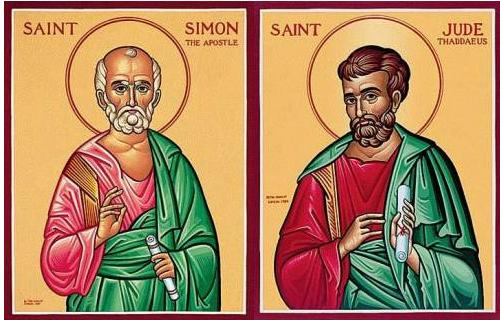
  • Saint Simon and St Jude

    Saint Simon and St Jude

    St Simon & St Jude
    Grafton Cathedral
    28 October 2018

    [video]

    During the course of the year, we celebrate numerous holy people: apostles and prophets, martyrs and teachers, missionaries and social reformers.

    Chief among the saints that we honour is Mary, Mother of the Lord. For many centuries she was the only woman to have a ‘red letter’ feast day, and indeed she has several feast days.

    Even among Australian Anglicans we find quite a list of holy days for Mary:

    February 2       Purification of the Blessed Virgin
    March 25        Annunciation to the Blessed Virgin Mary (Lady Day)
    May 31            Visitation of the Blessed Virgin Mary
    August 15        Falling Asleep of the Blessed Virgin Mary
    September 8   Nativity of the Blessed Virgin Mary
    December 8    Conception of the Blessed Virgin Mary

    Happily, Mary the Magdalene now has a red letter feast day on July 22 after disappearing from Anglican prayer books between 1552 and 1928.

    The Twelve Disciples are obvious candidates for celebration, as is St Paul. We celebrate the Twelve at various times of the year:

    • Matthias (February 24)
    • Phillip & James (May 1)
    • Peter & Paul (June 29)
    • James (July 25)
    • Bartholomew (August 24)
    • Matthew (September 21)
    • Simon & Jude (October 28)
    • Andrew (November 30)
    • Thomas (December 21)
    • John (December 27)

    So today we focus on Simon and Jude, as this is their day!

    Now let me summarise everything we know about these two people;

    (silent pause)

    Well, now that that is behind us, what are we going to do with a holy day for people about whom we know nothing at all?

    We can deduce some general information about people like them with names like this at that time in history. But about these two individuals, we know nothing beyond the fact that they were listed among the Twelve.

    Mind you, that is not bad!

    None of us will ever make that list. Nor did Paul—or Mark, or Luke, or Barnabas. Nor James the bother of the Lord, nor even Mary herself.

    The TwelveWe can never be one of the Twelve, but we do have something in common with Simon and Jude: we are disciples of Jesus.

    They were there at the beginning: walking around the dusty road of Galilee, listening to Jesus, watching him, learning to look for signs of God’s kingdom, and—in the end—running away in fear when Jesus was arrested and killed.

    Those people who first paid attention to Jesus are critical for us as people of faith. Had they abandoned the dream after Easter there would be no Christian faith. We really do not know why they kept the faith, but they did. And because they did, we can as well.

    Simon and Jude were disciples.

    “Disciple” (mathētēs) is an interesting term in earliest Christianity. It is a word never used by Paul nor any of the NT writers other than the 4 Evangelists. “Disciple” occurs 261 times, but only in the Gospel and (10% of the time) in the Acts of the Apostles, which was written by the same person who wrote the Gospel of Luke.

    There are similar statistics for the Greek word (akolouthein), “to follow”. The word occurs 90 times in the NT: 79 times in the gospels, 4 times in Acts, 6 times in the Book of revelation, and just one other time—in 1 Corinthians (where it refers to the Jewish legend of a miraculous rock that followed the Israelites as they wandered in the desert).

    One last data point. The situation is entirely reversed when we consider the word, “apostle” (apostolos). The term is virtually unknown in the Gospels (except for Luke who uses it 6 times), but very common—and very significant—in the epistles.

    Discipleship Terms NT

    Paul was always demanding people recognise his authority as an apostle, but he never once describes himself—or them—as disciples. Yet surely that is our deepest identity as people of faith.

    “Apostle” is a word linked to authority and leadership. “Disciple” is a word without those associations, but it is especially and distinctively associated with Jesus himself. We only find this word being used in the Gospels.

    To be a disciple is to get to the heart of what Jesus was doing: calling people to embrace his vision of God’s reign, to turn to God, to set aside other responsibilities, and to do what Jesus does: to proclaim, to heal, and to cast out evil.

    There is no status in this call. No privilege and no authority. No scheming to sit on the left hand or right hand of Jesus. To be a disciple is to be called into serving others, meeting their needs, and setting aside any privilege or status we may otherwise have enjoyed.

    Simon and Jude were honoured—most likely only after their deaths—as apostles and martyrs, but their real significance is simply that they were disciples.

    Like them, we discern the call of God in Jesus of Nazareth.

    Jesus calls us to follow him and be there for others.

    Simon and Jude—who are always listed in the tenth and eleventh place among the Twelve (only Judas Iscariot comes after them at #12)—did not leave a big impression in the memories of their peers.

    Like them today we can seek the grace to hear and respond to the call of Jesus, and the courage to waste our lives for the sake of other people. We may never become famous, but we know we can be faithful. And what can be more important than that?

  • Francis and the wolf

    Francis and the wolf

    Christ Church Cathedral, Grafton
    Creation Sunday
    Blessing of the Animals
    7 October 2018

    [video]

    Francis_wolfLet’s begin with a story …

    The date is 1220 CE, about six years before the death of Francis of Assisi.

    The place is Gubbio, a medieval town in Umbria. It is about halfway up the Italian peninsula.

    The problem: a large wolf has been attacking animals and people, and everyone is afraid even to leave the walls of the town.

    Francis was living in the town at that time, and he decided to solve the problem posed by the ferocious wolf. The townspeople said he was crazy to do that, but he determined to do it in any case.

    Brother Francis goes outside the walls to meet Brother Wolf.

    Alone.

    With no weapons.

    When the wolf charged at Francis, the saint made the sign of the cross and commanded the wolf Francis made the sign of the Cross and commanded the wolf to cease its attacks in the name of God, at which point the wolf trotted up to him docilely and lay at his feet, putting its head in his hands.

    The ancient legend tells the story this way:

    “Brother wolf, thou hast done much evil in this land, destroying and killing the creatures of God without his permission; yea, not animals only hast thou destroyed, but thou hast even dared to devour men, made after the image of God; for which thing thou art worthy of being hanged like a robber and a murderer. All men cry out against thee, the dogs pursue thee, and all the inhabitants of this city are thy enemies; but I will make peace between them and thee, O brother wolf, if so be thou no more offend them, and they shall forgive thee all thy past offences, and neither men nor dogs shall pursue thee any more.”

    The wolf bowed its head and submitted to Francis, completely at his mercy.

    “As thou art willing to make this peace, I promise thee that thou shalt be fed every day by the inhabitants of this land so long as thou shalt live among them; thou shalt no longer suffer hunger, as it is hunger which has made thee do so much evil; but if I obtain all this for thee, thou must promise, on thy side, never again to attack any animal or any human being; dost thou make this promise?”

    In agreement, the wolf placed one of its forepaws in Francis’ outstretched hand, and the oath was made. Francis then commanded the wolf to return with him to Gubbio. At this sight, the men who had followed him through the walls were utterly astonished and they spread the news; soon the whole city knew of the miracle. The townsfolk gathered in the city marketplace to await Francis and his companion, and were shocked to see the ferocious wolf behaving as though his pet. When Francis reached the marketplace, he offered the assembled crowd an impromptu sermon with the tame wolf at his feet. … With the sermon ended, Francis renewed his pact with the wolf publicly, assuring it that the people of Gubbio would feed it from their very doors if it ceased its depredations. Once more the wolf placed its paw in Francis’ hand.


    Such stories are common among the legends of the saints.

    Irrespective of their historicity, they point to a way of seeing the world that we seem to have lost.

    The people who told these stories lived in an enchanted world.

    We live in a world where nature, animals and birds have little intrinsic value.

    We appreciate them for the profit we can make by exploiting them, and not for their own sake as living creatures in the larger web of life.

    Today we pause and reconsider.

    In the past few centuries, we have become myopic, short-sighted, as we look around us.

    We look at the world and think it is all about us.

    We have reduced the meaning of “us” in two ways: first of all, “us” seems to mean “me” and maybe people like me; and secondly, “us” seems to mean “humans”, rather than all forms of life on this beautiful Earth.

    If we give other life forms any thought at all, we tend to think of them as existing for our sake and without any inherent rights.

    We fool ourselves into thinking that God only cares about humans.

    And we consistently act as if God does not care what we do to her creation.

    But that is not the case, even if our theology encourages us to think it is all about us.

    It is essential to rethink the meaning of “we” so that it embraces all life forms on this planet—and not simply humans.

    We especially need to rethink our attitude towards the wild things and the places where the wild things are.

    Domesticated animals and production animals are not the only ones that deserve our best efforts on their behalf. We need to value even those places and those creatures which seem not to offer us any benefit at all.

    Changing how we think about other creatures will also change the way we think about ourselves.

    Rather than imagine ourselves as the apex of creation, we see ourselves as part of the diverse web of life.

    We are distinct and different, but so is every other kind of creature, and all of us are expressions of God’s joie de vivre, God’s delight in abundance and diversity and variation.

    The neat lists of our limited outlook give way to the abundant messiness of God’s world.

    The messiness of our own lives reflects God’s delight in diversity.

    We erase the thick lines that place us in strict categories: humans/animals, men/women, insiders/outsiders, straight/gay, priests/people, rulers/governed.

    Today we pause to reflect with wonder and awe on the diversity of creation, and we give thanks for all that we share with other animals within the diversity of God’s good creation.

    We acknowledge our place with and among all God’s creatures.

    As we invoke God’s blessing on them, just as we seek it for ourselves, we pledge to think differently about them and about ourselves in the year ahead.


  • Capernaum’s child

    Christ Church Cathedral, Grafton
    Eighteenth Sunday after Pentecost (B)
    23 September 2018


    [video]

    Mark the Gospel artist continues working with his palette this week.

    He has crafted two powerful scenes, neither of which we have heard as we follow the cycle of readings set for us in the weekly lectionary.

    In the first scene, we have Mark’s account of the Transfiguration, when Jesus lets those closest to him catch a glimpse of his divine glory.

    It is an evocative episode, with echoes of a famous scene in the Old Testament where Moses spends so much time up the mountain with God that his face shines, and people are freaked out. In keeping with Mark’s theme that Jesus is not simply like Moses but greater than Moses, in this example the glory of God shines forth from Jesus himself. Indeed, in the story as Mark tells it, both Moses and Elijah appear alongside Jesus on top of a mountain.

    Mark could hardly make it any clearer.

    The God who was at work in Moses and Elijah is also at work in Jesus. Maybe even more so.

    Then we have a second scene that seems designed almost to make us cringe. As they come back down from the mountain Jesus and the inner set of his followers find that the rest of the disciples have been trying—without success—to heal a sick boy. The failure of the disciples stands in marked contrast with the success, the power and the glory of Jesus. With one word from Jesus, the boy is made well and they move off before too big a crowd gathers.

    Again, Mark could hardly it any clearer.

    There is no stopping Jesus, but his disciples are lacklustre. Underwhelming.

    Then we come to today’s Gospel passage.

    We have three character sets as Mark develops his narrative.


    First of all, there is Jesus.

    Jesus is in a class of his own. We might describe him as “eyes wide open”, telling anyone who will listen—and even those who will not—that this project will cost him his life, but even death will not be the end of him.

    He senses where his own faithfulness to God’s call on him will lead, and he does not flinch. At least that is how Mark portrays Jesus. One imagines it may have been a bit more complex than that, but we are listening to Mark’s way of telling the story.


    Then we have the Twelve.

    As the group has circled back to Capernaum, the Twelve have been keeping their distance from Jesus, it seems. They have been engaged in arguments with each other. No, they were not seeking to understand the significance of the Transfiguration nor to improve their clinical skills at casting out demons! Nor had they asked Jesus to explain what he meant by talking about his mission coming only at the cost of his own life. According to Mark, they were afraid to ask him!

    As they reach the little stone house in Capernaum that Jesus has made his home base, Jesus is waiting for them. ‘So, guys, what were you arguing about back there on the road?’

    Silence.

    Embarrassment.

    An awkward shuffling of the feet.

    Eyes downcast.

    They had been haggling over their personal status, which of them was more important and what was the pecking order within the band of disciples.

    Maybe it started with the Nine wanting to know why the Three (Peter, James and John) had been invited up the mountain with Jesus? We can almost imagine the conversation: So why are you three guys so special? Who do you think you are anyway? Don’t forget how much each of us has given up to follow Jesus!

    Jesus sat down and called them over to him.

    “Listen up, guys! Whoever wants to be first must be last of all and servant of all.” 


    Enter the third character set: a child.

    Then he took a little child and put it among them; and taking it in his arms, he said to them,  “Whoever welcomes one such child in my name welcomes me …

    There was a child in the house where Jesus was staying.

    There is a child in the story that Mark is telling.

    The child has no name and we do not even know its gender. It was just a child.

    That is exactly the point Mark is seeking to make.

    Children were not highly regarded in the ancient world. Most of them died before reaching adulthood in any case, and they rarely feature in the stories about Jesus. Yet here Jesus takes a child and tells his followers to stop obsessing about themselves and to focus on the child.

    It is always about the child, about the ‘little ones’ …

    Sometimes the child is indeed an infant or a toddler. Sometimes the child is a school student. Sometimes the child is a vulnerable adult, unemployed perhaps, or homeless. Sometimes the child is a frail older person.

    But the mission of God is always about the little ones, youth who are at risk, older folks who are being overlooked.

    The mission of God is never about the status or the privilege of the church leaders, the clergy, members of Parish Council or the Dean of the Cathedral. It is always about the child. The little one.

    Jesus saw past his own survival but his disciples could not see past their own privilege.

    He takes a little child and places her in our midst. It is all about the children, he says. It is never about us.

    We have seen what happens when the church overlooks that simple truth.

    May we never forget the child who Jesus places on our midst.

    As we treat the child, so we have treated Jesus.