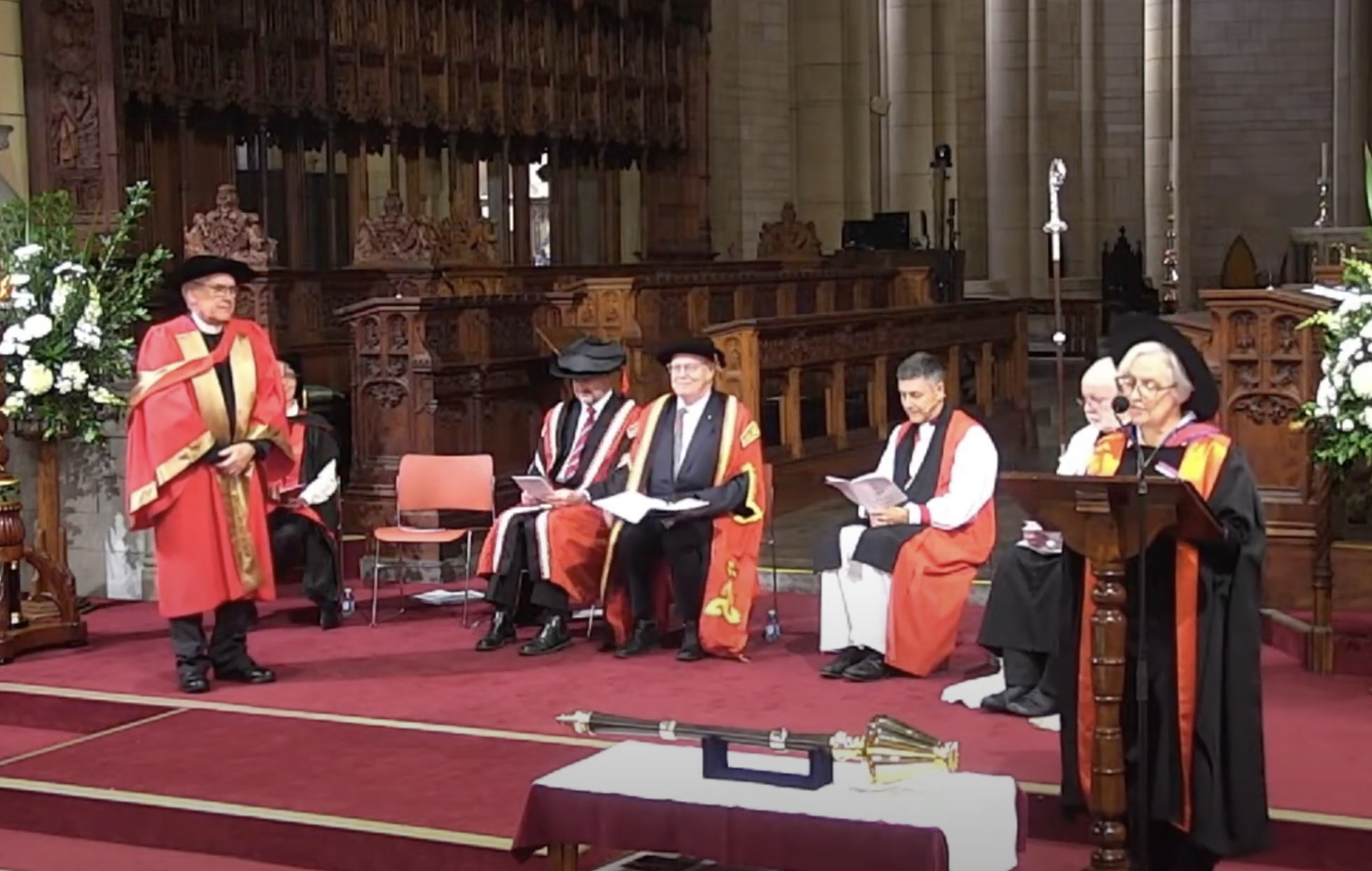
Address for the University of Divinity Graduation Ceremony at St John’s Anglican Cathedral, Brisbane on Friday, 30 May 2025.
The Revd Canon Gregory C. Jenks, MA, PhD, DD
[ video ]
I acknowledge with humility and gratitude the First Nations of this land and especially the Turrbal and Yaggera people on whose Country we gather this afternoon. I extend that respect to our Indigenous brothers and sisters who are with us this evening.
Chancellor, Vice-Chancellor, Archbishop Jeremy, Dean Peter Catt, distinguished guests, colleagues, graduates, families and friends …
Thank you, Vice-Chancellor, for the honour of delivering the address for this graduation ceremony. That seemed an appropriate way to conclude my 50 years of professional study and teaching, mostly at St Francis College here in Brisbane but also elsewhere Australia and overseas. It was enough. More than sufficient.
The subsequent news that the University Council had agreed to confer the Doctor of Divinity on me was a total surprise, as you may recall from my reaction when you made that phone call. I am deeply honoured and genuinely humbled by this award.
The readings that we heard earlier in the ceremony come from the Gospel according to Saint Matthew, which—as many of us here understand—is itself most likely an expanded edition of the Gospel according to Saint Mark.
Behind that chain of tradition we may even discern the poetic wit and wisdom of Jesus himself.
If they are not his actual words, then perhaps they preserve his voice print.
We do not need more than that.
Truth is not mortgaged to historicity.
Like all of us when we step into the pulpit or stand at the lectern, the gospel writers also exercised the privilege of speaking in the name of Jesus.
We are all prophets on those days when we speak in God’s name.
When he crafted the third of the three parables that we heard earlier, Matthew may have practising—and demonstrating—the skills of a scholar trained in the ways of Heaven’s imperial rule: bringing out what is old and what is new.
Matthew has brought something new to place alongside the things that were already old.
Be that as it may, I am grateful for Matthew’s generous and creative stewardship of that storehouse of faith that he mentions in verse 52.
This third and final parable has been my personal vision statement as a disciple and as a scholar.
I have always wanted to be that person: a scribe trained for God’s domain; someone with the knack for bring out from the treasures of our great spiritual tradition just the right piece of wisdom for the occasion at hand.
Something old and something new.
Our calling as Theology graduates is to bring out what is old and what is new.
Both are needed.
As students of Theology we are truly blessed people.
We find hidden treasure.
We hold in our hands the pearl of great value.
We are scholars (scribes) who are discipled and schooled for Heaven’s imperial rule, or to use words more closely aligned with the voice of Jesus: people ready for the kingdom of God.
Because of that formation which you have now completed we can draw from the great storehouse of faith to find just what is needed for the present moment.
Sometimes that will be an ancient truth.
Other times it will be something new, perhaps even disturbing.
But it will be just what the Spirit is guiding us to say to the churches at this time and in this place.
That happens week by week as we stand in our churches and proclaim the good news.
That happens when we stand at the demonstration and protest genocide.
That happens when we gather in councils, conclaves and synods to discern what the Spirit is saying to the church.
That happens when the churches speak truth to power, refuse government funding with unworthy strings attached, and call out the lack of compassion in public policy.
As we reflect on our vocation to bring out what is old and what is new, let me suggest that the scribe/scholar trained for heaven’s domain also moves beyond arguments, and beyond answers and beyond information.
This is what John Caputo refers to as “weak theology” and which he contrasts with “strong theology.” Weak theology is a dialogue that imagines, suggests and wonders rather than a theology which defines, prescribes and excludes.
We move beyond arguments since neither the hidden treasure nor the pearl of great value is the discovery that our god, our doctrine, or our church is bigger or better than theirs. This surely is one of the great values of our ecumenical university. It is not that truth no longer matters, but rather that we approach truth best when we seek understanding together rather than a rhetorical victory over the other person.
As scribes/scholars trained and ready for God’s imperial rule we already have found the hidden treasure and we are familiar with the contours of the pearl of great value. We have discovered that we—already—have spiritual wisdom to live with the questions, and especially with those questions that really matter. Living with the questions is more faithful to the praxis of Jesus than collecting—and defending—answers to questions that few people are asking these days.
As graduates and as faculty who are prepared (or at least preparing) for the reign of God, we have discovered that the call of God on us matters more than any of the information we acquire along the journey. We sense the call. While I did not choose the music for this evening, I was intrigued how the first song fits with this truth.
As my colleague Joseph Bessler (2025: 19) expresses it, “we have learned to lean into the possibility of perhaps.” As we lean into the call beyond certainty—and a wisdom beyond information—we discern a vocation which defines and fulfils us. Amen.
References
Joseph Bessler, Being Moved by Moving Words: Crediting Rhetoric in the Theopoetics of John D. Caputo. Westar Studies. Eugene: Cascade Books, 2025.
John D. Caputo, The Weakness of God: A Theology of the Event. Indiana Series in Philosophy of Religion. Bloomington: Indiana University Press, 2006.
Do leave a reply. I always appreciate hearing from my readers/