Tag: Byron Bay

  • Different drum beats

    Different drum beats

    Palm Sunday (Year A)
    St Paul’s Anglican Church, Byron Bay
    9 April 2017

    Well, here we are …

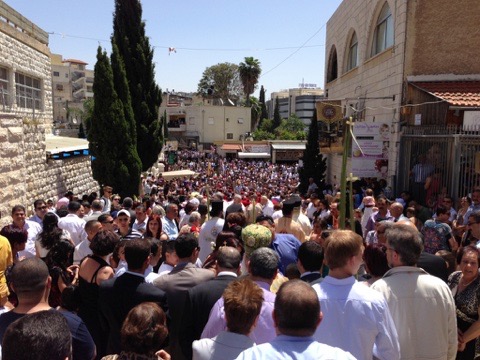
    With Christians around the world, we mark the beginning of Holy Week with the beautiful liturgy of the palms and at least a short procession.

    This is a different kind of service. It can be a bit chaotic at times. It is certainly longer than a ‘normal  Sunday’. But this is no normal day. This is the first day of Holy Week.

    The events of this week shape our identity as Christians.

    The events of this week are the very centre of our faith.

    For that reason, around the world today millions of Christians will join us in the observance of Palm Sunday.

    Because this is a year when the Eastern and Western calendars are in sync, there will be huge crowds in the Holy Land. To make this an even bigger week tomorrow is the eve of Passover, the night when the ancient paschal Seder will be observed by Jeweish households all around the world.

    Yes, this is a big week, but it is also a reminder that the people of God are divided and fearful. Instead of serving as a beacon of hope to the world, we hide our light under the bushel of religious tribalism.


    Flashback

    Around this time almost 2,000 years ago there was the original Palm Sunday procession.

    Jewish pilgrims were converging on the Jerusalem from near and far. Three times a year they were encouraged to be in the Holy City for the high Jewish festivals: Passover, Pentecost, and Tabernacles. But Passover was the big one. It celebrated the exodus from Egypt, liberation from slavery, and their unique calling to be the people of God.

    Among the Jewish pilgrims heading to Jerusalem was a group of Galileans led by Jesus of Nazareth.

    Jesus was bringing his prophetic message of the ‘kingdom (empire) of God’ from Galilee to Jerusalem, from the edges to the very centre of privilege and power.

    Jesus was living out—and inviting others also to live out—a new vision of God, a fresh glimpse of reality.

    This was the vision that would take him to the cross.

    This was the vision that sparked the birth of Christianity.

    This was a vision that the church too easily and too often forgets.

    Around the same time, even if not exactly the same day, another very different procession was making its way into Jerusalem on the western side of the city, the side nearest the Mediterranean Sea.

    Pontius Pilate, the Roman procurator for Judea and Samaria, was making his way to Jerusalem for Passover. He was not coming as a pilgrim, but as the Roman official responsible to keep all the pilgrims in order.

    There will be no liberation of the oppressed this Passover. Pilate is here to ensure that.

    The power of Rome has Jerusalem in its grip, and the ancient Jewish aspirations for liberation will be empty words again this Passover. Pilate is here to ensure that.

    Beyond the scope of their vision, the men at the head of these two processions were destined to meet within a few days time.

    One seemed very powerful.

    The other seemed very weak.

    The smart money was on the Empire. It always is.

    But God was with the little guy. God always is. That is the message of Passover.

    To help us tease out the significance of Jesus being in Jerusalem that first Palm Sunday, let’s watch a brief video clip from Michael Curry, Presiding Bishop of the Episcopal Church in the USA:

    2017 Easter Message from Michael Curry


    The beat of a different drum

    In that video clip, Michael Curry speaks of the ‘Jesus movement’. It is one of his favourite ways of speaking about the church.

    We are not best described as a multi-national institution operating for almost 2000 years and with vast resources. At our best, when we have not lost sight of the vision that Jesus embodied, we are the Jesus movement.

    The Jesus movement began with an alternative view of reality.

    Jesus saw the world differently. Jesus was counter-cultural. Jesus was out of step with his contemporaries.

    Palm Sunday invites us to be out of step. Palm Sunday calls us to walk against the grain, and not simply to go with the flow. Palm Sunday urges us to march to the beat of a different drum.

    Be warned.

    This is scary stuff.

    Holy Week was no Sunday School picnic.

    But Jesus calls us to see the world differently and then to act accordingly.

    In that choice to participate in the Jesus movement is the future of the church, and the future of the world.

  • None so blind …

    St Paul’s Anglican Church, Byron Bay
    St Oswald’s Church, Broken Head
    FOURTH SUNDAY OF LENT
    26 March 2017

    Introduction

    Well, that was a long reading: all 41 verses of John chapter 9!

    It is part of a series of readings from John during these central weeks of Lent. All of them are lengthy readings, and there will be another long one next week:

    • Lent 2 – Nicodemus comes to speak with Jesus under cover of darkness
    • Lent 3 – the Samaritan woman encounters Jesus at Jacob’s well
    • Lent 4 – Jesus heals a man born blind
    • Lent 5 – Jesus raises Lazarus to life

    In these readings, we see John’s art as a storyteller on display. He begins with a simple event: a late-night visitor, a chance encounter at a village well, healing of a blind beggar, the death of a close friend.  John then describes some form of confusion or misunderstanding which Jesus seeks to resolve by further explanation, often in the form of a lengthy speech. In this case, we do not have the lengthy speech, but we do have a very elaborate account of the conflict that followed Jesus healing the man born blind.

    At first sight this is a very simple story. But—as we discovered when we teased it out during the Bible study on Wednesday morning—it is a rather more complex story that can be quite challenging when we pay close attention.

    John offers us a story that invites us to ask the question: Who is the blind person here? Who are the ones lacking the capacity to see what God is doing right in front of them?

    THE STORY

    Let’s review the story and then reflect on the sacred wisdom that God is offering us today.

    The story begins with a chance encounter of Jesus and his disciples with a blind beggar. Nothing unusual about that. Beggars were a common sight in the streets of first-century Palestine.

    The disciples travelling with Jesus demonstrate their profound lack of spiritual wisdom when they respond to the sight of the blind beggar. They ask,”Who sinned, this man or his parents, to cause this blindness?” That is very bad theology, and Jesus simply brushes it aside. The victims are not to be blamed. He was born blind. Our obligation is to do God’s work, not to add to their pain by heartless speculation about them being to blame for their predicament.

    Jesus heals the blind man.

    Well we expected that! This is, after all, the New Testament. But notice how Jesus went about this healing.

    In the other Gospels, Jesus often prefers for his miracles not to be widely reported. At times the beneficiary is sent home and told to remain silent.

    Not so in this story.

    Jesus goes out of his way to ensure his actions are noticed and that conflict with the local religious authorities (represented in this story by the Pharisees) is provoked.

    • No private healing out of the public eye.
    • A paste made of saliva and dirt is applied to the man’s eyes.
    • He is sent to the Pool of Siloam, a very conspicuous location.
    • All this happens on Shabbat.

    As the story unfolds the Pharisees react to this provocation. The extended middle section of chapter 9 is a series of interrogations as the healed man and his parents experience the hostility of Jesus’ opponents.

    • The healed man is interrogated.
    • His parents are summoned but refuse to cooperate.
    • The man is subjected to further questioning and then expelled from the Jewish community.

    Finally, as the story concludes, Jesus catches up with the guy he had healed earlier in the day. Their conversation brings the story to a close, and it ends with a remarkable—and highly confronting—statement by Jesus:

    I came so those who are blind may see,
    and so those who do see may become blind.

    What is John up to here? Why has he chosen to finish this healing story with such a statement?

    If we can engage with that question we may well stumble on the wisdom this text has to offer.

    SELECTIVE BLINDNESS

    As I reflected on this passage during the past week, I found myself thinking of the ancient English aphorism:

    There is none so blind
    as those who will not see.

    When I was searching for the history of this saying, one web website suggested that the lines were first used by the American singer, Ray Stevens in his 1970 song, ‘Everything is beautiful’.

    But in searching further I found that these words have a much longer pedigree, with the  earliest known version of this saying found in the writings of John Heywood in 1546:

    Who is so deafe, or so blynde, as is hee,
    That wilfully will nother here nor see.

    In John 9 there are none so blind as the Pharisees who simply do not wish to see what has happened in the experience of this man born blind. They are masters of the tradition, and this event lies outside their sacred knowledge.

    The temptation for us is to sit back with a sense of spiritual complacency.

    We are not like them. We can discern God at work in our midst. We can see clearly what is happening in our own lives.

    Unlike ‘them’ we do not suffer from selective, self-serving and so-very-convenient blindness.

    If only that were so.

    If only we were indeed free from spiritual myopia.

    WISDOM FOR TODAY

    How does this ancient story connect with us here in the Bay?

    Right now this parish community is at a critical moment in its history. The three or four months that I shall be serving here as your locum priest provide a window during which time we have some serious work to do.

    We need to glimpse a new future.

    That will be real challenge for us. It always is. But before we can call a new priest to serve here, this community needs to discern what is the work to which God is calling us, and not just the new priest.

    If we are able to glimpse a new future, even that will not be enough.

    We shall then need to find the courage to embrace the new and different future that we have glimpsed. That may be even more challenging than discerning what to do. But even that is not the end.

    We—and that really means, ‘you’—will also need the commitment required to pursue the new vision that we glimpse.

    That will be a long journey into an uncertain future.

    But it will begin with a new vision, the capacity to see into the future.

    So the question for us this morning is whether can see? Do we have a blind spot? Are we living with a collective case of spiritual myopia?

    Do we want to glimpse a different future for the Anglican Church in this community?

    Do we dare to look?

    That might be the blessing we seek from God as we come to the Table of Jesus for Holy Communion this morning. Open our eyes, Lord. Help us to see clearly. And give us the courage to embrace that future. Not for our sake, but the sake of those people in this community—whether locals or visitors—who need us to see and embrace a different way of being church here in the Bay.

    I do not yet know what that future will look like, but I am certain we shall never glimpse it unless we are willing to see what God has to show us.

  • A Sermon at the Well

    A Sermon at the Well

    Second Sunday of Lent, Year A (19 March 2017)
    St Paul’s Anglican Church, Byron Bay

    It is not often we can identify the actual location of a Gospel episode, but today’s Gospel reading may be one of those rare times.

    Jesus’ conversation with a Samaritan woman in John 4 takes place at Jacob’s Well, the ancient water source for a series of Canaanite and Israelite villages now preserved under the archaeological site of Balata.

    The well still exists and has been venerated in a series of Christian churches, built one on top of the other. These days the web is located in a crypt below a large Orthodox Church build only in the last few decades.

    Jacob's Well web

    The well itself is very ancient, although the structures have been rebuilt and repaired after different phases of destruction over the years. As mentioned, the well is integrated with the nearby archaeological site of Balata, and that gives us increased confidence in the historicity of the well’s location.

    In today’s Gospel, the focus is not so much the antiquity of the well as the conversation between Jesus and the anonymous local woman that he meets at the well.

    160116 Jacobs Well Icon

    In the biblical tradition, significant encounters often take place at wells. So anyone listening to this story in the ancient world will know immediately that they should expect something special to happen here.

    Let’s engage with the story and see what wisdom we may be able to draw from the ancient well of Scripture this morning.

    ENGAGING WITH THE TEXT

    Where is this story happening?

    The story is set in Samaria, a region with a troubled relationship with Jerusalem after centuries of deep religious rivalry between these two factions in the biblical community.  The Jewish Jesus in Samaria is rather like a Catholic priest in Ulster.

    The location is quite specific, as already mentioned. At the ancient well outside the village of Sychar.

    The well is a short distance outside the village, and the women will have come early in the day or late in the afternoon to draw water for their families.

    It is around noon.

    Only an outsider will come to draw water at that hour.

    Who is in this story?

    The lead character, of course, is Jesus. He is exhausted by his travels, but that is not the point of the story. Like many a male hero from the biblical narratives, he stops at the well and rests from his journey.

    The disciples play a minor role in this story, as Jesus has sent them away to the nearby village looking for supplies. By the time they return, the action is over.

    Then there is a woman with a complex personal history. She is a seeker, although not exactly a puritan. She has had a colourful history, but comes across as a feisty woman. This anonymous Samaritan woman is the central figure in our story.

    As an aside, let me mention that the later tradition could not leave this amazing woman nameless. She had seen the light, so to speak. She was given the name Photine (or sometimes Photina), which means “the luminous one”, as it is derived from the Greek word for ‘light’, φως (phos).

    What is happening in this story?

    At the heart of this story we see Jesus crossing boundaries:

    • The ethnic/nationalist hostility between Jews and Samaritans.
    • The gender divide between male and female in the Jewish world.
    • The additional gap between a holy man and a woman with a colourful sexual history.

    This story is about scandal, but we have so domesticated it that it now mostly functions as a pale echo of the original dramatic story. The disciples were rightly shocked to find Jesus speaking to such a woman when they returned from the village. We have been taught to think they were lacking in spiritual perception, but perhaps we are the ones who have not been able to see what is happening here.

    So let’s now stand back from the story and think about what is happening!

    REFLECTIONS

    None of this was in the mission plan for Jesus and his disciples as they made their way to Jerusalem. This was not how they usually did things in the Jesus group. Jesus was going off script. His handlers were getting anxious.

    • Do we think we are Jesus’ handlers?
    • Do we have a monopoly on the Jesus franchise in this place?
    • Do we have the only well from which people can draw the living water?

    Where are the places in the Bay where we may encounter people who will never be found inside these walls?

    • Are we willing to go off script?
    • Can we look beyond lifestyle to see the person?
    • Can we discern the fragment of the God story in their lives?
    • Can we call them on to the better rather than berate them for the past?
    • Can we be a safe place for people to explore the future into which God is calling them?