Author: Gregory C. Jenks

  • Joy to the World

    Joy to the World

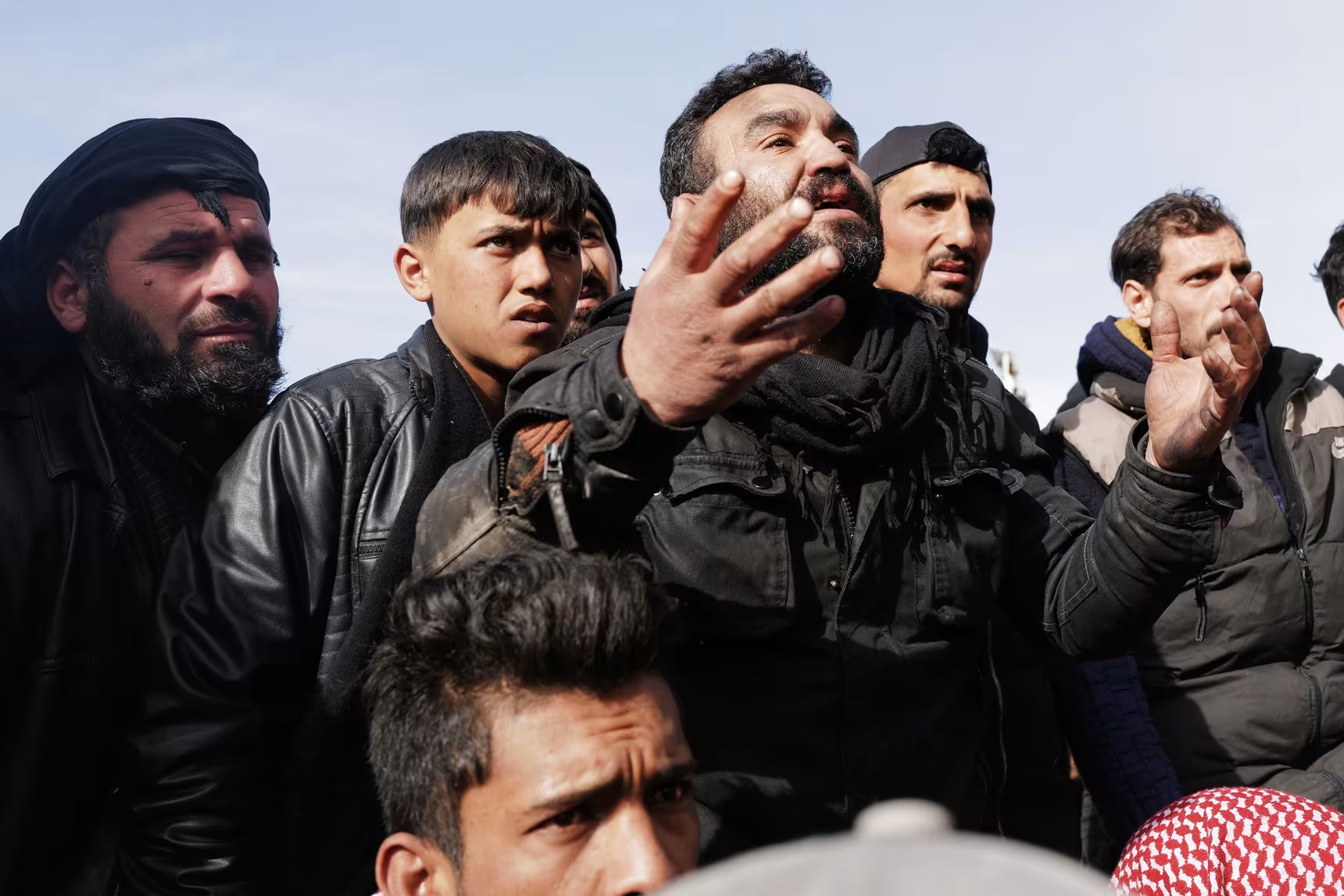
    IMAGE: https://media-cldnry.s-nbcnews.com/image/upload/t_fit-860w,f_avif,q_auto:eco,dpr_2/rockcms/2024-12/241211-syria-ted-turner-mb-0648-4b734b.jpg

    Advent 3C
    St Paul’s Church, Ipswich
    15 December 2024

    [ video ]

    On this third Sunday in Advent, we are invited to reflect on JOY as an essential attribute of our lives.

    So far this season we have done a little thinking about HOPE and PEACE, but today we shift our focus to JOY.

    It was certainly central to the various passage of Scripture that we heard just a few minutes ago. As Saint Paul puts it:

    Rejoice in the Lord always; again I will say, Rejoice.

    It is a bit harder to find much joy in the Gospel reading this week, where Luke offers a thumbnail sketch of the message proclaimed by John the Baptist. As Luke tells the story, John was not calling people to celebrate, but to turn their lives inside out as they prepared for the coming of the Messiah, for the coming of God’s kingdom.

    The time to celebrate would come, he assured then, but first there were some serious spiritual exercises needing to be completed.

    ———

    If you were following the news from Syria this week, there were multiple scenes of joy.

    Despite the 2,000-year time difference, those events in Syria echo the message of both John and Jesus. They proclaimed the kingdom of God in a world dominated by the Roman empire and its local proxies: Herod and his sons.

    John and then Jesus assured people that God’s kingdom was about to arrive. For John, that seems to have been imagined as the arrival of the Messiah, but when John—who was already in prison—sent messengers to check whether or not Jesus was the Messiah for whom they were waiting, Jesus replies as follows:

    Go and tell John what you have seen and heard: the blind receive their sight, the lame walk, the lepers are cleansed, the deaf hear, the dead are raised, the poor have good news brought to them. And blessed is anyone who takes no offense at me. [Luke 7:22-23 NRSV]

    In describing what the arrival of God’s kingdom looks like, Jesus was drawing on the words of prophet Isaiah who inspired both John and Jesus, and whose words have had their own echo again in Damascus this week:

    The spirit of the Lord GOD is upon me, because the LORD has anointed me; he has sent me to bring good news to the oppressed, to bind up the broken hearted, to proclaim liberty to the captives, and release to the prisoners; to proclaim the year of the LORD’S favour, and the day of vengeance of our God; to comfort all who mourn; to provide for those who mourn in Zion— to give them a garland instead of ashes, the oil of gladness instead of mourning, the mantle of praise instead of a faint spirit. They will be called oaks of righteousness, the planting of the LORD, to display his glory. They shall build up the ancient ruins, they shall raise up the former devastations; they shall repair the ruined cities, the devastations of many generations. [Isaiah 61:1-4 NRSV]

    In Damascus this past week and in Capernaum 2,000 years ago, these words capture what JOY looks like.

    Those prophetic lines sketch what the world looks like when God is active among us.

    This is the JOY that erupts when the impossible is achieved, when the unthinkable happens, when the mighty are indeed cast down from their thrones, and when the humble and meek are fed.

    This JOY is exuberant, as we have seen on our TV screens these past few days.

    Yes, it may all end in tears, but for now there is celebration and delight. JOY.

    The people who stumbled out of Assad’s prisons blinking in the bright light of the sun, understood what JOY is.

    Indeed, the people who walked in darkness have seen a great light; those who lived in a land of deep darkness— on them light has shined.  [Isaiah 9:2 NRSV]

    This week we hear words about JOY, but we have also witnessed scenes of great JOY as the ancient words of the prophets find an echo in the events of our own time.

    ———

    While we celebrate with the Syrians who have been surprised by joy and rediscovered hope after decades of tyranny and almost 15 years of civil war, we must not forget that there are people still incarcerated unjustly much closer to home.

    To our shame, Australia turns away people seeking safety.

    Equally to our shame, we pick and choose who we assist, based on the colour of their skin or the way they worship God. 

    We were generous with assistance to Europeans fleeing Ukraine after the Russians invaded. That is a cause for celebration. But we turned our backs on the people of Gaza when they attempted to find safety while Israel destroyed every hospital, school, university and mosque; not to mention water systems, sewerage systems, electricity plants and almost every single home for 2.4 million people.

    Were Mary and Joseph to be seeking refugee with the baby Jesus here today, I fear that our government would reject their application and send them to offshore detention.

    As we enjoy the outpouring of joy and hope in Damascus, let’s also have the courage to be more generous as a people.

    As we do that, may we give others cause for JOY and may we find deep JOY ourselves.

  • people of hope

    people of hope

    Advent Sunday
    St Paul’s Church, Ipswich
    1 December 2024

    [ video ]

    Here we are: 

    • 1 December
    • Advent Sunday
    • the beginning a new year of faith and mission here in the heart of Ipswich.

    Over these four Sundays we are asked to reflect on key themes:

    • Hope
    • Peace
    • Love
    • Joy.

    I have no idea who chose those 4 themes or determined their order.

    However, I am glad that someone did. 

    They are great themes for us to reflect on over these 4 Sundays.

    I am not interested in them as abstract ideas, but I am very interested in them as real-life challenges for us as a faith community:

    1. How do we be(come) a community of hope?
    2. How do be a community of peace?
    3. How can we make love the spiritual DNA in our life together?
    4. And what about joy? How do we as a church move beyond fake smiles to genuine happiness?

    We can work our way through those 4 sets of questions over the next few weeks, but for now let’s focus on HOPE.

    How hope can flourish here

    Sometimes hope gets squeezed by all the awful stuff happening in our lives, in our community, or around the world.

    Yet hope can flourish when it is grounded in faith and love. 

    Maybe that is why St Paul concludes his powerful Hymn to Love in 1 Corinthians 13 with the line:

    And now faith, hope, and love abide, these three …

    If we stick with that triple list for a moment longer, we might think of faith as the soil in which the seed of hope is planted; and love as the sunshine that ensures the plant (in this case, faith) is healthy and abundant.

    If someone has not experienced much love in their life, then their capacity for hope is going to be diminished.

    And if they are not sure that life is a precious gift to be enjoyed and lived to the full, then their capacity for hope is going to be diminished.

    There we have a first clue as to how this church can be a community that grows hope.

    As a first step we need to stop talking so much about evil, sin and guilt. Instead, we should affirm repeatedly that life is a precious gift from God. Every life. All of life. Even the tough bits.

    Faith is not the art of believing 16 impossible things before breakfast (as someone once said), but rather the confidence that life is good; even when it seems far from good some of the time. Even much of the time.

    As a church we proclaim our faith that God is good, that our world is inherently good because that is how God caused it to be. Indeed, one way to talk about God, is to use the phrase “the love at the heart of the cosmos.” 

    If we connect people with that love at the very heart of the cosmos, then they will discover the deep truth of creation:

    God saw everything that he had made, and indeed it was very good. [Genesis 1:31]

    There is always much to learn as we travel along the road of faith, but the most important thing is not how many things we know but rather whether we have understood this one truth: life is good, and it is a blessing to be here.

    From the ground of that confidence grows the seed of hope.

    As that seed grows, we can say YES to God. Here I am, Send me.

    Our role as a faith community is to nurture that seed of hope as it grows within each person who comes within our circle of faith.

    This is not to ignore the need for us to overcome blindspots, moral and spiritual injuries, and plain old nastiness at times.

    There are weeds in even the best-kept gardens, and there is a need for renewal and transformation in each and every person within this community.

    Conversion is a lifelong process, but it need not begin with shame. It can begin with delight and the joy of being loved .

    The profound truth that we have to offer our world is this message of hope.

    Because God brought us all into being in the first place, there is hope.

    Because Jesus shows us that love overwhelms fear, there is hope.

    Because the Spirit of God is at work in us, there is hope.

    Because we discern the Word of the Lord when the Scriptures are opened, there is hope.

    Because we affirm the faith of the church, there is hope.

    Because we pray for the world and the church, there is hope.

    Because we gather around the Table of Jesus, there is hope.

    Because we baptise babies and adults, there is hope.

    Because we feed the hungry, there is hope.

    Because we are church, there is hope.

    This Advent, let’s pray for God’s help to become the kind of people who inspire hope in others, and the kind of church that nurtures hope in the heart of everyone who walks through our doors.

  • It’s complicated

    It’s complicated

    Pentecost 26B
    St Paul’s Church, Ipswich
    17 November 2024

    [ video ]

    From widows to rival wives

    Last week we had readings that featured several women whose husbands had died, leaving them in particularly vulnerable situations as widows in ancient societies where there was no public social security system.

    Today the first reading features the rivalry between two wives: one of whom was the mother of several children, while her rival was unable to have any children.

    To use a modern catchphrase: It’s complicated!

    Some of us—perhaps most of us—come from families that are a bit complicated at times. For sure I do.

    I have been told that were the story of my family offered to a TV studio, it would be rejected as too far-fetched.

    Yes, sometimes life is complicated.

    Life is complicated. Families are often far from story book perfect. And we are complex people as well.

    Even church families.

    Last week we had the story of Ruth and Naomi. It was set at Bethlehem, and in the fields of Ephrathah. Echoes of Christmas reaching across the lectionary, since Ruth was not only identified as the great grandmother of King David but—in the Gospel of Matthew—becomes a direct ancestor of Jesus!

    That was one complicated family story indeed.

    As is the story of Jesus’ immediate family, for that matter.

    This week we have two rival wives—Hannah and Peninnah—who were both married to Elkanah son of Jeroham.

    There are lots of families like that in the Old Testament. Indeed, King Solomon—supposedly the wisest man ever to live—had 700 wives and 300 concubines (1 Kings 11:4).

    Such families were complicated, as we often see in the biblical narratives.

    Elkanah comes across as a caring and compassionate husband, even if Hannah had to share her husband with another woman. But the other (perhaps younger) rival was cruel and Hannah found her life was both complicated and bitter.

    We all know stories like that. Some of us may have families like this, and the cruel control games may be played by men just as much as by women, not to mention intergenerational abuse.

    And, yes, it happens even in church families.

    As the story unfolds this nasty plot is resolved when Hannah does eventually have a child—Samuel—who she promptly donates to the elderly priest at the temple! 

    Another complication.

    Not to worry: God gives Hannah 2 more sons as well as 2 daughters, while Samuel stays at the temple with Eli the priest.

    Yes, it is definitely complicated.

    It all ends well, but a happy ending does not take away the pain and the abuse in the middle of the story.

    Not then and not now.

    So where do we find holy wisdom in stories such as this?

    For me, that wisdom is especially to be found in the raw faithfulness of Hannah.

    Hannah comes across as a woman who lives with domestic and family violence, and yet keeps her dignity because she has such a strong faith.

    Elkanah also emerges as a good character in this complicated story. He supports, protects and loves Hannah. He even allows her to donate the long-awaited child to the temple.

    Their personal situation was complicated but they were there for each other, and they were people who practised their faith.

    As the story goes, their faith did not waver.

    In real life—and not just in this archetypal story—their faith may have been a bit more complicated as well. We shall never know.

    But the storyteller added to this story the beautiful Song of Hannah that we read together a few minutes ago. That song was fashioned by countless anonymous women from ancient Israel who discovered that God was with them, with the powerless and the vulnerable. It comes from a later time when there were kings and princes in Israel, but its message of hope is timeless.

    Yes, life can be complicated.

    Yes, our faith can gives us hope and enable to survive and thrive.

  • Noticing the widows

    Pentecost 25B
    St Paul’s Church, Ipswich
    10 November 2024

    [ video ]

    Yesterday I was in Lismore for a refresher course as part of the Safe Church Ministry training offered by the Diocese of Grafton. As we began that program we looked at various biblical text about vulnerable people, since our duty of care for vulnerable persons is such an important responsibility.

    The biblical passages offered the usual categories of people: widows, orphans, the poor and the foreigner (that is, aliens resident in the villages and towns of ancient Israel).

    Did you notice how our readings today featured several widows?

    The Old Testament reading came from the book of Ruth. It mentioned by name two of the three women (all of them widows) in that delightful little story: Naomi, the mother-in-law; Ruth, the daughter-in-law who came back to Bethlehem, with Naomi; and it referenced indirectly Orpah, the other daughter-in-law who followed Naomi’s advice and stayed with her own people in Moab when Naomi returned home.

    It is unusual for the Bible to offer us stories in which women play a leading role, and even more unusual for those women to have names.

    In case you have not read the book of Ruth recently, let me remind you of the story. 

    When famine breaks out in Bethlehem, a local man (Elimelech) relocates across to the other side of the Jordan river with his wife (Naomi) and their two sons. They settle in the territory of Moab where they are made welcome and make a new home. The two sons marry local women, but then all three men died. This leaves Naomi, Orpah and Ruth as widows. Naomi hears that things are back to normal in Bethlehem, so she decides to head back home and she encourages Orpah and Ruth to stay in their own land and make a fresh start with new husbands. After some back and forth Orpah agrees to stay behind, but Ruth insists on going to Bethlehem with Naomi. Famously, Ruth says:

    Do not press me to leave you or to turn back from following you! Where you go, I will go; Where you lodge, I will lodge; your people shall be my people, and your God my God.  Where you die, I will die— there will I be buried. May the LORD do thus and so to me, and more as well, if even death parts me from you! 

    [Ruth 1:16-17 NRSV]

    You may have heard those words read or sung at a wedding.

    By the time we pick up the story in this morning’s reading, Ruth has come to the attention of a wealthy relative (Boaz) who agrees to take over the property of his deceased cousins, which includes accepting Ruth the widow to be his wife.

    Clearly that is not how we do things these days; at least not in our society. But if you read the story for yourself, as I hope you will this week, Naomi and Ruth are not exactly passive agents. They scheme to get their man, and Boaz goes along with their plans.

    There are some twists in this story. Jews were not supposed to have anything to do with the people from Moab. There were deep memories of ancient conflict between these people, but Ruth is the hero of the tale. That makes this a remarkable story already. But there is another twist to this story. 

    Ruth and Boaz have a son together. They call the boy, Obed. As time goes by Obed will have a son, who was Jesse. Then Jesse will have several sons, including David, the future king of Jerusalem!

    That makes Ruth, the foreigner (the ultimate outsider) the great grandmother of King David.

    Whoever crafted this little narrative had a point to make, and it was all about making room for the vulnerable people; in this case someone with a double handicap since she was both a widow and a foreigner. 

    This outsider would become the ancestor not only of David but also of Jesus.

    But Ruth and Naomi (and Orpah) are not the only widows in our readings today. There is also the anonymous widow from the Gospel passage. Let’s call her “Penny” since she is famous for the two copper pennies that she dropped into the moneybox outside the temple.

    Of course they were not pennies, as this a term for English money. When the Bible was translated into English more than 400 years ago, they described her coins using the English word for the smallest coin available at the time: a mite.

    Not a halfpenny, or a farthing, but a mite.

    That is one very low-value coin.

    In the time of Jesus that coin was called a prutah, and I have several examples of those tiny coins from the time of Jesus here with me in case you want to have a look at them later.

    A silver denarius was the basic payment for a day’s work in the field, and you would need almost 1,000 prutotto exchange for one denarius. Yes, these were very low-value coins indeed.

    In our Gospel today, Jesus has been warning people about the spiritual games played by powerful people. Then he sits opposite the collection point for cash offerings outside the temple. 

    In among all the rich people making large gifts, Jesus notices a poor widow who made a very small gift: two small copper coins.

    He draws the attention of his disciples to her.

    Her gift, while very small, is more substantial than the larger gifts contributed by people who were wealthy by comparison. Their bank accounts were large, but her heart was bigger than theirs.

    Jesus was not encouraging the church to extract all the money we can from vulnerable widows. Sadly that has sometimes happened, and it needs to be recognised as a form of elder abuse as well as spiritual abuse.

    Jesus was simply saying, “This woman has her priorities right.”

    She is not worried about the future, but as Jesus himself encouraged people to do, she was confident that God would provide for her needs. Her generosity was a simple act of faith.

    So today we have stories about 4 widowed women. They were highly vulnerable in their societies at the time, but they were each women who had agency and they chose to live into the promise of a God who provides what we need.

    They were not nameless widows, but people of faith and courage.

    When we encounter vulnerable people, do we see the labels placed on them by our society: homeless, hungry, poor, drug user, drifters, drop outs, dysfunctional, disturbed, mentally ill, refugees, asylum-seekers, lost souls, losers, single mothers?

    Or do we see them as people? People with potential? People with dreams? People with names? People loved by God?

    I hope you will take the time this week to read the whole story of Ruth, and to notice her amazing legacy in the little family tree at the end of the story.

    And I hope we all take some time this week to think of those we might too easily lump into categories, like “poor widows” and other kinds of vulnerable people.

    Boaz noticed Ruth …

    Jesus noticed Penny with her two small copper coins … 

    Do we have eyes to see those people God wants us to notice this week

  • Because of them (2024)

    All Saints & All Souls
    St Paul’s Church, Ipswich
    3 November 2024

    [ video ]

    Today we pause to acknowledge all of those who have gone before us in the faith.

    Some of them are people from long ago.

    Many of them are people from far away.

    Others are people we have known; who we remember with love and appreciation.

    It is because of them that we are who we are.

    It is because of them that the faith has been passed across 2,000 years.

    It is because of them that the faith is expressed in every human language, within every culture and across all parts of this world.

    Had they been unfaithful, the faith would not have survived.

    Had they forgotten the story of Jesus, it would no longer be told among us.

    Had they not travelled far and wide, the faith would not be found in every part of the world.

    Had they not been people of courage, the flame of faith may well have been extinguished.

    Had they lost hope, how would we ever had heard the good news?

    We walk in their footsteps, but also need to find our own path.

    We carry the candle of faith in a very different world.

    Our challenge is not so much to imitate them as to replicate them.

    It is not that we do exactly what they did, but that we seek to achieve the same goal.

    The mission remains the same, but the operation may be rather different.

    A new legacy for those who come after us

    In our own time we are also creating a legacy for those who will come after us. In time they will look back at these times in the life of the church, and they may wonder why we were so concerned about this issue or that, and yet remained oblivious to something else which they find central to their concerns.

    Just as we need not imitate those who went before us, so we cannot presume to imagine that those who come after us will keep doing things the way we do them now. And that is OK.

    Our task is to be faithful here and now; encouraged by the past and open to the future.

    St Paul’s Anglican Church has been here in the heart of Ipswich since 1859, seeking to serve God and this community.

    Once upon a time this church was packed most Sundays and we had several services a day. Those days have long passed and we are still trying to find the best way to be Jesus people in this community at time when being “at church” does not matter to most of our family and friends.

    In a way, this little brick church with its beautiful arches itself is a parable, hinting at the challenge before us. We have much from the past for which we are grateful, but the way forward is not so easy to discern.

    The heart of the matter

    We cannot imagine what the church will be like in the years to come, but the heart of our faith and our mission remains the same even when expressed in different ways at different times:

    Intentional – We are people who seek to follow Jesus with our eyes wide open. We are not drifting along with church life because it is the accepted thing that “everyone around here” does. No, we make a conscious choice to pay attention to faith, to seek God and to take the spiritual quest seriously.

    Centred on Jesus – There are many ways to respond to God’s call on our lives. We accept and affirm the faithfulness of people in other spiritual traditions who are also intentional about their desire to say YES to God, however they understand that sacred reality. We especially acknowledge the faithfulness of Jews and Muslims, with whom we share so much yet differ so profoundly over just a few points. Yet for us, it is all about Jesus. For us, Jesus is the way that leads to God, and for us Jesus is God among us in human form. Emmanuel 

    Compassion – As we seek to follow Jesus, the hallmark will be compassion. It matters little whether we are right or wrong, if we fail to be compassionate. One classic text which captures this truth so well is found in 1 Corinthians, the great hymn to love. 

    And if I have prophetic powers, and understand all mysteries and all knowledge, and if I have all faith, so as to remove mountains, but do not have love, I am nothing. [1 Cor 13:2]

    That will be as true in the future as it is now, and ever has been in the past. If we fail to be people of compassion then we have nothing to offer the world.

    Justice – Blessed are those who hunger and thirst for justice. (Matt 5:6). Or as the great Covenant Code we call the book of Deuteronomy expresses it: Justice, and only justice, you shall pursue, so that you may live and occupy the land that the LORD your God is giving you. [Deut 16:20] The church has a prophetic role in society, whether it is welcomed or rejected. It is the work of God to defend the weak and speak for those without power. Those with power hate us doing that; mostly because in their heart of hearts they know we are right and they are on the wrong side of history.

    Hope – we are not selling fire insurance for the next life, but we are affirming that in the end—as at the beginning— it is all about love. The love that brought our universe into existence will ensure that—in the end—what is right does prevail, life defeats death, the mighty are cast down from their seats, the hungry are fed, and the rich are indeed sent away empty. God turns everything upside down, and that is why we are people of hope even when it seems everything is so dark.

    This is what we have learned from those who went before us.

    This is the truth we seek to live in our everyday lives.

    And this is the legacy we leave for those who will come after us.

  • Changes along the way

    Pentecost 22B
    St Paul’s Church, Ipswich
    20 October 2024

    [ video ]

    Changes along the way

    For several weeks now our Sunday Gospel readings have offered us glimpses of the journey taken by Jesus, his disciples and a mixed crowd of people as they headed south from Galilee to Jerusalem.

    This was to be a one-way journey, although it seems that only Jesus understood that.

    For everyone on that trip, life would never be the same once they arrived in Jerusalem. Again, it seems that no-one but Jesus understood any of this.

    In today’s episode along the way, as we draw close to the end of the journey, we see two people from the inner circle of Jesus—James and John, the sons of Zebedee—asking for special favours when Jesus establishes God’s kingdom.

    They had totally missed everything that Jesus had been seeking to teach them, and they certainly had learned nothing about servant leadership.

    As we reflect on that episode this week, I invite you to set that story in the context of the journey that we are now beginning with our friends from St Thomas’ Church in North Ipswich.

    I begin with a prayer that I crafted shortly after the two Special Meetings held in each parish when the decision was made to embrace a new future together. The prayer goes like this:

    Imagine us—if you will—as two groups of disciples who have left Galilee behind us and are now walking together into an uncertain but shared future.

    The success of that journey depends more on what lies ahead than on what lies behind us.

    And there will be no privileged seats at the table of power and influence.

    We are in this together.

    There will certainly be changes. I do not know what they will be, but I am sure that some of them will be hard to embrace.

    The key to success will be our ability to practise the way of Jesus, to embrace servant leadership.

    Jesus himself came to serve and not to be served.

    That is both our calling and the formula for our success as we weave two faith communities into a single ministry unit.

    We need to move beyond us and them, and embrace the new reality of us together.

    If—when—we achieve that, we shall have transformed our local congregations, and perhaps also reinvented the Anglican mission in the heart of Ipswich.

    Imagine a church that seeks to serve rather than scold.

    Imagine a church where vulnerable people are safe.

    Imagine a church where seekers are welcome.

    Imagine a church with confidence in the good news and a humility about its task.

    Imagine a church with deep roots in the past and bold dreams for the future.

    That can be us, if we embrace servant leadership … 

    Let me close by reading that prayer again: