Author: Gregory C. Jenks

  • Four Sundays with Philippians

    A Congregational Companion

    Papyrus_16_-_Papyrus_Oxyrhynchus_1009_-_Cairo_Egyptian_Museum_JE_47424_-_Epistle_to_the_Philippians_3,10–17,_4,2–8

    IMAGE: Our earliest copy of this letter: Papyrus 16 – Papyrus Oxyrhynchus 1009 – Cairo Egyptian Museum JE 47424 – Epistle to the Philippians 3:10–17, 4:2–8. Public Domain.


    Gerald F. Hawthorne reflected on the four years he invested in research for his commentary on Philippians in the Word Biblical Commentary:

    Four years with Philippians seems like a long time. And it is! Yet it is not time enough to grasp completely all of the richness locked away in this beautiful letter that Paul wrote to his friends at Philippi, nor to master adequately the mass of literature that scholars, ancient and modern, have produced in an attempt to express what Paul meant by what he wrote. [Gerald F. Hawthorne and Ralph P. Martin, Philippians, WBC 43; (Grand Rapids: Zondervan, 2004), 1.]

    We have just four Sundays for our series on Philippians, but I hope that the insights we gain by paying attention to Paul’s ideas in this powerful first-century pastoral correspondence will help us shape lives that are holy and true. ‘Holy’ in the sense of sensitive to the sacred dimensions of our life, and ‘true’ in the sense of authentic, or genuine.

    This brief ‘companion’ is neither a commentary nor a set of sermon notes. However, it is designed to provide an informed perspective on Paul’s letter to the Christian assembly in Philippi. There will also be an online version for those who prefer to access these notes on the web, and it will have live links to additional online resources. No matter which format works best for you, I hope you find these notes helpful.

    Greg Jenks


    Paul and his letters

    The transport infrastructure created by the Roman Empire allowed the early Christians to send people between the emerging Christian communities around the Mediterranean. These emissaries often carried letters from senior leaders such as Paul, and it was the obligation of the messenger to deliver the letter with an oral performance. These key pastoral communications were heard, rather than read.

    CHALLENGE: either read the whole letter though out aloud by yourself, or arrange for someone else to read it out aloud—and without you having a copy of the text.

    Over time, local groups of Christians collected and exchanged letters sent to other nearby communities, as Colossians 4:16 describes: “And when this letter has been read among you, have it read also in the church of the Laodiceans; and see that you read also the letter from Laodicea.”

    A large percentage of the New Testament is comprised of such letters, and there are several more within the Revelation to John. Several of the 26 ‘books’ in the NT are ancient letters attributed to various first-century Christian leaders, although critical scholars think only 7 of them are from Paul. By the end of the first century we know of a collection of 10 Pauline letters, and eventually 13 NT texts were accepted as Pauline. There are other letters not found in the NT that claim to be from Paul, which reminds us how influential his writings had become as time went by.

    It is possible that the document we call Philippians is actually more like a file of Paul’s correspondence with the young church at Philippi than one single letter. Some scholars think that three different letters are preserved in this ‘file’:

    1: A Thank-You Note (4:10–200
    2: A Letter from Prison (1:1–3:1a plus 4:4–9,21–23) and
    3: Paul’s Testimony and Advice (3:1b–4:3).

    No one doubts that the material is all from Paul himself.

    Philippi

    The city is located in northern Greece was on the main East/West transport route, the Via Egnatia.

    MapGreece

    The city was founded in 356 BCE by Philip II of Macedon, the father of Alexander the Great, to take advantage of the rich gold mines in the area. During the Civil War that followed the assassination of Julius Caesar in 43 BCE, the city was made a Roman colony and it enjoyed legal and taxation privileges as if it were a city in Italy.

    Substantial numbers of military veterans were given land grants to settle in its considerable (almost 2,000 km2) territories. It was a city of some 10,000 people, and the walled city area was almost 68 hectares.

    As Hawthorne describes it, “the inhabitants were a people proud of their city, proud of their ties with Rome, proud to observe Roman customs and obey Roman laws, proud to be Roman citizens (cf. Acts 16:21).”


    Paul and the Philippian Christians

    According to the traditions preserved in Acts 16, Philippi was the first stop in a mission to four European cities by Paul: Philippi, Thessalonika, Athens, Corinth. The account in Acts suggests a dramatic visit that was very successful despite being cut short when Paul was expelled from the city:

    We set sail from Troas and took a straight course to Samothrace, the following day to Neapolis, and from there to Philippi, which is a leading city of the district of Macedonia and a Roman colony. We remained in this city for some days. On the sabbath day we went outside the gate by the river, where we supposed there was a place of prayer; and we sat down and spoke to the women who had gathered there. A certain woman named Lydia, a worshiper of God, was listening to us; she was from the city of Thyatira and a dealer in purple cloth. The Lord opened her heart to listen eagerly to what was said by Paul. When she and her household were baptized, she urged us, saying, “If you have judged me to be faithful to the Lord, come and stay at my home.” And she prevailed upon us.

    One day, as we were going to the place of prayer, we met a slave girl who had a spirit of divination and brought her owners a great deal of money by fortune-telling. While she followed Paul and us, she would cry out, “These men are slaves of the Most High God, who proclaim to you a way of salvation.” She kept doing this for many days. But Paul, very much annoyed, turned and said to the spirit, “I order you in the name of Jesus Christ to come out of her.” And it came out that very hour.

    But when her owners saw that their hope of making money was gone, they seized Paul and Silas and dragged them into the marketplace before the authorities. When they had brought them before the magistrates, they said, “These men are disturbing our city; they are Jews and are advocating customs that are not lawful for us as Romans to adopt or observe.” The crowd joined in attacking them, and the magistrates had them stripped of their clothing and ordered them to be beaten with rods. After they had given them a severe flogging, they threw them into prison and ordered the jailer to keep them securely. Following these instructions, he put them in the innermost cell and fastened their feet in the stocks.

    About midnight Paul and Silas were praying and singing hymns to God, and the prisoners were listening to them. Suddenly there was an earthquake, so violent that the foundations of the prison were shaken; and immediately all the doors were opened and everyone’s chains were unfastened. When the jailer woke up and saw the prison doors wide open, he drew his sword and was about to kill himself, since he supposed that the prisoners had escaped. But Paul shouted in a loud voice, “Do not harm yourself, for we are all here.” The jailer called for lights, and rushing in, he fell down trembling before Paul and Silas. Then he brought them outside and said, “Sirs, what must I do to be saved?” They answered, “Believe on the Lord Jesus, and you will be saved, you and your household.” They spoke the word of the Lord to him and to all who were in his house. At the same hour of the night he took them and washed their wounds; then he and his entire family were baptized without delay. He brought them up into the house and set food before them; and he and his entire household rejoiced that he had become a believer in God.

    When morning came, the magistrates sent the police, saying, “Let those men go.” And the jailer reported the message to Paul, saying, “The magistrates sent word to let you go; therefore come out now and go in peace.” But Paul replied, “They have beaten us in public, uncondemned, men who are Roman citizens, and have thrown us into prison; and now are they going to discharge us in secret? Certainly not! Let them come and take us out themselves.” The police reported these words to the magistrates, and they were afraid when they heard that they were Roman citizens; so they came and apologized to them. And they took them out and asked them to leave the city. After leaving the prison they went to Lydia’s home; and when they had seen and encouraged the brothers and sisters there, they departed. (Acts 16:10–40 NRSV)

    See also the brief reference in Paul’s earliest surviving letter to his troubles in Philippi:

    You yourselves know, brothers and sisters, that our coming to you was not in vain, but though we had already suffered and been shamefully mistreated at Philippi, as you know, we had courage in our God to declare to you the gospel of God in spite of great opposition. (1 Thessalonians 2:1–2)

    The young Christian community at Philippi seems to have maintained good relations with Paul after his brief stay, and they did not present the pastoral problems for him that we see in the nearby community at Thessalonika or in Corinth further to the south.

    They expressed their support for Paul in very practical ways, including sending one of their own people (Epaphroditus) to provide financial and personal assistance while Paul was in prison. The location and date of Paul’s incarceration remains unclear, but the depth of the attachment between Paul and the Philippians is conspicuous.

    Because Paul was not addressing pastoral and theological problems, his letters offer us a more personal insight into Paul’s own faith and also reveals his affectionate relationship with the people in this fledgling church community.

    The correspondence preserved in Philippians is dated to late 54 and early 55 CE. This is just 25 years after Easter.

    Additional Resources

    Three Days with Paul in Northern Greece (Bible studies for the Anglican Church Provincial Clergy Conference, Gold Coast, August 2915.

    Arthur J. Dewey, Roy W. Hoover, Lane McGaughy and Daryl D. Schmidt, The Authentic Letters of Paul: A New Reading of Paul’s Rhetoric and Meaning. Polebridge President, 2011. (Available in Kindle format)

  • Lady Cancer, Holy Sophia

    Lady Cancer, Holy Sophia

    Three weeks have now passed since my urologist visited my hospital bed to share with me the results of the biopsy on the tumors he had removed from my bladder some 36 hours earlier. Almost a week has passed since I sat in his consultation room to review the diagnosis and discuss treatment options.

    The details matter only to me—along with my family and closest friends—so I shall not review them here.

    However, I would like to offer a personal reflection on this new phase in my life.

    In doing so, I draw partly on some of the journal entries I have made in the past three weeks.

    Lady Cancer has moved in with me.

    Turns out, for some time now she has probably been quietly setting herself up in a corner of my ‘house’ to which I have paid little attention. In any case, she has now announced her arrival and it falls to me to respond to this uninvited companion.

    Following a chance conversation with a colleague while attending the Australian Anglican Deans conference in Bendigo over the first weekend of August, I have been reading, Die Wise, written by  Stephen Jenkinson. This is not a review of his book. I may write a review at some stage, but there is already a thoughtful review on the Seven Ponds web site.

    Jenkinson has spent decades working in palliative care, in the ‘death trade’ as he puts it, and offers a distillation of his own insights into what constitutes a good death within the wider context of the human story and the story of Earth.

    Once upon a time folk would have looked to the church for wisdom on dying well. These days the churches have mostly lost their confidence to speak about such topics, and joined the conspiracy of silence in our death-denying culture. Those believers who remain confident to hold forth on the topic of death have mostly shredded their credibility on the subject by exploiting fear of death as a lever for doctrinal conformity and moral compliance.

    Early in chapter two, Jenkinson points out that dying is something we do, and not something that happens to us. In English it always occurs in the active voice, and never in the passive voice. Too bad that we do not have a middle voice in English!

    In a sense, a cancer diagnosis is an invitation to embrace the awareness that I am dying — even if I continue to live, and continue to enjoy life, for many more years yet.

    Death changes from a theoretical possibility for someone else to become a personal existential reality for me.

    Once we know that we are dying, then we can become an active, aware and morally responsible agent who participates in our own dying. This does not mean that we hasten our death, but rather that we live each moment deeply engaged with others, with the world around us, and with our own dying — even if our death may be some considerable time away.

    The certainty of my own death is now firmly on the agenda of my life.

    That changes how I choose to live. It will now permeate my ministry as a priest and scholar. And it informs how I hope to die.

    The challenge, the opportunity and the privilege of being a dying person is to live each and every day from now on in such a way that the joy of being alive is affirmed, the meaning of life is explored, and the reality of my own death serves to magnify and sharpen the delight of being alive.

    I expect to live for many more years yet, while also knowing that may not be the case for any number of reasons (many of them unrelated to my recent diagnosis).

    I want to spend those years living with and for the people that I love. But I feel that the cancer diagnosis has been a wake up call. And for that I am grateful.

    Like everyone else, my days are limited. One day I shall die. It may not be immediate, but it is ‘soon’ and inevitable.

    ‘Lady Cancer’ has moved into my home, and she will never leave. She will be my companion on the journey from now until my death, and her arrival makes me aware of my dying as well as inviting me to choose how to live my dying in the meantime.

    I choose not to repel her as an unwanted intruder. She has every right to be in my house.

    For me, Lady Cancer is not draped in the garb of the Grim Reaper. Rather, she is the incarnation of Lady Wisdom, Holy Sophia, who we find in both the Jewish Scriptures and the New Testament.

    Here is one of many beautiful texts that speak of Lady Wisdom:

    Wisdom has built her house,
    she has hewn her seven pillars.
    She has slaughtered her animals,
    she has mixed her wine,
    she has also set her table.
    She has sent out her servant girls,
    she calls from the highest places in the town,
    “You that are simple, turn in here!”
    To those without sense she says,
    “Come, eat of my bread and drink of the wine I have mixed.
    Lay aside immaturity, and live,
    and walk in the way of insight.”
    [Proverbs 9:1–6]

    As a Christian, I encounter Holy Sophia in the humanity of Jesus, the sage of Nazareth, the prophet of God’s irresistible reign, and the human face of God. He lived a life that was holy and true. His death reflected the character and quality of his life. He died well. As his disciple I aspire to do the same.

    However long it proves to be, I intend to live this time of my dying with hope, with gratitude, with courage, with compassion, and with love for those who have a special place in my heart.

    This is a declaration of life and love, and not a resignation into death.

  • Dreams, nightmares and well-being

    Dreams, nightmares and well-being

    Pentecost 10 (A)
    13 August 2017
    Byron Bay Anglican Parish

    The readings set for today invite us to explore corners of our faith practice that sit uncomfortably with the prevailing outlook of our culture.

    This is often the case, and mostly it is a good thing.

    Being asked to imagine reality from a different perspective to that offered by our consumption-obsessed world is almost always a first step towards deeper wisdom.

    But sometimes the cognitive dissonance is harder for us to manage, and for some people that may be the case with both the first reading and the Gospel today.

    For different reasons they challenge how we see the world.

    For another set of different reasons again they also invite us to see the world as a place of immense mystery and complexity.


    Joseph the dreamer

    The lengthy reading from Genesis 37 is one of the classic stories of the Bible.

    At its heart are two fundamental principles that millions of people have lived by in years past, but which we may find hard to embrace:

    1. The underlying idea is that God is in charge of all that happens, good and evil, and is weaving them together for the sake of some larger purpose of salvation.
    2. The second principle embedded in the Joseph tale as a whole, and seen in the opening scenes of this chapter, is that dreams can be a means of spiritual insight into God’s purposes.

    The first principle seems hard to maintain on this side of the Nazi deaths camps in Europe, or the killing fields of Kampuchea, or the madness of a nuclear conflict on the Korean Peninsula.

    We struggle with the idea that good and bad derive from God, and that he weaves them all together in some way for the greater good.

    If only that were so, we pray.

    And yet God seems mostly to be missing in action.

    As for dreams, we prefer hard data rather than fleeting impressions on the screen of our sleeping mind.

    Yet there are those who find that paying attention to their dreams is a discipline that helps them live better lives, holier lives, more grateful lives.

    There is wisdom in these ancient practices that we too often discard with a cocky sneer.


    Nightmare on the lake

    The Gospel offers a different invitation to wisdom despite our misgivings over the material in the text.

    The experienced sailors familiar with the Kinneret are all at sea.

    They are trapped in a fierce storm, and it seems their small craft is about to sink. Then their nightmare turns even worse as they see what seems like a ghost walking across the lake towards them. Once convinced that the ‘ghost’ was Jesus, Peter leaps out of the boat and attempts—unsuccessfully—to walk towards Jesus on the sea. as Jesus climbs into the boat, dragging Peter with him, the storm abates and all is at peace.

    Now here is a strange thing.

    People cannot walk on the waves, and yet we find such traditions in different parts of the world and in different religious contexts.

    This tale is a paradox, and it invites us to look again—and more deeply.

    Where is the truth in this story? And how might it take shape in my own experience?

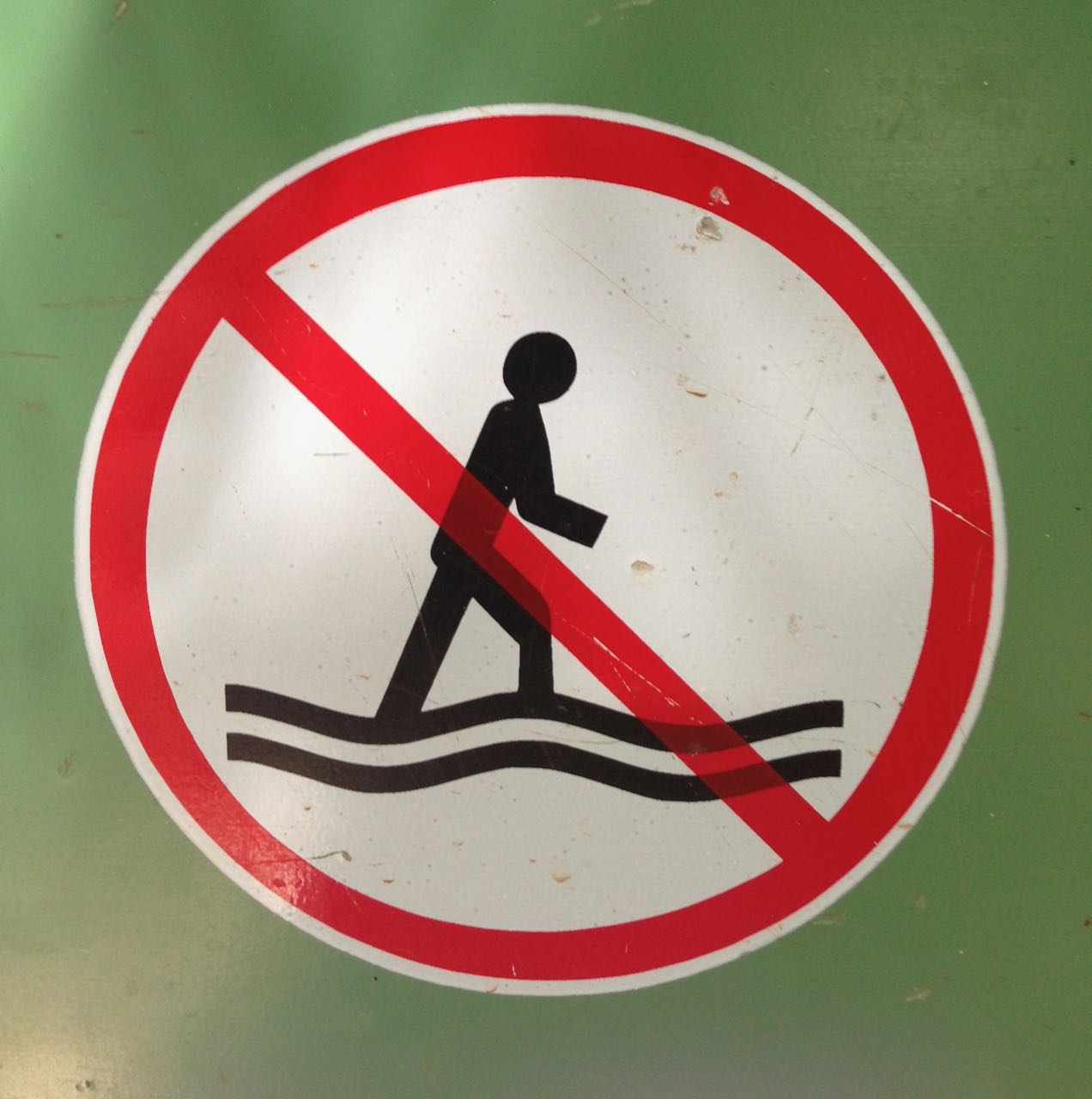
    On a lighter note, my personal favourite echo of this theme is a sign I once photographed on the shore of the Sea of Galilee:


    No Walking on Water Sign


    Deeply true even if they never happened

    The stories we are offered today may never have happened, yet they are deeply true.

    Theses stories offer us truth to live by and wisdom for a holy death.

    The persistence of dreams in the spiritual toolkit of the human race, reminds us to look beyond the obvious and the superficial.

    We can explain so much, yet we understand so little.

    We travel far and wide, but do not go very deep into the mystery of life.

    Our candles, dreams, icons, holy oils and rituals are not the answers in themselves, but they may invite us to go deep into the open-ended mysteries of this amazing world, and even the deep complexities of our own selves.

    We may never find the answers.

    But we live better when we face the questions.

    As and when we have the courage to embrace that journey into the unknown, then we find a mysterious yet familiar figure walking towards us through the storm and the haze.

    That is the role of the Saviour: to come alongside as needed and draw us to safety.

    We do not have to believe impossible things to be a person of faith.

    We simply have to trust that God is always with us: not because of our virtue, but that is the very nature of our God, of Emmanuel.

    If we can imagine Emmanuel then we can find the courage to be, the courage to hope, the courage to live, and the courage to go deeper and deeper into the eternal mystery which is our life and our world.

    In the final scene of Matthew’s Gospel, Jesus reminds his followers—some of whom even then are questioning who he is and what is happening—I am with you you always, to the end of the world.

    May that be our experience, and may it enable us to live lives that are holy and true,


  • Treasure, Pearls, Fish and Scholars

    Pentecost 8 (A)
    30 July 2017
    Byron Bay


    We have four more parables this Sunday as we complete our series in Matthew 13. Not one of them involves farmers, so George can relax this week.

    • Buried treasure (casual passer-by)
    • Pearl of immense value (merchant)
    • Fishing net (fisher folk on the lake)
    • Scribe trained for God’s rule (scholar, rabbi)

    These are three of my favourite parables, along with one that I could easily skip in its canonical form.

    This set will wrap up Matthew’s parable collection, so please indulge me while I reflect on the three parables that speak most powerfully to me from this set.


    The Fishnet

    First a brief comment on the Parable of the Fishnet.

    It evokes the earlier Parable of the Wheat and the Weeds, but the action has been translated from field to the lake.

    Jesus spent a lot of time around the lake. He observed the fishers at work and included several of them among inner circle of 12 disciples.

    We know that Galilean fishers used nets: small casting nets, larger nets dragged behind boats, and nets walked out into shallow areas then back to the shore. All such methods result in a mixed haul, like the shark nets installed on beaches recently.

    Our task is to prepare the nets, repair and maintain the nets, and to deploy them in ways to gather in the largest haul. In other words, our responsibility is to fish and it is the Master’s role to sift and sort afterwards.


    ASIDE: Allegory kills the parable

    One of the problems with parables is how we use them.

    Parables mostly designed to be heard as a whole. They work because the story subverts common sense. They tend to cut across the grain of conventional wisdom, but the people after Jesus were mostly not as adept as he was in using open-ended stories. They felt the need to explain everything and limit the potential meaning of the parable. At times they even undermined the point Jesus was making.

    One strategy that they used was allegorization. In this way they could convert the parable into a moralistic story. They attributed moral and spiritual significance to each detail of the story. Such interpreters also tend to present the story in context of the great day of judgment in the distant future. Where Jesus called on people to live NOW as children of a generous a God, later tradition tended to use fear of the FUTURE as a discipline on morals.

    We see all these in The Fishnet. At its core is a genuine saying of Jesus, but already by Matthew’s time it becomes an allegory as the simple story is elaborated with horrific scenes from the day of judgment. This parable does not occur in Mark, which was Matthew’s major source. He has found it somewhere else, and we can also find an earlier version in Thomas 8 – where there is no interpretation such as we find in Matthew. Most likely Matthew has created the judgment scene interpretation, a theme we find several times in his Gospel.


    Three More Parables

    Buried treasure

    This brief and simple story indicates the essence of the parable.

    Here, God’s Kingdom / reign is like … the accidental discovery of a hidden treasure trove. The lucky finder disposes of everything else in order to acquire that field and gain the rights to the treasure trove.

    No moral issues are entertained, just the excitement of discovering the treasure; the joy of passion; and the folly of enthusiasm.

    The Pearl of Great Price

    Next we have a similar story, this time featuring a merchant: someone always on the lookout for a bargain. Today he finds the bargain of his lifetime: a pearl of immense value.

    Like the lucky treasure hunter he sells up everything he owns. Now he can possess the precious pearl.

    This is a parable where we see the humour of Jesus at work. Think through this story.

    The merchant has sold all he possessed: his house, his merchandise, his animals, any servants or slaves (and maybe even his wife and children).

    So now he has his pearl. But what is he able to do with it?

    This was folly: impulse purchasing at its worst. Jesus is not giving financial advice, but describing how God’s reign takes hold of us. This is not about success, not about respectability, and not about traditional family obligations.

    Rather, this is about a passion for God, a passion for the ‘pearl of great price’, a thirst for
    the spiritual wisdom we draw from the well of faith.

    A Scribe Trained for God’s Kingdom

    Now we come to one of my favourite parables. The central character is a scribe, a Bible scholar, in our terms a theologian or a priest. The scribes were usually seen as the opponents of Jesus, but the early Jesus movement must have included some. They were needed to write gospels, etc and also to copy and study the Old Testament,

    So what is such a godly scholar like?

    This is the part I especially appreciate: he is like the manager of a household who knows what to fetch from the shed as needs arise. Sometimes it will be something new, but other times it will be something old. Such is my vocation as a priest and a scholar.

    That is a role we are all called to fill at times and one of those times will be at Parish Council later today. As we engage in our mission planning process we need the wisdom to blend the old with the new.


    Conclusion

    We finish our three weeks of parables now.

    They draw us deeply into the mystery of God. They encourage us to be excited by mission. They invite us to take foolish risks for God. They demand that we stop critiquing others and learn how to blend the old with the new.

    Here in the Bay these parables resonate with our context. We are called to move beyond the safe spaces and to venture out to risky places. We do that knowing always that God is already there: EMMANUEL is not just with us, but also ahead of us.

    Thanks be to God.

  • Feral weeds and rotting yeast

    Pentecost 7 (A)
    23 July 2017
    Byron Bay & Broken Head

    Today’s readings offer us another serve of Jesus as the master of the parable.

    This is the second of three Sundays that we spend in Matthew 13.

    The lectionary wants us to focus on just the one parable this week: both the earliest tradition with the core parable, and also the later tradition with its allegorical interpretation. In the first we discern the voice print of Jesus, in the latter we sense the calcification of the tradition as the challenge of the kingdom’s Prophet is domesticated into personal piety and good living.

    In the process, the lectionary wants us to skip over two other brief parables that occur in between these two lengthy paragraphs. However, I propose to focus on all three parables and leave the interpretation or some other time.

    The church has turned the parables into (safe) earthly stories with a (pietistic) heavenly message, but the art of the Storyteller from Nazareth was such that these stories still have power to challenge, provoke, and transform. Even after 2000 years.

    The parables are not ‘nice’ stories for children in Sunday School or Scripture classes. Rather, we should think of them as theological booby traps thrown into our hearts by the Master Teacher, the Galilean Sage. These parables tease us. They stretch our minds. They open our hearts. They dare us to think differently about God, the world and ourselves.

    These ‘inconvenient truths’ echo across the millennia despite the best efforts of the church to lower the voltage of the Jesus legacy so that our lives are less disrupted by the poetic wisdom of the Nazarene.

    Three parables from the Master

    Each of these parables draws on daily life in rural Palestine: one is from the field, another is from the garden, and the last from the house.

    • In the first, a farmer sows his field—seemingly with more care than the farmer in the parable of The Sower that we had last week. In this there is no problem with seed falling on the pathway, among thistles, or in shallow soil. The planting process seems to have gone well, but then weeds come up—all over the place. There are so many weeds they cannot be pulled out without risking the crop. All is good says the farmer. Let them be until the harvest time.
    • In the second parable, someone plants mustard seeds in the garden. That makes us much sense back then as planting nut grass in the blue couch lawn today. Once mustard gets into the garden it will never be eradicated. It is a pest. It gets out of control.
    • A similar idea seems to be at work in the third parable, but with a twist. God’s reign, says Jesus, is like a woman who hides a tiny amount of yeast in a very large amount of flour. ‘Three measures’ does not mean ‘three cups’. It is more like three sacks. Around 100 litres of flour is permeated by this small amount of yeast. Yet yeast is something unclean for the Jewish audience.

    Three parables.

    Three seemingly simple stories.

    But each of them confronts and subverts how we think of God.

    Church is not a place where we need to hunt down those with different views and drive them from our midst. We are more like a paddock with crops and weeds growing side by side. Time will tell what has sprung from the good seed, and what has sprung from the bad seed. It is not our job include some while excluding others. All are welcome here.

    Jesus says God is just like the feral mustard that runs amok in the garden. Once God gains a toe-hold in our lives there is no getting rid of her. God’s presence expands and multiplies and permeates and changes—everything.

    God (says Jesus) is like the rotting yeast whose decay penetrates a huge quantity of flour. God’s reign will work its way through our lives, through our community, through our church, until—in the End—God is everywhere, and God’s will is done on earth as it is in heaven. It cannot be stopped. It spreads everywhere.

    Holy things for holy people, broken things for broken people

    As the Priest calls us to the Table of Jesus we often hear these words:

    The gifts of God for the people of God.
    Holy things for holy people.
    Broken things for broken people.

    These words invite us to bring together two aspects of life that we often seek to keep apart: holiness and brokenness.

    The parables mix these up and claim everything in life for God’s kingdom.

    In our lives we live with brokenness and wholeness, side by side.

    The people of God are broken people, and the broken people are the holy people.

    Thanks be to God.


  • Comfortable words, challenging words

    Comfortable words, challenging words

    Pentecost 5A
    9 July 2017
    Byron Bay


    The readings set for today each have their own logic, but taken together they fail to cohere in the way that we sometimes experience. We could pursue anyone of these three readings, and with sufficient time we would find that each offers us profound spiritual wisdom. Indeed, we did a little of that in our discussion last Wednesday morning.

    The first reading from Genesis 24 continues the story of Abraham, and today we see the beginning of the transition from Abraham to Isaac. As always, the Psalm serves as a response to some aspect of the first reading: in this case to the experience of a young woman who is leaving her family of origin to join the family of her new husband, a man she may not even have met prior to the marriage being arranged. That whole scenario triggered some interesting reflections on family, culture and faith when we explored these texts last Wednesday morning.

    In our second reading, we hear Paul at his most vulnerable. In this section of his letter to the Romans, Paul speaks of his personal distress as he finds himself unable to live up to his own expectations as a person of faith. Again, this is a passage that triggered some significant reflections as we discussed Paul’s words last Wednesday morning.

    Today’s gospel reading presents Jesus engaged with people whose response to his own ministry and his own actions was very mixed. We sometimes think how wonderful it would have been to hear and observe Jesus directly during his life in the first century. Surely, we think, it must have been so much easier to respond with faith when Jesus was right there in front of us. Not so it seems. Today’s gospel invites us to explore more deeply our response to God’s call.

    Already you can see that each of these readings invites us to explore different aspects of faith. But we only have time for one sermon, and the sermon can only go down one track. So let’s focus on the gospel this week, having spent a considerable amount of time with the Old Testament readings over the past couple of weeks.


    Take my yoke upon you

    In today’s Gospel we find these words on Jesus’ lips:

    Come to me, all you that are weary and are carrying heavy burdens, and I will give you rest. Take my yoke upon you, and learn from me; for I am gentle and humble in heart, and you will find rest for your souls. For my yoke is easy, and my burden is light. [Matt 11:28–30]

    For Anglicans who grew up with the old prayer book, the Book of Common Prayer, these are very familiar words. They form part of the so-called comfortable words which generations of Anglicans heard just before coming to communion:

    Hear what comfortable words our Saviour Christ saith
    unto all that truly turn to him:

    Come unto me, all that travail and are heavy laden,
    and I will refresh you. 

    Long before the BCP, these words will also have sounded familiar to Jewish ears in synagogues across the Middle East. Similar things were said by Lady Wisdom as she invited people to embrace the demands of Torah and find their burden was light, and the yoke was easy. Here are three examples from the Wisdom of Jesus son of Sirach (written about 180 years before Jesus):

    Come to me, you who desire me,
    and eat your fill of my fruits.
    For the memory of me is sweeter than honey,
    and the possession of me sweeter than the honeycomb.
    Those who eat of me will hunger for more,
    and those who drink of me will thirst for more.
    Whoever obeys me will not be put to shame,
    and those who work with me will not sin. [Sir 24:19–22]


    Draw near to me, you who are uneducated,
    and lodge in the house of instruction.
    Why do you say you are lacking in these things,
    and why do you endure such great thirst?
    I opened my mouth and said,
    Acquire wisdom for yourselves without money.
    Put your neck under her yoke,
    and let your souls receive instruction;
    it is to be found close by.
    See with your own eyes that I have labored but little
    and found for myself much serenity. [Sir 51:23-27]


    Listen, my child, and accept my judgment;
    do not reject my counsel.
    Put your feet into her fetters,
    and your neck into her collar.
    Bend your shoulders and carry her,
    and do not fret under her bonds.
    Come to her with all your soul,
    and keep her ways with all your might.
    Search out and seek, and she will become known to you;
    and when you get hold of her, do not let her go.
    For at last you will find the rest she gives,
    and she will be changed into joy for you.
    Then her fetters will become for you a strong defense,
    and her collar a glorious robe.
    Her yoke is a golden ornament,
    and her bonds a purple cord.
    You will wear her like a glorious robe,
    and put her on like a splendid crown. [Sir 6:23-31]


    You may recall that Matthew was writing his account of the Gospel to address the needs of Christians with a strong Jewish background. In his Christian community in Antioch around the end of the first century such people needed to know that following Jesus did not mean they were rejecting their spiritual legacy as Jews.

    When Matthew chooses these words from the wider oral tradition of the early church, he is inviting his readers to link Jesus calling them to discipleship with the older traditions of Lady Wisdom inviting people to take her yoke upon themselves, and discover that the religious life is not a heavy burden, but rather a source of joy and strength.

    Such words were familiar to people in the past, but the recent national census data suggests that they would be rather unfamiliar words to most of our neighbours.

    Accepting the yoke of religion is not something with broad appeal these days. Yet maybe this ancient wisdom still has something to teach us today. Maybe it also speaks to the matters we shall be engaging with in our mission planning session directly after the service ends?

    What might it look like for us as a faith community to accept the yoke of Christ?

    At a time when fewer Australians want religion of any kind, what if we choose to be different?

    What did the yoke of Holy Wisdom look like to ancient Jews and to those first Christians? And how might it look to us today?

    COVENANT – at the heart of Judaism and Christianity there is a deep sense that we are in a covenant with God. That covenant is initiated by God as an act of grace, and we respond to that divine initiative by choosing to live within the covenant; by accepting the yoke. To put that in more everyday terms, we experience life as a profound gift, and we choose to live with a mindset of gratitude. One reminder of that dynamic in the life of faith is that our distinctive act of worship is the Eucharist, a Greek word that means thanksgiving.

    COMMUNAL – our response to God is communal. We need others to travel with us on the path. We do not make this journey alone. Our religion is not about solitary achievement, but about shaping and sustaining healthy and grateful communities. Further, as a ‘church’ rather than a ‘sect’, our sense of community is large and inclusive. Everyone is welcome. We have soft boundaries. People can come and go. It is OK.

    EARTHED – as grateful beneficiaries of God’s goodness, we are deeply connected with the earth and the intricate web of life in which we participate. We are not seeking to escape from this world, but to live faithfully and gratefully within this world. The ancient Hebrew creation story captures this well with its delightful pun: the earth creature (adam) is fashioned from the earth (adamah). As people of the earth, we have work to do: whether we still work the soil or now create digital content. We are engaged in the web of life as stewards of creation. It is our destiny and our vocation. And our joy.

    COMPASSION – hard wired into our stories of faith is the idea that we are people of compassion, people who care about justice, people who welcome strangers, people who protect the vulnerable (‘widows and orphans’ in biblical terms). When people of power exploit others, drive them into poverty, and force them into slavery then people of faith speak truth to power, often at great personal cost. Jesus is our model. The symbol of our faith is a cross, not a rocking chair.

    RITUAL – we know the power of ritual to express our gratitude for the gift of life and to sustain our commitment to lives of justice and hope. Yes, our worship can become jaded and our rituals can degenerate, but good liturgy enlivens and transforms. We need more than words because humans are more than word processors. We need colour, music, movement and incense. The whole person needs to be caught up in our grateful response to the God ‘in whom we live and move and have our being’.


    Later this morning we shall devote some time to discerning what taking up the yoke of Christ looks like here in the Bay, and how that may unfold in the next few years.

    I do not know what ideas will emerge from this process, but I am confident that as we take up the yoke of Christ and send our roots down deep into our local community here in the Bay, God will use us to make a difference in the lives of other people.

    First we shall make Eucharist together, and then we shall seek the wisdom of God for the task before us.