Author: Gregory C. Jenks

  • Mary says thank you

    Mary says thank you

    Lent 5C
    St Paul’s Church, Ipswich
    6 April 2025

    [ video ]

    As I mentioned earlier, today we change gear and move into a lower worship tone, as it were. Until recent times, in many churches today would have been called Passion Sunday, two weeks before Easter, a week before Palm Sunday. 

    As you may remember, the little purple sacks would magically appear from the flower vestry and then cover everything that was too celebratory. The cross above the Altar, the processional cross, the cross on the wall in the western sacrament chapel and so on. And it’s just one of those little customs that developed and then—sort of it like nut grass—got away on us, so it’s being pulled back under control. The idea was that as we got closer to Good Friday, we would cover all the bejewelled and glorious decorations in the church, and particularly empty crosses, which, of course, represent resurrection. But once people got the idea of putting little purple sacks over things there was no stopping them, and anything in the church that could be covered was draped in purple.  I was fortunate never to have a purple sack put over myself. 

    So we’ve changed somewhat in how we observe these festivals, in the more recent liturgical thinking. I note with delight that the incoming Rector teaches liturgy at the College of the Transfiguration in South Africa. I’m just a simple biblical scholar, but Mpole is a liturgical scholar. So we’re about to get some really well-thought out liturgical leadership in the life of the parish, which will be a great blessing. I shall watch it with pleasure from afar. 

    Today, we’ve got this beautiful, fascinating, and delightful story is surely one of my favourite stories from the Gospels. It must have been a favorite in ancient times as well, because there’s a version of this story in each of the four gospels. It occurs in Mark, the earliest gospel and it occurs in Matthew, which is an expanded edition of Mark. It occurs in Luke, although for some reason, Luke relocates the story up into Galilee at an earlier point in the narrative. And as we heard, it occurs in John. There are not many stories that occur in all four Gospels, and this is one of them. It’s even more unusual because it’s a story where a woman is the central character. 

    That makes it unusual in the Bible as well. You might remember even last Sunday, Mothering Sunday, we had the story of the prodigal father, because there was not a story about a loving mother that could easily be read from the Gospels. 

    So we have this story which is set in what was then the village of Bethany. Bethany is on the other side of the Mount of Olives. One side of that ridge faces towards Jerusalem, the other side faces towards the desert, and that’s where the little village of Bethany was. It appears to have been Jesus’ safe place whenever he came to Jerusalem. That, by the way, makes the story a bit odd, because the best we can tell, Jesus was already staying at Mary and Martha’s house. He didn’t just turn up there in the way this passage suggests today. 

    There are two interesting things about that location. Firstly, the 40,000 or so local Palestinians who live there and—of course—speak Arabic, do not call their village Bethany. Rather, they call it el-Azariyya, Lazarus town.

    Two thousand years on, they’re still remembering the story of Lazarus. I guess it’s the biggest thing that’s ever happened in Bethany. So the local people still know their village as el-Azariyya, the home of Lazarus. 

    The sad thing about Bethany these days is that it has the misfortune to be right on the cusp of the so-called green line or at least the apartheid wall, which Israel has built between its own territories and the West Bank. It’s in what’s called Area C under the Oslo Agreement. Area A is supposed to be under Palestinian control, except when the Israelis want to go and get something. Area B is under shared control, and Area C is under Israeli control, but Bethany is just on the other side of the four-meter-high concrete wall which Israel has put through the middle of the Abu Dis village to divide Palestinians on one side of the street from those on the other side of the street.

    So Bethany today is a kind of no man’s land.  The Palestinian authority has no control because it’s in Area C and the Israelis don’t go there because they don’t care what happens on the other side of the wall. If you’re in trouble with the authorities today, Bethany is the place to be. It’s a wild west kind of town. 

    So Jesus comes to a Bethany, which was much smaller, much quieter, and in many ways offered him a safe haven. In just the previous chapter of John’s gospel, he’d already been in Bethany because he’d come to show his respect and his love for the family following the death of Lazarus

    They had let him know that Lazarus wasn’t well, but he didn’t come straight away. In chapter 11, he delayed a few days, and by the time he and the disciples got to Bethany, Lazarus had been dead several days. Martha, the tougher of the two sisters—remember Mary and Martha?—Martha gave Jesus a piece of her mind as he arrived. Why weren’t you here? Had you been here my brother would not be dead. And Jesus says something like chill, Martha, just chill. It’ll be okay. Wait. Watch.

    So as the story goes on, Jesus calls Lazarus out of the tomb and restores him to life and restores him to his sisters.

    The little household that we have there in Bethany is an interesting household. It’s a household comprised of two adult women and their brother, Lazarus, who often is not part of the story. In some ways, it really is Mary and Martha’s place and Lazarus seem to be there some of the time. So in today’s part of the story, Jesus has turned up for dinner at the home of Martha and Mary and Lazarus.

    The little family of three adults is putting on a bang-up feast. Well, of course they are. Think about it. Just a few days earlier, Lazarus was dead and they were getting ready to host wave upon way of neighbours and family coming for the days of condolences, which also means wave upon wave of cooking for the people who are hosting visitors, who are coming to express their solidarity and their comfort to the bereaved family. That was the plan. 

    That was the expectation but now Lazarus is alive and Jesus is coming for dinner, and it’s going to be a bang-up celebration for sure, and the guest of honour … Well, is it Jesus, or is it Lazarus? 

    I mean, who are people coming to see when they come by Mary and Martha’s house? For sure they’ve heard about Jesus but I suspect they really wanted to see for themselves that Lazarus really is alive. 

    So Martha is busy. You might remember, that’s her role in these stories, Martha is busy serving, and it is Mary who is the more emotional sister here. I’m not going to say anything about my three sisters, because this is being live streamed. But many of you will have sisters, or be a sister, and you will know some sisters are very organized. They work from the head. Other sisters are very emotional, and they work from the heart. Mary is the second. She’s the one who is much more emotional. She’s the one who—in Luke’s story—sits by Jesus’ feet, listening to him while Martha is busy in the kitchen. So we know, we know this family, okay?

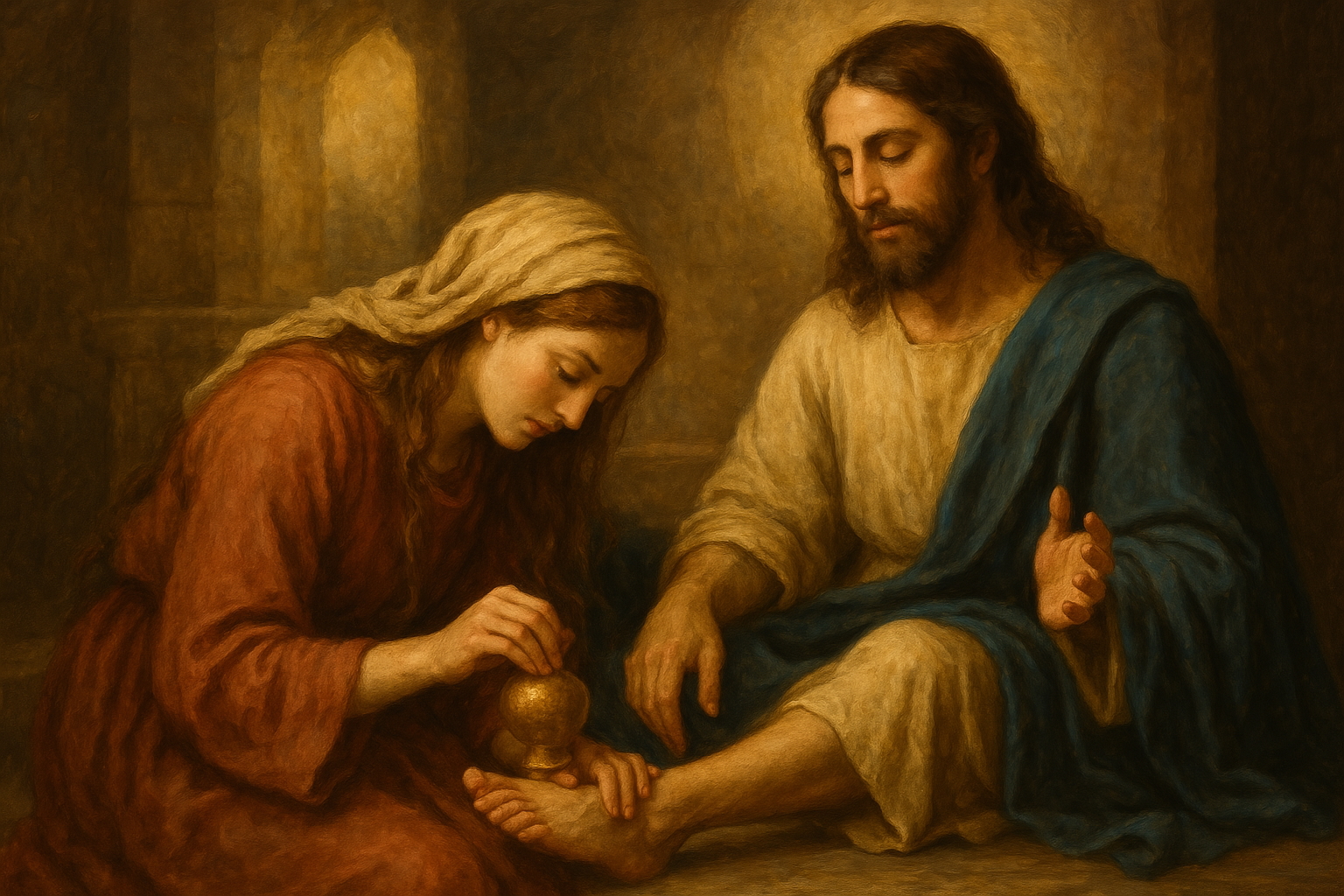
    Mary took a pound of costly perfume, pure nard and which would have been in a little tiny bottle. If I had thought about in time, I could have actually brought one in from the collection at the college: a little glass bottle about so deep, full of precious ointment. She uses the ointment to anoint Jesus’ feet, and then she wipes off the excess ointment with her hair.

    An interesting moment in the middle of dinner, I guess. But the point is, she is just so happy to see Jesus, that she can’t do enough for him. Where she might have been by preparing her dead brother’s body with ointment, she’s now massaging and anointing the feet of the one who brought her brother back to life. 

    And of course, there is the grumpy uncle, Judas Iscariot, sitting in the room. “What a waste of money. That item could have been sold for 300 denarii and the money given to the poor.” We all know people like that. Three hundred denarii, by the way, is basically a year’s wages to a worker: one denarius a day, so 300 denarii is pretty close to year’s wages.

    That’s a lot of money. In our terms, it cost around $80,000 for that little jar of ointment.

    But for Mary—and I suspect for Martha in her better moments—nothing was too expensive to express their gratitude to Jesus; whereas Judas just sees a waste of money.

    Jesus’ comment is interesting.

    Leave her alone. Get off her case. She bought this so that she might have it for the day of my burial. 

    And in saying that Jesus is connecting the events in the house of Mary and Martha and Lazarus with his own destiny on the cross in just a few days’ time, about a week later, according to the time signal at the start of today’s Gospel.

    So I love this story, but I guess the point of this story, which has been playing around in my head during the week is, is the question of gratitude. How grateful are we for what God has done for us? In another version of this story in Luke’s Gospel, Jesus says to Simon the Pharisee, those for whom much has been forgiven, had much love to show.

    Where is our gratitude? How aware are we of all that God has done for us? And where are the limits to our generosity, to our enthusiasm, to our love as we demonstrate our gratitude to God, the source of life and the source of our salvation? Amen.

  • Stories that shape worlds

    Stories that shape worlds

    Lent 4C
    St Paul’s Church, Ipswich
    30 March 2025

    [ video ]

    We’ve just heard one of the great stories of our faith, and indeed, one of the great stories of the Western world. I guess, of our whole culture. Stories have the power to shape the world. The stories we tell each other not only tell us who we are, but they form the lens through which we experience each other and interact with the world around us. 

    And as we step into a five week federal election campaign, we’re going to hear a lot of stories, stories about them, stories about us, stories about you, and some of them might even be true, but as we’ve learned in the last several years, we’ve moved, sadly, into a post fact world where this power of the story is more important than its actuality and its truthfulness. 

    And in a sense, it’s always been like that with important stories, the stories that really matter are not stories whose truth is mortgaged to their historicity, and that is never more so than with the parables of Jesus. Of course, they’re true, but they’re made-up stories. We don’t mortgage their spiritual value to their historicity.

    So we’ve just heard one of the great stories. It is a story about love and compassion and good parenting, and it’s a great combination, as it happens, for Mothering Sunday, except it’s not about a mother, it’s about a father! But then it’s pretty hard to find stories in the Bible that celebrate Mothers, actually, because the Bible was mostly written by and for men. 

    So here we have this amazing story which Luke has gathered up and which would otherwise have been completely forgotten. This story is not remembered in Matthew or Mark or John, and of course, there’s not a peep of it in the letters of Paul.

    If we didn’t have the Gospel of Luke in our Bible, we would never have heard this story. So imagine a Christianity without the parable of the prodigal son.

    What Luke has done in this part of his gospel is to gather together three stories about lost things: a lost sheep in the first paragraph, a lost coin and then a very lengthy story about a lost son.

    Or is it two lost sons?

    The first parable—the one with 100 sheep, 99 are doing the right thing, and one goes astray—we also know from Matthew’s Gospel. But the story of the lost coin and the story of the lost boys is only known to us in Luke.

    This year, we particularly listen to the Gospel of Luke because it’s the focus during this third year of our three-year lectionary cycle. 

    So spare some time this week to say thank you to God for Luke and for the incredible riches we have in the Gospel of Luke and the Acts of the Apostles.

    The story seems so familiar to us, and yet it is, of course, a story from another place and another time. While it makes sense to us in our culture and in our time, it doesn’t have quite the same impact when taken out of the cultural context in which it was first given.

    The gifted biblical scholar Kenneth Bailey, who sadly died just a few years ago, has given us a powerful interpretation of this parable, indeed of the whole of Luke chapter 15, that invites us to see and hear what Jesus is saying through ancient Palestinian or peasant eyes and ears. In fact, Ken kept coming back to this chapter in Luke and to the prodigal son in particular. He’s written several books on just this one portion of Luke’s gospel, and has given countless talks on his interpretation of the prodigal I had the privilege of hearing one of those presentations in Bethlehem some years ago now and then over the next few days during the conference, engaging with Ken in conversation. We disagree about all sorts of things, but he was an awesome scholar, and I was particularly impressed with his mastery of Arabic and early Arabic commentaries on the Bible.

    If you look up the web version of this sermon later, there’ll be a link to one of his videos so you can see and hear the kind of wisdom that Ken Bailey offered us. Instead of taking multiple volumes and several hours of videos, let’s try and do it in five minutes. Let’s try and catch an insight into this amazing story of the prodigal father.

    The key character in this parable is, of course, not the younger son, but the father.

    Repeatedly in the parable, it is the farther who plays the role of God, just as the shepherd who goes looking for the one lost sheep and the housewife who goes searching for the one lost coin are metaphors for the God who goes searching for the lost soul. 

    The father in this story is the compassionate rock around whose strong presence we see the ebb and the flow of his two dysfunctional sons. 

    The father is constantly acting in ways that are contrary to the culture of the time, although that’s not immediately obvious to us. And so I think we’re right to think of this as really the parable of the loving father, rather than the prodigal.

    The parable begins. You will recall when the younger son makes a request that is designed to break the father’s heart and bring shame on him and the whole family. He wants his future inheritance right now, why wait for the old guy to die? Let me have it now! That, of course, is not just an ancient dynamic, is it?
    Those of us who live in properties that are accumulating in value and have children and grandchildren that are struggling to pay their mortgages know something of that pressure as well.

    When I was a locum for a period at Byron Bay this was a real thing. People who bought a house at the Bay in the 1950s for a few hundred dollars were now living in properties worth millions and the grandchildren were really keen for them to move into a nursing home. 

    In our world today, we don’t see it, sadly, as such a shameful thing, but in the ancient world and in the Middle East, still, it could not get much worse than what the younger son does to his father.
    In their world, everything is about honor and shame. Honor and shame. The father loses his honor, and the son brings shame, not only on himself, but on his father and on the family, and indeed, on the whole village.

    It was like that in the palace in the eastern Mediterranean. It remains. So today. Identity is not so much the individual, but the family to which the individual belongs. So even today, in Nazareth, if a Palestinian is meeting somebody for the first time, they won’t ask, “So what’s your name and what do you do?”  or even, “Where do you live?”—which in Ipswich might give us a sense of what kind of person you are. Rather, they’re going to say who’s your grandfather? Because if I know your grandfather, I know you. I know where you fit in. I know whether you come from a family with honor or riffraff.

    I had my own taste of that many years ago on the edge of Byron Bay parish, in a little church at a place called Broken Head. My family had gone there one Sunday when we were on holidays. It was a tiny little chapel, a timber chapel. Later on, as I said, I found myself as the locum, and that was one of the churches where I took services. But it was obvious on that first visit that everybody in the building—apart from my family, the four of us—everybody else in the building were obviously from the same family, and it wasn’t our family. They were all a little group of Armstrongs, as it turned out. So after the service, we’re taken across to meet old Mrs. Armstrong. That’s how she was referred to when I met her. So I was introduced to Mrs. Armstrong: “And what’s your name? Where are you from?” And I said, “Well, my name is Greg Jenks. I’m Rector of Holy Trinity Church in Fortitude Valley.” She said, “We had a Jenks in our family once, but he moved to Brisbane and he died.” And I said, “Well, that was my dad.” Old Mrs Armstrong continued: “So your grandmother and me, we used to walk to Coopers School together, and we used to play under the railway line. Welcome.”

    I was slotted in. I belonged. Okay? I possessed an identity and experienced the welcome and the honor of being connected.

    So back to the story of the man with two sons. 

    Rather than retreat into wounded honor and a persistent sense of shame, the father waits expectantly for the day when the troubled boy will come back.

    More public shame is about to befall this old man, but he brings it on himself.

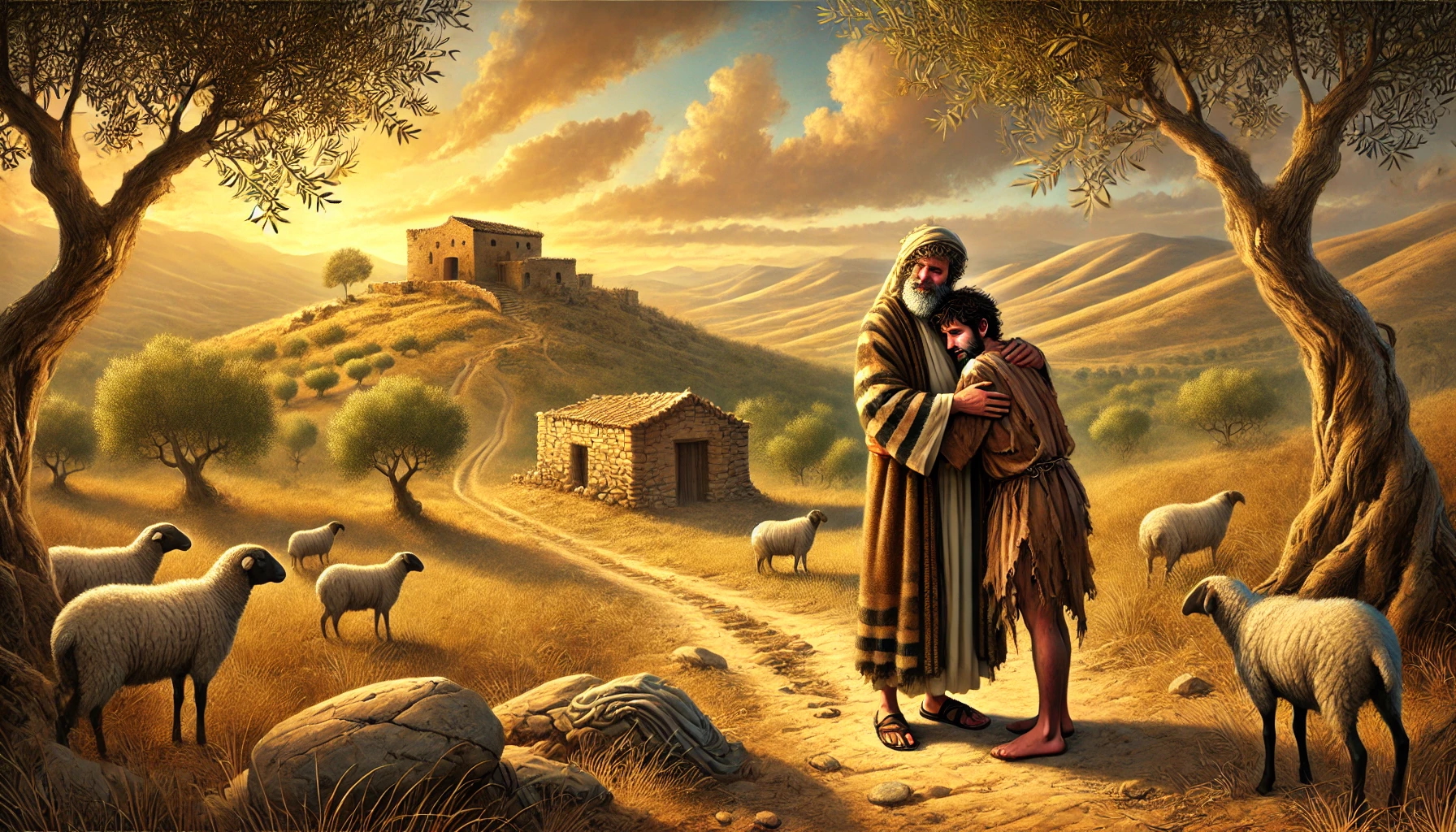
    There comes the day when he spots the bedraggled form of his younger son, barefoot and in rags, creeping through the streets of the village, making his way home. He runs down the street to embrace the boy who had treated him as dead.

    Oh, that sounds nice, doesn’t it, we think, but in that village and in that culture, and at that time, what the father did was shocking.

    Right there in the streets of the village, in front of the neighbors, he runs to the son who has treated him so shamefully. In the peasant world of the eastern Mediterranean—then and now—senior men do not run anywhere. Thank you very much. They walk with dignity and slowly.

    We can easily miss that detail, because that’s not the world we live in. We’re hearing the story, but it’s told for people with different ears and different eyes. You see to run towards his son, the old man has to hitch up his robes because—no more than I can run to the front door with all this gear on—the old farmer can’t run to his son unless he hitches up his robes. 

    Shock, horror, he then exposes his legs.

    That’s a serious costume fail in the villages of the ancient Levant in front of the neighbors. It’s not elegant, and worse, it’s shameful. But the old man doesn’t care. His only concern is for the son who had been dead, but now is alive, back safe and sound.

    In that frail old man running awkwardly down the village street. Jesus paints a picture of God, but he’s also sketching the outlines of what his community of disciples would be like: people of compassion, not holding grudges, not clinging to status, compelled by love.

    So in this story—this familiar, beautiful, misunderstood story—we see a different world, a new world, fashioned and sustained by divine love. 

    And that new world is the reality we are called to create as a community of Jesus people here in the heart of Ipswich. Amen.

  • Children of Abraham

    Children of Abraham

    [ video ]

    St Paul’s Church Ipswich
    Lent 2C
    16 March 2025

    Our first reading today invites us to reflect on the figure of Abraham, or Abram as he is called in the earlier parts of his story.

    Abraham: A character in the biblical narrative

    Abraham looms large in the cast of characters we meet in the Bible, and especially in the Hebrew Scriptures (what Christians tend to call the “Old Testament”).

    We have just a single episode from the Abraham cycle in the lectionary during Lent, so let me—very briefly—fill in the larger story for you.

    You can find the Abraham cycle in Genesis chapters 12 through 25, so I really encourage you to read that material as one continuous story sometime this week.

    The story begins as Abram accepts a call from God to go to the place where God wants Abram to be. The location is not revealed, but Abram is told that when he is where God wants him to be then he will know he has arrived.

    The LORD said to Abram, “Go forth from your native land and from your father’s house to the land that I will show you.” [Genesis 12:1 JPS]

    In the story, saying YES to God required Abram to move from modern-day Iraq to the region around Hebron in Palestine. It is in Hebron that Abram will purchase the only parcel of land that he ever owns; the cave where he will bury his wife, Sarah and later be buried himself.

    The original invitation from God, as it happens, was not to steal the land from the Indigenous people but to live among the people of the land in such a positive way that they consider themselves blessed to have had Abraham and his family come among them.

    “I will make of you a great nation, 
    And I will bless you; 
    I will make your name great, 
    And you shall be a blessing.
    I will bless those who bless you 
    And curse him that curses you; 
    And all the families of the [land]* 
    Shall bless themselves by you.” 
    [Genesis 12:2-3 JPS modified]

    The Hebrew word אדמה is better translated as “land, soil, ground” rather than “earth, world” as it implies a local and immediate reality rather than the whole inhabited earth for which ארץ is the more typical Hebrew term (as in Genesis 1:1).

    Between that opening scene and this week’s portion, Abram and Sarah have been engaged in a series of adventures, including an encounter with the Pharoah in Egypt and Abram defeating the massed armies of 5 kings from Mesopotamia.

    At this pivotal point of the cycle, Abram is concerned that all he has achieved will count for nothing as he has no one to inherit his wealth. Again, note that there is no land involved; Abram is wealthy because of the herds and the slaves that he owns.

    Yes, Abraham was a slave owner.

    As we read, God assures Abram that he will have son to inherit his wealth and the next several chapters revolve around that theme as the story identifies not one son but two sons who might inherit everything that Abram (now called Abraham) will leave behind. Ishmael and later Isaac emerge as contenders for that role. 

    Finally Sarah dies. Abraham buys the burial plot for her and then sets about to arrange a suitable wife from “back home” for Isaac, his heir. Finally, Abraham himself dies and is buried alongside Sarah.

    Abraham is far from a perfect character, and the story raises some ethical dilemmas for us as we read it these days. But his principal virtue was that he trusts God, even when it seems there is no good reason to do so.

    This idea will later be picked by Paul in Romans 4, but we heard it in today’s passage:

    And [Abram] believed the LORD, and the LORD reckoned it to him as righteousness. [Genesis 15:6 NRSVue]

    Father Abraham

    In the Bible as also in the Qur’an, Abraham is seen as the father of the faithful. He is the first and greatest believer.

    His diverse community of “children” sadly reflect the complex dynamics of the first two sons mentioned in the biblical story itself.

    Life Ishmael and Isaac, there has been a long-running competition between Jews, Christians and Muslims over the legacy of Abraham, or Ibrahim as he is called in Arabic.

    Yet—like Ishmael and Isaac coming together for their father’s burial—we can all agree that Abraham is a biblical character that we have in common.

    This is sometimes expressed in the term Abrahamic religions.

    All three Abrahamic faith communities share some important elements of faith:

    • belief in one God
    • as “people of the book” we each value the role of sacred scriptures 
    • we each value the role of a founding prophet as part of a line of prophets
    • we have many common ethical values
    • we all look for the final consummation at the end of time

    Of course there are also important differences between the three Abrahamic faiths, but Jews and Muslims are closer to one another in many ways, than we are to either of them.

    The significance of Jesus for the Christian children of Abraham makes it very hard for Jews and Muslims to accept us as part of the family of Abraham.

    A shared future

    Here in Australia at this time—as in many other places around the world—there are rising tensions between the children of Abraham. 

    Anti-Semitism is in the air and seems to be rising at rates we have not seen for a very long time. We have all seen the arson attacks and the racist graffiti. We have also seen the impact of Jewish extremism on the Palestinians as their lands are stolen to establish exclusive Jewish control of all the lands “between the river and the sea.” 

    However, Islamophobia is also a nasty undercurrent in our nation. And in many other seemingly civil societies. Yesterday we marked the International Day to Combat Islamophobia. The date (15 March) was chosen as it marks the anniversary of the terror attack on two mosques in Christchurch, by a white Australian Christian from Grafton.

    Meanwhile we see Christian Nationalist extremists corrupt the legacy of Jesus, by promoting a racist heresy that links white supremacy with a perverted form of Christian faith.

    And today our Bible readings invite us to reflect on the significance of Abraham for us.

    We can never tolerate Anti-Semitism nor Islamophobia.

    And we can never accept the heresy of Christian Nationalism.

    We turn our backs on fear and hatred, and we turn our faces towards each other as children of Abraham and servants of the God who calls us all to be merciful, just as God is merciful.

  • Be like Jesus

    Be like Jesus

    [ video ]

    Last Sunday after Epiphany
    St Paul’s Church, Ipswich
    2 March 2025

    This morning we are in a liminal space, as we prepare to move from the season of Epiphany into the season of Lent.

    For 8 weeks we have been reflecting on some of the many ways that we experience epiphanies; moments of insight and recognition. 

    Moments when we glimpse something new about the grace of God among us.

    The greatest epiphany of all, of course, is Jesus himself. 

    I have always appreciated the way that Bishop John A.T. Robinson described Jesus as “the human face of God” when crafting a title for his 1973 book. As a young seminarian his ideas and especially this poignant phrase impressed me deeply. It still does.

    Today we are encouraged to focus on Jesus.

    The Prayer of the Day catches the multiple levels of attentiveness, as it imagines each and every one of us being changed in the likeness of Jesus “from glory to glory:”

    • perceive his glory
    • listen to him
    • walk in his way

    That is one big idea and it is worth pausing to let it sink in.

    The point of faith is to be become more and more like Jesus.  That is a lifelong process of persistent transformation as we pass from one stage of glory to another stage of glory.

    Let’s briefly unpack each of those steps.

    Perceive his glory

    We recognise—in our process of epiphany moments—that Jesus is more than just another human being.

    He certainly was human, and that is the basis of our connection with him. Yet at the very heart of our faith is the amazing insight that when we look at Jesus we are—in some sense—looking at God.

    Of course we struggle to put that into words, but it is the first and foundational epiphany.

    “This is my Son, my Chosen; listen to him!”

    The visitors from the East, the voice from heaven at his own Baptism, the water that becomes wine, the familiar stranger in the Nazareth synagogue, the fishermen who haul in the catch of a lifetime, the confronting wisdom of the Galilean sage … these all draw us to the mountain top revelation (epiphany) of the Transfiguration.

    In this person we catch a glimpse of what God would look like as a human being, as one of us.

    And we catch a glimpse of what God sees when God looks at us!

    Listen to him

    Why do we stand when the Gospel is read?

    It is because listening to Jesus is more important than hearing anything else from the Bible.

    Some Christians express that same insights when they choose Bible with the words of Jesus in red.

    Simply put, the most important thing we can ever do as people of faith is to listen to Jesus.

    Not just the words of Jesus in the Bible, but the guidance of Christ in our own lives.

    Prayer, mindfulness and reflection are essential as we seek to listen to him. Along with conversation and discernment as we seek to understand the mind of Christ.

    This is a shared task, and not simply a sport for heroic individuals.

    Of course, we are always testing what we discern Jesus to be saying to us against the witness of the Bible and the wisdom of the church. But being in a conversation with Jesus each and every day is of the very essence of our faith.

    Walk in his way

    The final and necessary step in this process of lifelong transformation is to walk the way of Jesus.

    Jesus chose to live—and he called others to live—as if the reign of God was already a reality here among us.

    See Jesus. Listen to him. Be like him.

    In the end it really is that simple.

    Recognise God in the person of Jesus.

    Listen for the wisdom of Jesus in our own lives.

    Act like Jesus. Be like him.

    Without that third and final step, the other stages are pointless.

    It is no surprise then, that one of the very early names of the Jesus people, was simply The Way.

    We are people of the Way, the Way of Jesus.

    What matters most is not what we think about Jesus or how well we know the Bible.

    What matters most is that we act like Jesus.

    It is that simple. And that hard.

  • Looking for happiness

    Looking for happiness

    St Paul’s Church, Ipswich
    Epiphany 6C
    16 February 2025

    [ video ]

    Two of our three readings today revolve around the question of happiness. Expressed in other terms, these readings deal with the recipe for a good life.

    This idea is conveyed through the concept of beatitudes, which are essentially a form of wisdom teaching where the master urges the disciples to embrace the good life—and find true happiness—by acting in certain ways.

    Blessed (happy) is the person who …

    That idea is introduced in the Old Testament reading from Jeremiah 17, with a carefully crafted set of parallel exhortations:

    Cursed are those … blessed are those

    That doubling of the form, with both blessings and curses, is especially significant as that is what we find in Luke’s version of the Beatitudes as well.

    I suspect that many sermons will be delivered on the Beatitudes on Luke today, and I am pretty confident that some of them will focus on the ways Luke’s version of the Beatitudes resonate (or not) with the extreme “Christian Nationalist” agenda being implemented at considerable speed by the new administration in the USA.

    But I want us engage with these texts from a different angle.

    While the natural focus with today’s Gospel is the double set of in-your-face Beatitudes, there is a back story mentioned in the opening paragraph and an even deeper back story in the previous paragraph that has not been read today.

    You may recall that last Sunday we had the story of miraculous catch of fish in Luke 5:1–11.

    In the meantime we have skipped over the rest of chapter 5 and much of chapter 6.

    In those missing episodes Jesus has been quite busy:

    • He heals a blind man (5:12–16)
    • He heals a paralysed man whose friends make a hole in the roof of the house (5:17–26)
    • He calls Levi the hated tax collector to join his band of followers, and then has a meal at Levi’s house with a wider circle of Levi’s colleagues (5:27–32)
    • Jesus gets into an argument with the Pharisees about his poor choice of company (5:33–38)
    • He then upsets them further by picking grain to eat while walking through a field on Shabbat (6:1–5)
    • He adds further salt to their wounds by healing a man with a withered hand on Shabbat (6:6–11)

    All of that has been happening prior to the paragraph that directly precedes our Gospel passage today. In that final missing bit of the story, Jesus spends a night in prayer up a mountain as he decides which people to call as his followers, and which ones to designate as apostles (6:12–16).

    Only after all that do we get the opening scene of today’s Gospel:

    He came down with them and stood on a level place, with a great crowd of his disciples and a great multitude of people from all Judea, Jerusalem, and the coast of Tyre and Sidon. They had come to hear him and to be healed of their diseases; and those who were troubled with unclean spirits were cured. And all in the crowd were trying to touch him, for power came out from him and healed all of them. (6:17–19)

    When we were exploring today’s readings in the online Thursday evening discussion group, I was struck by Luke’s portrayal of the impact Jesus was having.

    As Luke tells the story, people were coming from the far south (all Judea, Jerusalem) as well as from the southern coast of Lebanon (coast of Tyre and Sidon). They not only came from far away, but they came in huge numbers.

    And they were a demanding lot. Everyone was trying to touch Jesus. As they did so, spiritual power came out from him and everyone received whatever blessings they were seeking that day.

    Luke even tells us why they came, and what they were looking for:

    They had come to hear him and to be healed of their diseases; and those who were troubled with unclean spirits were cured. (6:18)

    • Some came for spiritual wisdom (to hear him) …
    • Others came with some health problem (to be healed of their diseases) …
    • And some came with powerful personal problems (troubled with unclean spirits) …

    So the question that the text poses for us this morning may simply be: why are you here?

    What blessing are you seeking in order to enjoy a happy life?

    Note that Jesus is not offering any kind of prosperity gospel here. 

    The harsh terms of the beatitudes in Luke make that very clear.

    Those seeking wisdom will find it. Those seeking healing will be cured. Those needing to deal with their own demons with find the power to do that.

    • But they will still be poor.
    • They will still be hungry.
    • They will still be sad.
    • And they will still have people talking badly about them!

    What does the Gospel of Jesus look like?

    It looks like wisdom for everyday life, healing of our diseases and overcoming our demons.

    True happiness—the good life—is not measured by wealth, food, laughter or popularity. 

    Rather, true happiness is ours when we find in Jesus the wisdom we need for everyday life, strength to lives with our diseases, and the strength to overcome our personal demons.

    May you find those blessings today as you join us here in church or connect with us online.

  • The home town crowd

    The home town crowd

    St Paul’s Church, Ipswich
    Epiphany 4C
    2 February 2025

    [ video ]

    Another week and another awesome set of biblical texts calling us to discern what the Spirit is saying to the church.

    As mentioned in the bulletin, for me this is the time of year when I mark the anniversaries of my ordinations: first as a Deacon on 5 February 1978 and then as a Priest on 11 February 1979.

    Let me save you the trouble of doing the maths. That is 47 and 46 years respectively.

    The Spirit speaks to us—or maybe whispers to us—when we bring our own lived experience into conversation with the great story of faith found in the Bible.

    So I engage with the story of Jeremiah in Jerusalem and the story of Jesus in Nazareth through the lens of my own experience as some called into prophetic and priestly ministry, and as someone who is familiar in the streets of both those ancient towns.

    The call of Jeremiah is a powerful scene.

    Let me paraphrase God’s words as follows:

    Since before you were conceived I had a plan for you. Do not try to wriggle out of this calling. Do not claim a lack of experience. Do not be afraid of those to whom I send you to speak. You will sometimes pluck up and destroy, other times you will build and plant, but at all times you will speak my words.

    Jeremiah’s vocation took him into a long journey of controversy, imprisonment, hardship and eventually exile. That is way too complex a story for one sermon, but perhaps we can tease it out over several weeks in the Tuesday Bible study group?

    Meanwhile, in the Gospel today we have the second part of Luke’s story about Jesus visiting the synagogue in his hometown of Nazareth. What started so well had turned nasty. By this week’s episode the locals are ready to throw him of the hill on which their village was built. It is a tense scene as Jesus stares down his critics and almost dares them to try. It seems that they blinked. No one laid a hand on Jesus. He passed through their midst and went on his way.

    So far as we know, Jesus never went back to Nazareth ever again.

    Jesus utters one of those rare sayings found in all four gospels: Truly, no prophet is accepted in the prophet’s hometown. (Compare: Mark 6:4 & Matthew 13:57; Luke 4:24; and John 4:44 as well as GThomas 31.)

    The people who know us best are the toughest audience for our ministry.

    That applies to us all, of course. Not just to clergy and messiahs!

    Our faithfulness to God’s call may be patchy, but the crowd will never be happy.

    You may recall that we saw another echo of that tough truth in Luke’s version of the Beatitudes last week:

    Blessed are you when people hate you, and when they exclude you, revile you, and defame you on account of the Son of Man. Rejoice in that day and leap for joy, for surely your reward is great in heaven; for that is what their ancestors did to the prophets.

    Woe to you when all speak well of you, for that is what their ancestors did to the false prophets.” [Luke 6:22 & 26]

    With that grim reality always in mind, it remains true that a life spent in the ministry of the Church is a life of blessing and great privilege.

    Sharing your faith journeys and being invited into your lives is a huge privilege. We dream dreams together, we shed tears together. We celebrate holy, moments, new life and fresh insights into the meaning of life. 

    The tough moments are transformed by our shared participation in the grace of God.

    So I am glad that in between the tough readings from Jeremiah and Luke, the lectionary committee offers us the great Hymn to Love in 1 Corinthians 13.

    That second reading is not just a respite from the challenges of embracing God’s call on our lives. It is also a reminder that even prophets and messiahs—not to mention regular priests—need to act in ways that are loving.

    Prophetic speech and powerful actions and are worthless unless they are both motivated and implemented by love.

    Now that is a reality check for anyone called into ministry.

    Being (in the) right is not enough. We also need to be loving.

    Maybe that is our homework this week: to read and reflect on this call to the one thing that matters: love.

    St Paul knew a thing or two about tough times in ministry, but he ends with these words:

    And now faith, hope, and love abide, these three; and the greatest of these is love. [1 Cor 13:13]