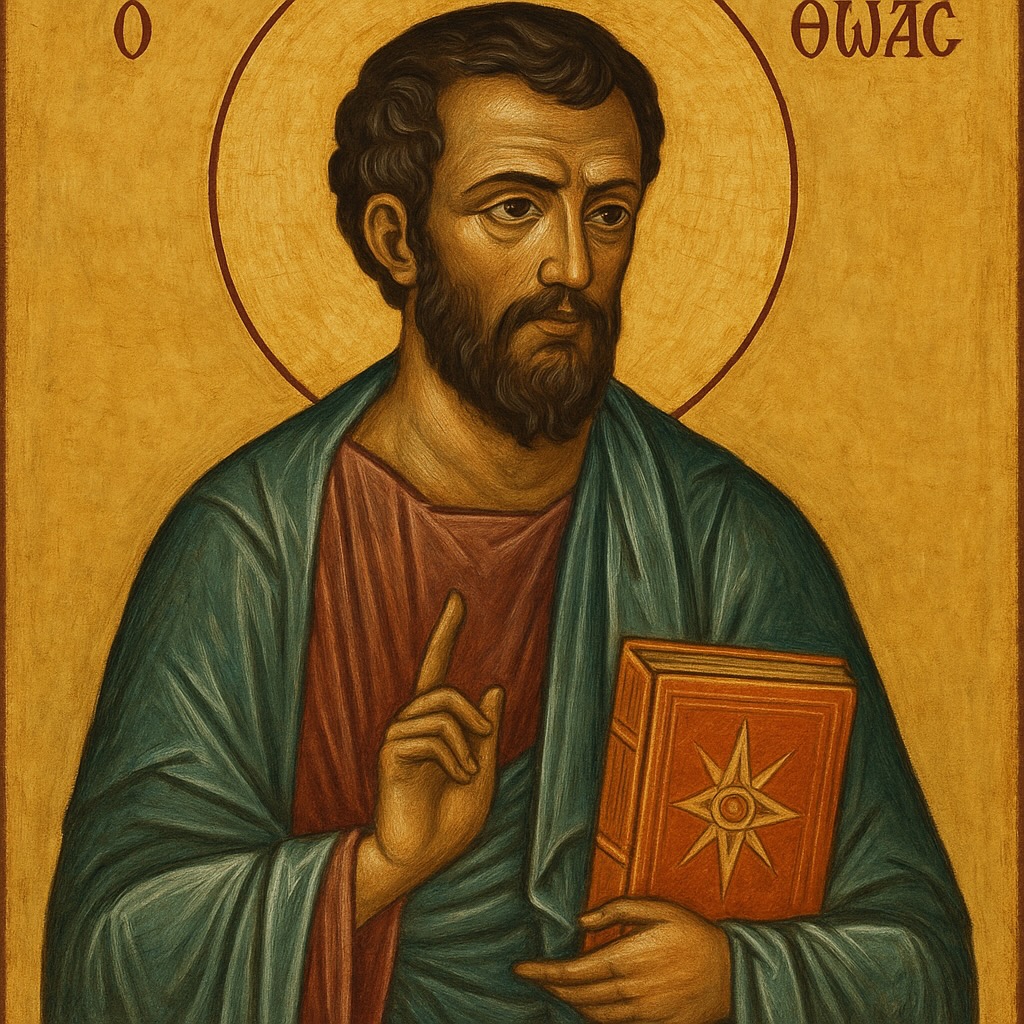
Feast of St Thomas
St Thomas’ Church, North Ipswich
6 July 2025
Last weekend and this weekend we have had two special Sundays:
Last Sunday we celebrated one of the major feasts for Saint Paul
This week we celebrate the feast of St Thomas.
These two festivals offer liturgical book ends as we wrap up our first six months together as the Ipswich Anglican Community—the new Parish of Ipswich—with our twin churches of St Paul and St Thomas.
This double celebration is an opportunity to reflect, affirm, celebrate and re-imagine.
Last week I invited people to focus on what the legacy of Paul might mean for Ipswich Anglicans.
This week we focus on the legacy of Thomas.
Today we are thinking about the legacy of Thomas, and what spiritual wisdom we might draw from his legacy.
Unlike Paul, Thomas is not a major character in the New Testament.
Where Paul looms large across the NT, Thomas features in just a handful of verses in the Gospel of John. In the other Gospels and in the Acts of the Apostles, Thomas is just a name in a list of 12 men; most of whom we know nothing about.
But in the Gospel of John we find more interest in this otherwise mysterious character.
Let’s think about Thomas under three categories: the historical Thomas, the canonical Thomas, and the legendary Thomas.
There is not much to see here. We know almost nothing about this character, and even his name is uncertain.
“Thomas” seems to be a Greek rendering of the Aramaic word tĕʾomâ, meaning “twin.” In the NT, he is often identified as “Thomas called the twin.” However, that final label is simply the Greek word for “twin,” didymos.
In the first-century Gospel of Thomas, our saint is identified as “Didymos Judas Thomas” [GThom 1:1], and some scholars suggest his actual name may have been Jude or even Judas.
In any case, we are never told whose twin this person was as his brother or sister is never identified in the New Testament.
We know nothing about his life before meeting Jesus, of his role within the community of disciples, nor what he did after Easter. Nothing beyond the simple fact that he was part of the Galilean set of followers with Jesus from the beginning.
The canonical Thomas
Within the NT, and especially in the Gospel of John, the character of Thomas is rather more developed, but we have no reason to take these developments as historical. They may simply reflect the prominence of Thomas in some circles of the early Jesus movement, and perhaps even represent an attempt to reduce the influence of Thomas in favour of John.
Jesus and Lazarus (John 11:11-16)
After saying this, he told them, “Our friend Lazarus has fallen asleep, but I am going there to awaken him.” The disciples said to him, “Lord, if he has fallen asleep, he will be all right.” Jesus, however, had been speaking about his death, but they thought that he was referring merely to sleep. Then Jesus told them plainly, “Lazarus is dead. For your sake I am glad I was not there, so that you may believe. But let us go to him.” Thomas, who was called the Twin, said to his fellow disciples, “Let us also go, that we may die with him.”
Thomas Questions Jesus (John 14:1-7)
“Do not let your hearts be troubled. Believe in God, believe also in me. In my Father’s house there are many dwelling places. If it were not so, would I have told you that I go to prepare a place for you? And if I go and prepare a place for you, I will come again and will take you to myself, so that where I am, there you may be also. And you know the way to the place where I am going.” Thomas said to him, “Lord, we do not know where you are going. How can we know the way?” Jesus said to him, “I am the way, and the truth, and the life. No one comes to the Father except through me. If you know me, you will know my Father also. From now on you do know him and have seen him.”
Thomas and the Resurrection (John 20:24-29)
But Thomas (who was called the Twin), one of the twelve, was not with them when Jesus came. So the other disciples told him, “We have seen the Lord.” But he said to them, “Unless I see the mark of the nails in his hands, and put my finger in the mark of the nails and my hand in his side, I will not believe.”
A week later his disciples were again in the house, and Thomas was with them. Although the doors were shut, Jesus came and stood among them and said, “Peace be with you.” Then he said to Thomas, “Put your finger here and see my hands. Reach out your hand and put it in my side. Do not doubt but believe.” Thomas answered him, “My Lord and my God!” Jesus said to him, “Have you believed because you have seen me? Blessed are those who have not seen and yet have come to believe.”
Thomas as fisher (John 21:1-3)
After these things Jesus showed himself again to the disciples by the Sea of Tiberias; and he showed himself in this way. Gathered there together were Simon Peter, Thomas called the Twin, Nathanael of Cana in Galilee, the sons of Zebedee, and two others of his disciples. Simon Peter said to them, “I am going fishing.” They said to him, “We will go with you.” They went out and got into the boat, but that night they caught nothing.
The best known of those 4 Thomas texts in the Gospel of John is the “doubting Thomas” episode, but the text we actually hear more often is the paragraph from John 14 as it is often read at funerals.
The legendary Thomas
Outside the New Testament, the character of Thomas is very important in the Gospel of Thomas and the Acts of Thomas.
The Gospel of Thomas is a collection of 114 sayings attributed to Jesus, some of which seem to go back to the time of Jesus himself while others may date some 100 years after the time of Jesus.
This document was lost for almost 2,000 years but recovered accidentally among the Egyptian Nag Hammadi document trove in 1945.
This text was valued back then—and is valued now—by people more interested in the spiritual wisdom of Jesus than in the events of his life. There are no miracles in the GThomas and no mention of Jesus’ death and resurrection.
This esoteric tradition was attached to the name of Thomas.
The Acts of Thomas is a collection of adventures, supposedly by Thomas, as he travels to India to proclaim the Gospel there. It most likely dates from around 250 CE, although all the surviving copies are somewhat later. This document reflects the spirituality of the Syrian Christianity, which highly valued the ascetic tradition of the monastic orders.
The legacy of St Thomas for Ipswich Anglicans
Thomas invites us to think outside of the box.
We see this even in that most familiar of Thomas stories, the doubting Thomas episode.
All of the disciples were hiding in a locked room for fear of the Jewish authorities. But not Thomas. He is not in the secret hiding place. He is outside. Mixing with people. Going about his everyday tasks. We might think of him as doubting Thomas, but he was certainly not a fearful follower.
Was he even doubting? I prefer to think of Thomas as having his eyes wide open. No fairy tales for him. Just as the other male disciples had not believed the women with their fantastic tales about seeing Jesus alive when they went to the tomb, so Thomas not going to believe the other guys when they shared their equally fantastic tale about having seen the Lord. No second-hand religion for him. He wants to know directly. For himself. And he is not afraid to ask questions which could make him unpopular.
Yet Thomas is still part of the community—even with his questions. He was not ostracised. Equally, he did not cut himself off from the others. He was still with them a week later when Jesus again appears to the more fearful disciples hiding in the secret room.
Thomas part of a community that tolerated difference, and even held within its life people who did not just go along with the flow. They had created a community where everyone did not need to think the same, and a community where it was safe to ask questions and express doubts.
Do any of us want to be in a church where it is not safe to ask questions?
Perhaps, most of all, Thomas calls us to authenticity.
Be our true selves.
But keep the community intact.
May God give us the grace to be authentic, courageous, honest and with a faith that is truly grounded in our own experience of God in Christ.
Do leave a reply. I always appreciate hearing from my readers/