
Feast of St Mark
St Paul’s Church, Ipswich
27 April 2025
[ video ]
Today we celebrate the legacy of John Mark, better known to us Saint Mark.
He is remembered in the thousands of churches, hospitals, health clinics, schools and colleges named after him: from the Basilica of St Mark in Venice to St Marks National Theological Centre in Canberra, and from St Mark’s Anglican Church in Warwick to the Coptic Cathedral Church of St Mark in Cairo (Egypt).
Most famously of all, Mark is remembered each we open the New Testament see that the four Gospels are named: Matthew, Mark, Luke and John.
We read from the Gospel according to Saint Mark just now.
I wonder how closely you were listening to the Gospel as I read it for you.
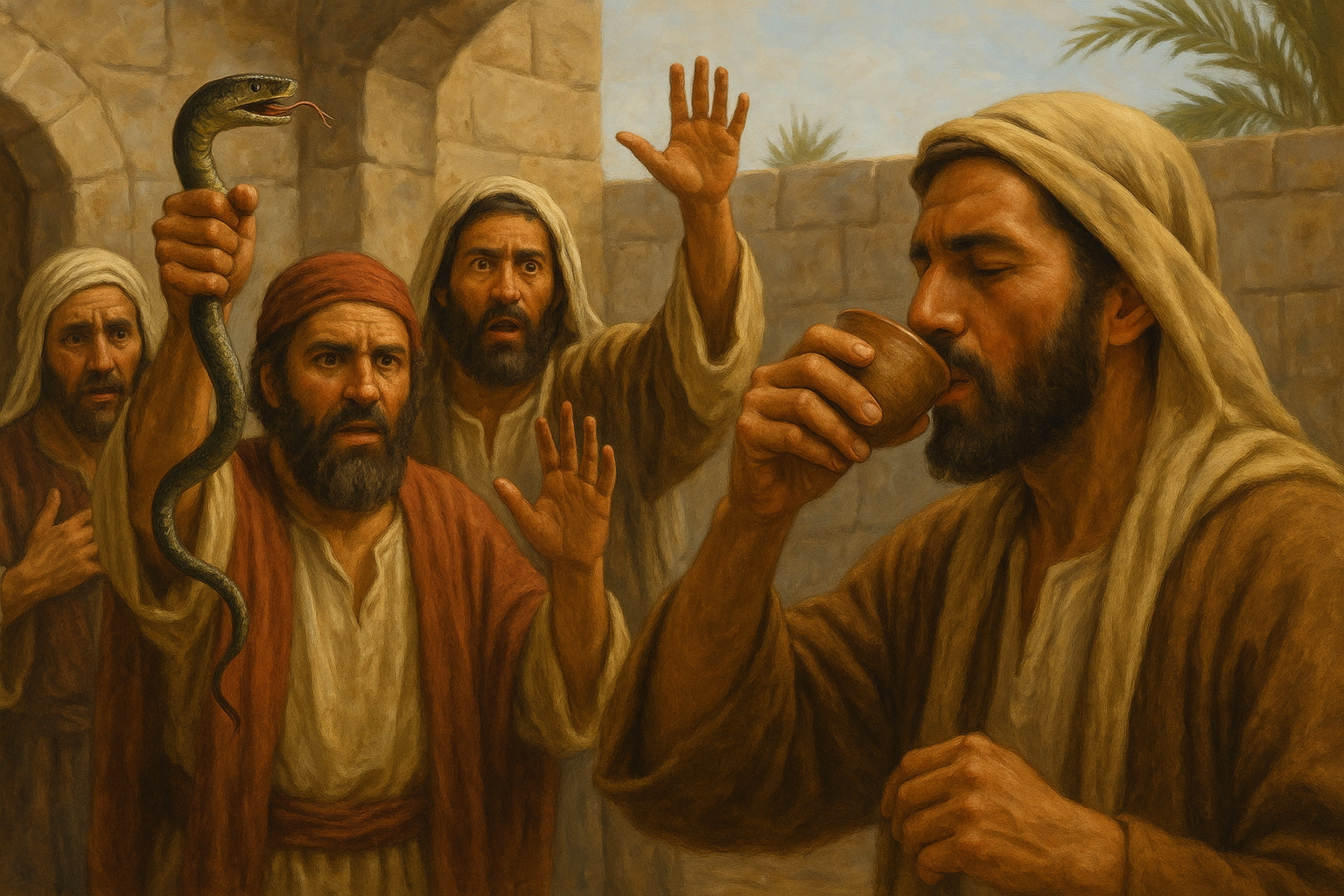
For the first time ever, I am kind of hoping that you were NOT listening very closely as that was kind of a weird passage that we heard.
It is also kind of weird for me to say that I hoped you were not listening when I went to all the trouble to draw your attention to the Gospel today.
We carried to Gospel book down into the middle of the church, as we always do. We had candles and a cross. We sang special music as I carried the Gospel book. And everyone stood up to listen to the words that I was reading.
It was just like every other Sunday; except this time, I was kind of hoping no-one was really paying attention.
Why is that?
Well, it is a little bit complicated, but it is also kind of interesting. At least, I hope so.
And maybe there is also an important lesson about how we listen to the Bible and how we find our way in the sometimes-ambivalent world of the church.
The story starts in the final decades of the first century.
In the year 70 CE the Roman armies captured Jerusalem after a 4-year rebellion by the Jews. They burnt the temple and destroyed the whole city. The war did not end immediately, but after another 4 years the Romans had defeated every stronghold of the rebels, including the famous desert fortress of Masada.
At some stage during the 15 or 20 years after the Roman victory, someone created the first written story about Jesus. We call that document, The Gospel according to Mark.
It was the first of the Gospels to be written, so far as we can tell.
Even when other gospels were written and between them preserved almost everything that we have in the little Gospel of Mark while adding extra material, for some reason the early church kept Mark in the NT alongside Matthew, Luke and John.
But there is another twist to this story.
The final page of the Gospel of Mark is missing.
We have thousands of handwritten copies of the New Testament, including quite a number relating to Mark. Almost all of them include the words that I read earlier, but the oldest and “better” copies of Mark do not have those extra words.
We can say with confidence that the material I just read was not originally part of the Gospel according to Mark.
On the other hand, for almost every Christian between about 400 and 1950 these words were in their copy of the Bible, even though almost everyone agrees now that they were not written by Mark.
It feels odd to discard these words after more than 1,500 years, but it is important that we listen to the original version of the Bible so far as we can.
These words seemed to have been composed to “fix” the problem of Mark not having a “proper” ending.
This seems to have happened between 150 and 250 CE.
The good news: poison drinks and venomous snakes are part of our church activities. Phew!
The bad news: we need to switch on our brains when we read or listen to the Bible.
Actually, that is not just true for the Bible. It also applies to prayers, liturgies, hymns, songs and sermons.
And that brings us around to the question of discipleship and faith formation.
These children we have baptised this morning, along with Annabelle who we baptised last Sunday and Carter who I will baptise at 10.30 today, are learning how to be followers of Jesus.
They learn to do that by participating in the life of the church, including our use of the Bible, the prayers we say, the songs we sing, the sermons we hear and the actions we undertake together in the wider community. For example, the food ministry each Sunday afternoon.
All of those things together—along with the personal witness of the Spirit of God within us—teach us how to be followers of Jesus.
But—get this point, for it is very important—none of them are perfect.
Sometimes things are said or done or explained in ways that are not fully in keeping with the Spirit of Jesus. Even our capacity to listen well to the voice of the Spirit is distorted at times.
That is why we need to develop the skills of discernment, and to practice those skills with our fellow disciples.
Rather than say, “This is what Jesus wants us to do …” it is better for us to ask, “What do you think Jesus is asking us to do …?”
Teaching that capacity for discernment is the most important thing that parents and godparents can do for the children in their care, and it is also the most important thing we can teach adult converts as well.
“Have we got the correct answer?” is not as important as asking “How do I discern what Jesus is asking me to do?”
Learning to ask the right question is more important than having the correct answer.
When we do that, we also discover that Jesus does not want us drinking cups of poison or handling venomous snakes!
Thanks be to God!
Do leave a reply. I always appreciate hearing from my readers/Cancel reply