
[ video ]
Season of Holy Women 3
Ipswich Anglican Community
3 August 2025
It has been quite a journey since that first Sunday in May last year.
In my sermon that day, I reflected on the question: Are we there yet?
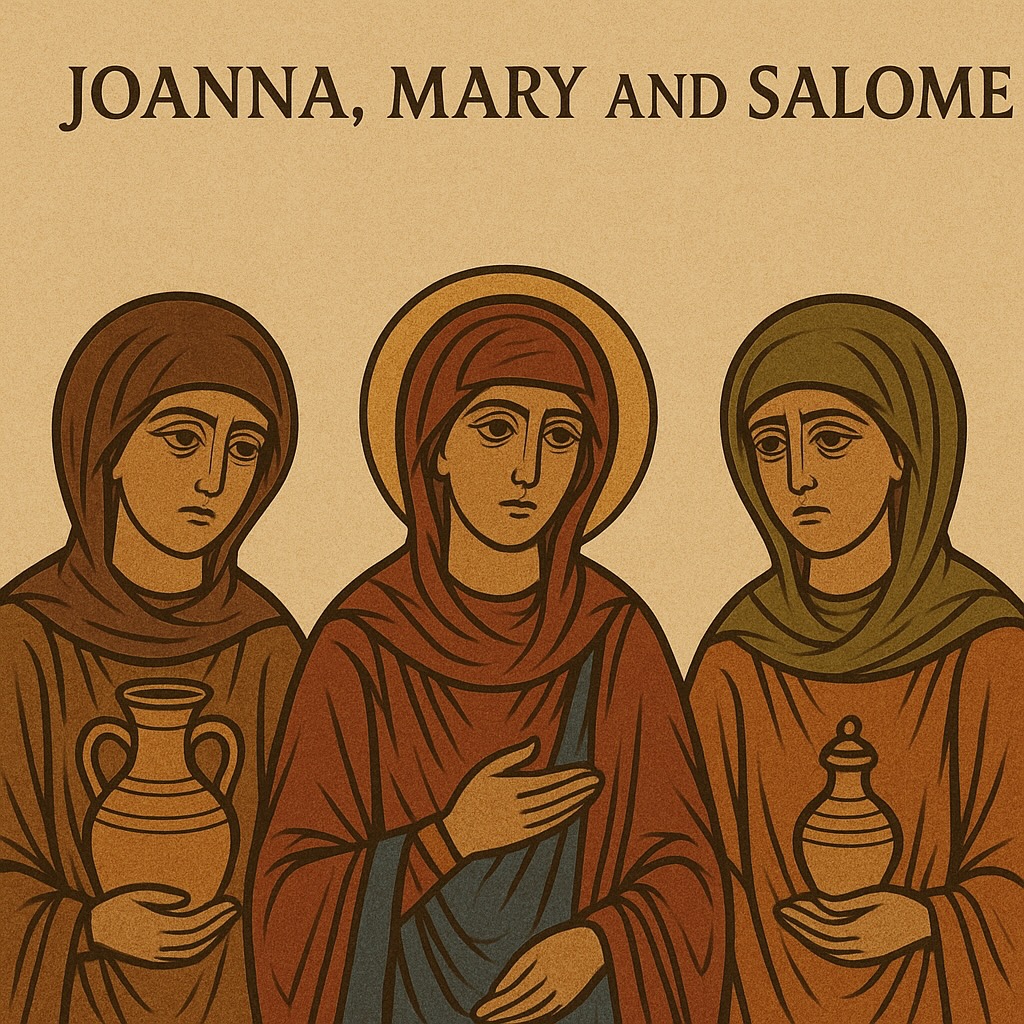
Perhaps that was a question the women asked themselves as they made their way through the city streets of Roman Jerusalem in the darkness of the early morning. They were heading for the place where Jesus had been hastily laid to rest—not yet buried, but at least laid inside the chamber of the rock tomb—on Friday evening.
The question we were pondering last year year was whether we were yet at that time when God would begin something new here in the Ipswich Anglican community?
The question that they did now even know how to ask, was whether this was the time for God to do something new in human history?
It did not occur to them that this was even a possibility. They were simply coming to the tomb to complete the burial process for their friend and master. They had no expectations of a whole new beginning.
In May last year, we said the time was not yet.
But today we can say, the time is now.
We are about to see the beginning of a whole new phase of mission and ministry within and by the Ipswich Anglican community.
The time has come.
The new beginning is about to unfold.
As we reflect on this place of grace where we stand this morning, my thoughts are mostly shaped by the reading from Colossians.
So if you have been raised with Christ, seek the things that are above, where Christ is, seated at the right hand of God. Set your minds on things that are above, not on things that are on earth, for you have died, and your life is hidden with Christ in God. When Christ who is your life is revealed, then you also will be revealed with him in glory. Do not lie to one another, seeing that you have stripped off the old self with its practices and have clothed yourselves with the new self, which is being renewed in knowledge according to the image of its creator. In that renewal there is no longer Greek and Jew, circumcised and uncircumcised, barbarian, Scythian, slave and free; but Christ is all and in all!
As I have reflected on that passage during the past week, I find myself noting how this passage plays with same key themes found in the great summary of faith that Paul offers at the end of 1 Corinthians 13:
And now faith, hope, and love remain, these three,
and the greatest of these is love.
So let’s take each of those three elements in turn.
Faith
We are people of faith, but the faith that matters most is not our own faith but that faith which Jesus himself demonstrated towards God.
Jesus lived and died as one comprehensive and consistent act of faith. He trusted God to death and beyond.
Easter is God’s response to the faith—or the faithfulness—of Jesus.
Paul tells us in Galatians and in Romans, that just as Abraham’s faith was the basis for God blessing the Jewish people, so the faithfulness of Jesus is the basis for God blessing all of us.
All of us.
And not just us.
Rather, everyone.
That is profoundly good news, and it takes us way beyond arguing over beliefs and doctrines.
Faith is about trusting that God has this: whether that be the future of the world, or our own personal situation. We are in God’s hands, and all is well.
That is faith.
It is not about having a formula—a set of words—that meets some theological correctness test, but living with an attitude that trusts God for now and for tomorrow.
This is the kind of trust we see in the Lord’s Prayer: give us today our daily bread.
We seek to live that faith and share that faith, as we shape a community of loving practice here in the heart of Ipswich.
Unless we live it we cannot share it
The first challenge, then—as we move into the new future God has for us—is to be people of faith.
Hope
That faith will be expressed in our hope and in our love, but let’s think next about hope.
How do we unpack the concept of hope?
May I suggest that it means the opposite of fear. If we are afraid we shall not be exercising hope. Fear will limit our imagination and harden our responses to one another.
Fear erodes hope and taints the wellsprings of compassion.
Fear makes us hold tightly to what we have left, rather than share the little we have with those need it.
We see a lot of fear in the wider world and in Australian society. And we see the way fear causes people to fight one another and attack those who threaten their sense of safety.
Fear can galvanise people to act (and to vote), but it is never the basis for a healthy and secure future.
On the other hand, when hope drives out fear, we are free to take risks and to love one another extravagantly.
Not cautiously.
Not in a very Anglican (careful) way.
But extravagantly!
As God begins something new here amongst us, we need to be people of hope, who are not afraid about the future, and are comfortable taking risks.
Love
In the Colossians passage, Paul tells his readers not to lie to one another.
I take that to mean more than simply speaking the truth to one another, although it certainly begins there.
No power games!
Be authentic.
This is simply a continuation of the message we had in the Epistle last Sunday:
Let love be genuine; hate what is evil, hold fast to what is good; love one another with mutual affection; outdo one another in showing honour. Do not lag in zeal, be ardent in spirit, serve the Lord. Rejoice in hope, be patient in suffering, persevere in prayer. Contribute to the needs of the saints; extend hospitality to strangers.
That is what love looks like.
That is how this Ipswich Anglican community will look as God begins her new work amongst us.
If we are to be a blessing to the city of Ipswich, then first of all we need to a community of loving practice.
Our love for each other—and for anyone and everyone who crosses our path—has to be genuine.
We—you—are standing at the threshold of something new.
May you be people of faith, people of hope and a community of love.
Do leave a reply. I always appreciate hearing from my readers/Cancel reply