Pentecost 7B / NAIDOC Sunday
St Paul’s Church, Ipswich
7 July 2024
[ video ]
In today’s sermon I want to invite you to join me in a reflection that seeks to intertwine a story of Jesus going back home to Nazareth—described simply as his “hometown”—with our sense of belonging to the places we call home, and with the deep spiritual connection of the Indigenous people of this ancient land to their own country.
In other words, in the quest for spiritual wisdom to help us shape lives that are holy and true, I am looking at the ways that Scripture and context interact.
That context, for us, includes today being NAIDOC Sunday as well as our own sense of being local, people with roots in the place where we belong.
Nazareth
Nazareth is not named in this episode from Mark’s Gospel, but it is clear from the wider narrative that Mark is speaking of Nazareth and not Bethlehem.
Whatever historical value you place on the tradition of Jesus being born in Bethlehem, it is clear that Nazareth was his hometown, his mother’s country, as we might learn to say if we could just listen to our First Nations people.
This is not the time for me to give one of my favourite lectures, on Nazareth in the first century. You can watch one of the videos of me doing exactly that (here is one example), but we are not here for a biblical geography class.
We want wisdom for everyday life, not information about the past.
Suffice to say that Nazareth was a small village in the time of Jesus, with perhaps just 15 or so families.
It was off the beaten track, although within sight of Sepphoris, a small city recently rebuilt by Herod Antipas after having been destroyed by the Roman army after its citizens rebelled following the death of Herod the Great. As part of that devastation the Romans had crucified a Jewish rebel every mile along the highway leading to Sepphoris.
So, part of Jesus being in his own country, on his own land, was to know firsthand what happened to people who rebelled against the Roman empire.
The empire always strikes back, as the people of Gaza know all too well.
He comes to his hometown and joins the other menfolk when they gather for Sabbath prayers. The village was probably too small for a synagogue structure to have been built yet, but the faithful will have met for prayers with 10 men required for a quorum (minyan in Hebrew). This regular gathering of the adult menfolk will have been part religious ceremony and part village council.
They recognise Jesus as one of them. Of course they did. There were fewer than 200 people in the village at the time and most of them would have been children.
Jesus came home, but there was no welcome for him in his own village.
In response, Jesus utters an aphorism that is one the very few pieces of tradition found in all four gospels within the NT:
Prophets are not without honour, except in their hometown, and among their own kin, and in their own house.(Mark 6:4 NRSV)
Our hometown, our own kinship circle
In many ways, Nazareth is the place my heart calls home.
But Nazareth is not my hometown, nor is it my mother’s country.
My mother’s country is the rich red volcanic soil around Lismore, with what we used to call the north arm of Richmond River cutting through the city and the Nightcap Range creating my familiar childhood horizon in the distance.
That part of the Richmond River has since been renamed the Wilsons River, to celebrate the first colonial station owner when that land was stolen from the Bundjalung Nation by British settlers in the 1840s.
I hope that someday soon we shall rename that river yet again and give it a name that reflects the ancient association of this river with the Widjabul people for whom it is a sacred river and an old friend.
Although most of my life has been spent away from my country, that is where my soul is anchored.
It was a great delight to serve as the locum priest for the Anglican community in Lismore last year. It was just a year after the massive floods that devastated the community in 2022, but to be back home was a special privilege.
I wonder where is your mother’s country?
Perhaps it is here in Ipswich, within the ancient lands of the Yaggera people?
Perhaps, like me, your mother’s country is somewhere else, but now we all live on Yaggera country.
How do we name, honour and respect our mother’s country and the places where we were born?
Always was, always will be …
Underneath our buildings, roads and concrete pavements is the sacred soil of the Yaggera nation.
We breath their air, we drink their water, and we enjoy their trees and we admire their mountains.
It always was and always will be Aboriginal land.
Our ancestors did not seek permission to settle on their land, cut down their forests and pollute their streams.
They simply stole everything.
Then they took away their dignity and their hope as well.
There is much for which we say sorry and much for us to learn from the dark-skinned prophets of this place about living well on this sacred land.
As an Anglican faith community whose members are either recent immigrants or the descendants of immigrants during the past 175 years, we have mostly been blind to the dignity of the people whose home this has always been; and blind to their suffering.
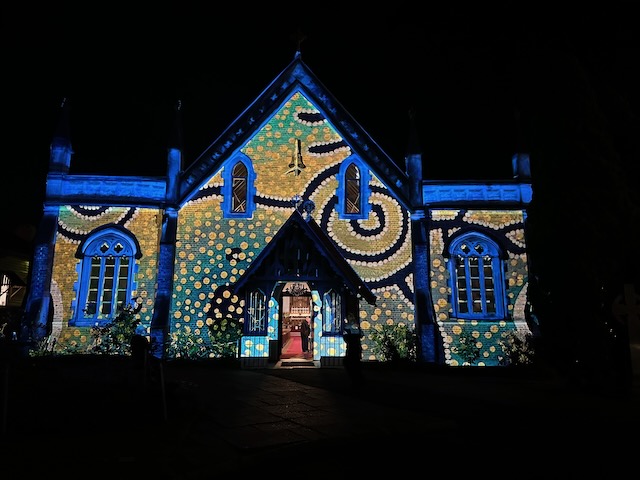
These past few nights our church walls have been awash with the vivid colours of Indigenous artwork.
May our hearts also be awash with profound respect for the people for whom this country has always been home.
And may that respect inspire us to listen to their voice, to embrace the statement from the heart, and to engage in the hard work of reconciliation and justice for everyone who now calls this ancient land home.
Do leave a reply. I always appreciate hearing from my readers/Cancel reply