Author: Gregory C. Jenks

  • a picnic at the heart of the universe

    a picnic at the heart of the universe

    Pentecost 13B
    St Paul’s Church, Ipswich
    18 August 2024

    [ video ]

    At the heart of every faith community there is a symbol of the good life, or perhaps the struggle to overcome evil.

    Sometimes there are multiple symbols.

    These symbols capture almost without words the essence of our faith.

    For some Christians, the ultimate symbol of our faith is the cross. It certainly represents a distinctive and unique aspect of our faith, and is easily recognised as the de facto “trademark” of Christianity. It has parallels in Judaism and Islam, with their symbols of the star of David and the crescent (sometimes with a star).

    However, for me as an Anglican, the central symbol is the Table of Jesus; that Table where Jesus is both the host and the menu. The Table—the Altar—is the most prominent and central feature of our church space.

    I wonder which symbols speak most powerfully to you and your faith?

    In churches where the Table takes precedence over the pulpit or the organ, we are being reminded each time we step inside the church that God has called us to a place at the Table, at God’s Table.

    In this understanding of faith, there is a picnic at the very heart of the universe.

    Indeed, the whole point of the cosmos is God inviting us to claim our place at the Table

    In the ancient book of Proverbs we read these words:

    Wisdom has built her house, she has hewn her seven pillars.  She has slaughtered her animals, she has mixed her wine, she has also set her table.  She has sent out her servant girls, she calls from the highest places in the town, “You that are simple, turn in here!” To those without sense she says, “Come, eat of my bread and drink of the wine I have mixed. Lay aside immaturity, and live, and walk in the way of insight.”[Proverbs 9:1-6 NRSV]

    The prophet Isaiah imagined God inviting people to a magnificent feast:

    Ho, everyone who thirsts, come to the waters; and you that have no money, come, buy and eat! Come, buy wine and milk without money and without price. Why do you spend your money for that which is not bread, and your labour for that which does not satisfy? Listen carefully to me, and eat what is good, and delight yourselves in rich food. Incline your ear, and come to me; listen, so that you may live. [Isaiah 55:1-3 NRSV]

    In today’s Gospel we hear Jesus—the wisdom of God in human form—inviting people to the meal where he is both host and menu:

    Jesus said to them, “I am the bread of life. Whoever comes to me will never be hungry, and whoever believes in me will never be thirsty.

    I am the living bread that came down from heaven. Whoever eats of this bread will live forever; and the bread that I will give for the life of the world is my flesh.”

    Those who eat my flesh and drink my blood have eternal life, and I will raise them up on the last day; for my flesh is true food and my blood is true drink. This is the bread that came down from heaven, not like that which your ancestors ate, and they died. But the one who eats this bread will live forever.” 
    [John 6:35, 51, 54-55, 58 NRSV]

    To imagine God as setting a table and inviting us to come and eat together, is to see the world through the eyes of Jesus.

    In the time of Jesus, there were strict boundaries around meal customs. Purity rules once designed for the temple in Jerusalem were increasingly applied to everyday life out in the villages.

    Jesus broke the rules.

    He ate and drank with anyone and everyone.

    The shared meal—the open table—was at the very heart of his mission. It was both his message and his program.

    He gathered people for meals and in those gatherings around a shared table they discovered forgiveness, healing and new wisdom for everyday life.

    The rich and powerful hated it, and they hated him.

    Indeed, they killed him because of his radical idea that God was closest when we sit around a table with strangers, rather than when the High Priest offers a lamb in the temple.

    So we come to the table of Jesus here today.

    It is Jesus who invites us.

    The bread we break and the cup we share is a communion in the essence of Jesus. We are fed with his life, we are shaped by his wisdom, we are renewed by his love, we are strengthened by his faithfulness.

    As we prepare to reach out our hands to receive the Bread of Life, we say this line from the prayer that Jesus himself gave us:

    Give us today our daily bread …

    Yes, Lord, give us that bread.

    One day at a time—one step at a time—grant us the wisdom, the courage and the grace to be authentic followers of Jesus. 

    That is the blessing we seek as we come to the Table of Jesus.

  • How to kill a church

    Pentecost 12B
    St Paul’s Church, Ipswich
    11 August 2024

    The theme sentence for our liturgy today came from the Epistle to the Ephesians. You can find it at the very top of page 2 of the service booklet:

    Be imitators of God, as beloved children,
    and live in love,
    as Christ loved us and gave himself up for us.

    As the Old Testament reading grinds its way through the troubles besetting the dynasty of David, and as the Gospel offers yet another reflection on the metaphor of Jesus as bread from heaven for a hungry world, I want us to pause and think about this direct and simple piece of spiritual wisdom from the Pauline tradition.

    If you flick over to page 5 of the service booklet you can see that the Christian community in Ephesus at the time of this letter must have been quite an interesting bunch of people.

    We do not even have to read between the lines.

    It is there in plain sight.

    They were known for speaking falsely to one another. No one could trust anything that the church people said to them because they were inclined to misrepresent the truth.

    They were inclined to get angry with each other. That was not such a big deal, but they held grudges and then the power of evil was set loose among them. It seems there is nothing wrong with having strong opinions and even expressing them forcefully, but all that needs to have a sunset clause. Literally, when the sun goes down, draw a line under the arguments and start afresh next day,

    Some of them were known to be thieves. Seriously! It seems they had not yet given up their stealing, but they are told the time to do so has arrived. For them repentance included a change of lifestyle and a new focus on assisting the needy, rather than nicking stuff from the rich.

    Then there was the gossip. What? In a church? Need we ask! Loose lips do not just sink ships. They also damage people and destroy churches. Our words are to be acts of grace for those who hear us, rather than spiritual poison that seeps from one soul to another.

    They were to embrace a new set of values: instead of bitterness, wrath, anger, wrangling, slander and malice (what a fun church they must have been), they were to be kind to one another, tender-hearted and forgiving one another.

    That is quite a turn around. A real conversion!

    Yet these are the people to whom our theme sentence today is addressed. These are the people—liars, cantankerous, and corrupt gossips—who are addressed as “beloved children” and called to live together in love.

    It seems that God does indeed think more highly of us than we deserve!

    In their life together they were to reflect what we see in God and what we see in Jesus: selfless love.

    Had I recently seen a huge argument in this church, or experienced grudges being held long after the sun had set, then this would be a really tough sermon to give.

    Maybe I have just not been here long enough yet?

    No matter how good or bad things may have been in the past, the call for conversion and a fresh start is very clear in today’s reading.

    If we want to kill this parish, today’s reading gives us a checklist of nasty attributes to unleash. That spiritual poison will kill this place dead.

    If we want to renew and refresh this parish as we wait for our new priest being appointed, then today’s reading is also very clear.

    What reputation do we want this faith community to have around town?

    It is ours to create and ours to destroy.

    Have we earned a reputation as genuine people who care for each other and look out for the needy?

    Are we building a church where others can say: These people act like Jesus!

    As today’s theme sentence says:

    Be imitators of God, as beloved children,
    and live in love,
    as Christ loved us and gave himself up for us.

  • Why bother with the Bible

    After presenting a webinar on “Reclaiming the Bible for Progressive Christians” for the Progressive Christian Network of Victoria recently, I was asked a few additional questions by email. Those questions and my responses to them may be of wider interest.


    As you questioned why anyone should want a Bible for a child it can be assumed you are not recommending biblical content for children.

    My question concerned why anyone would want to give a Bible to a child, which is not quite the same thing as ensuring that children have some familiarity with the key biblical stories and characters. We want them to have some basic biblical literacy, but the Bible is an adult book and represents rather complex hermeneutical challenges when used in a very different culture far removed by time and geography from its origins.

    As a parallel, we can assume that people such as Jesus were familiar with the stories from the Hebrew Bible (not least because the names of his siblings are all drawn from the Torah, suggesting a family with some knowledge of and commitment to the story). Yet people such as Jesus and his family were most likely illiterate and—since they were not in the social elite—would not have had the resources to acquire and study a copy of the Torah. 

    This is a tough nut to crack, as Christian educators know very well. Simplified versions of key biblical texts are surely part of the spiritual repertoire of children within a family that practises its faith. But encouraging children to read the Bible itself, seems (to me) to be rather inappropriate. Of course we can also use art, drama and music to convey the essential <?> biblical content without expecting kids to read a Bible.

    And who reads a book these days, in any case?

    Surely the move to digital texts will impact how everyone engages with the Bible? (But that is a different topic.)


    You were commendatory about the Lectionary because it removed selection of preaching focus from a worship leader in favour of the presented content of the lectionary. The question is: Why privilege 20 to 30 year old writings (with many assumptions peculiar in light of science and modern thought generally) above a well informed and qualified contemporary worship leader? 

    I am simply not as negative towards the lectionary, in any of its forms, as you seem to be.

    We are not reading the lectionary, we are using the lectionary as a map to read selected portions of the Bible week by week in the gathered assembly of the faithful. I would not describe the RCL as “20 to 30 years old writings” (in fact it is more like 50 years old now), as everyone uses some filtering system. Not even the most fundamentalist preacher reads the whole of the Bible from Genesis through to Revelation week after week. Everyone makes selections. The RCL is reliable ecumenical example. For me, ecuemncial is always better than denominational, and denominational is always better than individual minister.

    I am not so sure that we have that many “well-informed and qualified contemporary worship leaders” around these days. Your comments possibly reflect a UCA context, but Anglicans and Catholics tend to follow the order for the Eucharist with the CL/RCL readings. The art of leading people in worship, for me, is not creating new content but using traditional content creatively in the quest for spiritual wisdom. In the liturgical tradition of the Great Church, a lectionary is simply part of the liturgical landscape. I realise that is a different universe from what used to be called the Free Churches, let alone the wannabe megachurch startups. 

    Maybe your disinclination for any lectionary other than the pastor’s personal choice of texts, ultimately stems from a Methodist culture where neither Prayer Book nor Lectionary were highly valued? For me as an Anglican, I listen to the Church and I am happy to be guided in my menu of Bible readings by a lectionary. I prefer the RCL to the one-year cycle of BCP, but there has always been a system for reading the Bible. Even in the 1C, the synagogues seem to have had a lectionary of sorts as they read the Torah in 50+ portions and related those readings with a set of passages from the Prophets. Our oldest existing Bible, Codex Sinaiticus, is already marked up into portions for readings. That is a lectionary, in effect.

    For me the spiritual hierarchy is: Church > Prayer Book > Lectionary.

    I receive the lectionary as a gift from the church and as an invitation to listen to more of Scripture each week than I may otherwise have chosen to do.


    Continuing that question: What parts of the ancient biblical writings are sufficiently relevant to living today to feature as basic to being Christian? As church leaders have to make decisions about what to offer for the education of adolescents and adults, what are the priority parts of the Bible you recommend for church study/exploration programs?

    I think is an impossible question to answer. 

    All of Scripture is basic for Christianity, but various parts of Scripture are more relevant to different people and communities across time and in various contexts. What matters more to me is how we read the ancient texts, not which ancient text we should read. I suggest that we need to read them all, and engage with critical minds in every case. We are not looking for information, but for wisdom. That can be derived from a ghastly biblical passage just as much as from a beautiful passage.

    If there is to be a canon within the canon, which is more or else what your question implies, then for me it is the Gospel, and the Synoptic Gospels in particular. Most weeks my preaching is centred on the Gospel passage, with the OT and Epistles being viewed through the lens of Jesus. Occasionally I will focus on a non-Gospel reading, but I usually bringing it into some relationship with the wisdom of Jesus that we know from the Gospels.

    There are some biblical passages I would never read in worship and others that I can use only with an explicit disclaimer. Again, what is suitable for use in worship may be different from what is suitable for a Bible study group where we have more time to engage with the hermeneutical process, and that is different again from what we may do in a Biblical Studies class within the University.


    I hope these comments are helpful. They are not so much “answers” to questions, as—with hindsight—they seem more like reflections on the difference between the culture of the historic liturgical tradition and the Free Church tradition.

  • The Magdalene

    Feast of the Magdalene
    St Paul’s Church, Ipswich
    21 July 2024

    [ video ]

    This Sunday we celebrate the feast of Saint Mary Magdalene, perhaps better named as The Magdalene.

    As we reflect on this feast day and gather up fragments of wisdom for our own lives I want to suggest that we use three simple questions to go deeper in this sacred tradition.

    Q1: Why did Jesus give her the nickname, Magdalene/Tower?

    Mary was a very common name for Jewish girls in the time of Jesus. Half of the women at that time were named in honour of Miriam, (Mary), the sister of Moses. Like Miriam the sister of Moses, Mary the Magdalene was a woman who stood out from the crowd. Both Miriam and Mary were leaders whose status was no less than that of their brothers. 

    Miriam was a prophet and a powerful voice in the circle around Moses. Indeed, she is remembered as having saved his life when he was just an infant. 

    Migdal (“tower”) was a common name for villages across the holy land in biblical times, but Mary is never said to be “from Magdala.” Rather, “the Madgdalene” (meaning “the tower”) seems to have been a nickname given to Mary by Jesus, just as he gave similar pet names to Simon (“Peter/Rocky”) and to the sons of Zebedee (“Boanerges / sons of thunder”). 

    In some way or other, Mary stood out from the crowd. She was a tower among the disciples, just as Simon was the rock on which Jesus built his first community of disciples. The Magdalene was also the leader of the Jesus women, just as Miriam led the women in their dancing and singing when God saved the Israelites at the Red Sea.

    Most significantly, the Magdalene was the first disciple to whom Jesus appears after his resurrection. She is honoured as the Apostle to the Apostles, as Jesus sent her with the good news for her brothers.

    Q2: How did the early church with its male leadership treat Mary?

    Mary the Magdalene was a towering figure among the disciples of Jesus, although the male-dominated church that emerged after 100 years or so did not know what to do with this woman at the very heart of the apostolic community.

    She was silenced and sidelined. As many women have been by the male church over the 2,000 years between the Magdalene and us.

    Mary was overlooked and pushed aside as early as the time of Paul, just 20 years after Easter. Mary was never being included among the apostles let alone as one of the pillars of the early Jesus movement.

    She was written out of the story by the second and third-century church leaders (all males, of course). In some cases, texts with her name were changed to substitute a more pliable woman into the storyline.

    But when the Gospels came to be written after Paul, Peter, James and John were all dead and gone; memories of Mary remained.

    The Gospels were written after the authentic letters of Paul and what Mary had done was told “in remembrance of her,” just as Jesus had said.

    Truly I tell you, wherever the good news is proclaimed in the whole world, what she has done will be told in remembrance of her.” (Mark 14:9 NRSV)

    Eventually Pope Gregory I (590–604) determined that she had been a sex-worker before Jesus rescued her from a life of shame, except that in the Pope’s eyes the shame never quite got removed.

    Despite all that, Mary’s special festival survived in the English Book of Common Prayer. The Magdelene is honoured with colleges at both Cambridge and Oxford, and her legacy has survived among the Anglicans even when her festival was downgraded in Rome.

    Q3: What aspect of discipleship does she represent for us today?

    In the last few decades the Magdalene has returned to the spotlight as the church struggles to make sense of mission in a post-Christian world.

    Mary—the overlooked and despised woman—calls us back to the heart of our faith: our love for Jesus.

    Like Mary in Jesus Christ Superstar we often don’t know how love Jesus.

    Yet that is the one thing that actually matters.

    Not our carefully crafted creeds and volumes of church regulations. Not our buildings and charitable institutions. Not the size of our membership nor the eloquence of our preachers.

    All that matters is that we are disciples of Jesus.

    In that lies wisdom for today.


    For an earlier sermon on Mary Magdalene see: Mary the Tower (20 July 2019)

  • When God comes to church

    Beam of sunlight above the tomb of Christ at the Church of the Resurrection in Jerusalem.
    Photograph ©2015 Gregory C. Jenks

    Pentecost 8B
    St Paul’s Church, Ipswich
    14 July 2024

    [ video ]

    A couple of weeks ago we celebrated the joint feast of Saint Peter and Saint Paul.

    In my sermon for that day, I observed that Peter tends to be a witness to what Jesus was like, while Paul is a witness to the difference Jesus has made.

    I went on to say:

    We need both those voices, and—I suggest—we especially need the voice of Peter to keep Paul a little more grounded in reality.

    One of the fault lines in contemporary Christianity is between those who prefer to shape their lives around Jesus in the Gospels, and those who say that it is the voice of Paul which we most need to hear.

    Perhaps what we need most is to stay engaged with both those conversations.

    We need to be exploring the meaning of God in Christ, actively reconciling the world (kosmos) to himself (2 Cor 5:19). Without that edge, our faith becomes a historical society devoted to an interesting person from 2,000 years ago.

    Today we get an opportunity to think more directly about the difference Jesus has made. 

    In particular, I want us to think outside the box a wee bit about what we are doing here when we gather for worship.

    Two factors have suggested this focus for me today.

    First of all, as noted in the service booklet, today we begin a series of several weeks during which the second reading will be from the letter to the Ephesians.

    Ephesians is a very different kind of document from any of the Gospels, as the writer—almost certainly not Paul himself, but perhaps one of his students—is expressing himself in very poetic and even liturgical ways.

    Indeed, we use the opening verses of Ephesians as a canticle in the daily prayer service for Wednesday morning.

    So, the language and the subject matter of Ephesians 1 invites us to engage in worship and to reflect on what it means for us to gather for worship.

    The second factor that has motivated me to focus on these matters in the sermon today was a conversation that I had with a colleague at St Francis College on Friday morning. He was talking about the importance of asking questions when we are teaching a class, and to illustrate his point my colleague said, “What do we think happens when we worship? Who are the ones engaged in worship? Is it something we do as humans, or is God also involved when worship happens?”

    To express that question in very simple and direct terms: Does God go to church?

    As we prepare to reflect on that question—and seek fresh spiritual wisdom for our everyday lives—let me repeat a few lines from Ephesians:

    Blessed be the God and Father of our Lord Jesus Christ, who has blessed us in Christ with every spiritual blessing in the heavenly places, just as he chose us in Christ before the foundation of the world to be holy and blameless before him in love. He destined us for adoption as his children through Jesus Christ, according to the good pleasure of his will, to the praise of his glorious grace that he freely bestowed on us in the Beloved. 
    (Ephesians 1:3-6 NRSV)

    These poetic words sketch out the parameters of the change that God has made in and through Jesus.

    What once upon a time might have been the purpose of sacrifices on the altar of the temple in Jerusalem, has now become our lived experience as people “in Christ.” 

    In Christ God has blessed us already—right here and right now, in this life and not just in the life to come—with every spiritual blessing in the heavenly places.

    Surely that changes everything, and it also makes coming to church something very special.

    We do not come to church to earn these blessings.

    We come to church to take hold of these blessings and to develop the skills needed to live such a transformed life.

    We do not lose the blessings when we stay away from church, but we do lose the skills in living the blessed life. Our spiritual fitness declines if we do not come to the sacred gymnasium.

    But back to that interesting question posed by my colleague and boiled down to its essence in the words: Does God come to church?

    Or to ask it another way: What does God do during worship?

    For sure God is not basking in our expressions of thanks and praise. 

    My first (interim) answer to the question of whether God comes to church, is to say that God is indeed here.

    When we turn up for worship, God is here as well.

    Of course, God is everywhere; but there is something else happening when we gather for worship.

    God joins in.

    In the Old Testament, this was described as God coming to visit the people.

    Any time that God visited the covenant people, God had not just popped by for a chat. A visit from God—what we once called divine visitation—is always either to bless or to judge.

    Something always changes when God visits us.

    Even a visit for judging is a blessing, since the point of judging is to restore us back to relationship with God and set things right.

    Worship is more than a Bible class or a music session, it is an encounter with the living God, known to us in and through the Risen Lord.

    We are all familiar with the words that the priest says during the Great Thanksgiving Prayer:

    Therefore, with angels and archangels,
    and with all the company of heaven,
    we proclaim your great and glorious name …

    But those words only tell a part of the greater truth that is at the very heart of our worship.

    It is not just the company of heaven that joins us in our worship, but God as well!

    Surely the greatest of all the blessings bestowed on us in Christ is that God is here with us this morning.

    There is an ancient Hebrew word for this reality: Emmanuel = God with us.

    Imagine if we took that truth seriously.

    God is here.

    God is actively present.

    God is here making things whole.

    Making everything holy.

    God is answering our most familiar prayer:

    God’s name is being hallowed when we gather for worship.

    God kingdom is happening, right here and right now, as in heaven so on earth.

    Here in this place.

    Every Sunday.

    That is why God comes to church.

    I think it should be why we come to church as well.

  • Being on country

    Pentecost 7B / NAIDOC Sunday
    St Paul’s Church, Ipswich
    7 July 2024

    [ video ]

    In today’s sermon I want to invite you to join me in a reflection that seeks to intertwine a story of Jesus going back home to Nazareth—described simply as his “hometown”—with our sense of belonging to the places we call home, and with the deep spiritual connection of the Indigenous people of this ancient land to their own country.

    In other words, in the quest for spiritual wisdom to help us shape lives that are holy and true, I am looking at the ways that Scripture and context interact.

    That context, for us, includes today being NAIDOC Sunday as well as our own sense of being local, people with roots in the place where we belong.

    Nazareth

    Nazareth is not named in this episode from Mark’s Gospel, but it is clear from the wider narrative that Mark is speaking of Nazareth and not Bethlehem.

    Whatever historical value you place on the tradition of Jesus being born in Bethlehem, it is clear that Nazareth was his hometown, his mother’s country, as we might learn to say if we could just listen to our First Nations people.

    This is not the time for me to give one of my favourite lectures, on Nazareth in the first century. You can watch one of the videos of me doing exactly that (here is one example), but we are not here for a biblical geography class.

    We want wisdom for everyday life, not information about the past.

    Suffice to say that Nazareth was a small village in the time of Jesus, with perhaps just 15 or so families.

    It was off the beaten track, although within sight of Sepphoris, a small city recently rebuilt by Herod Antipas after having been destroyed by the Roman army after its citizens rebelled following the death of Herod the Great. As part of that devastation the Romans had crucified a Jewish rebel every mile along the highway leading to Sepphoris.

    So, part of Jesus being in his own country, on his own land, was to know firsthand what happened to people who rebelled against the Roman empire.

    The empire always strikes back, as the people of Gaza know all too well.

    He comes to his hometown and joins the other menfolk when they gather for Sabbath prayers. The village was probably too small for a synagogue structure to have been built yet, but the faithful will have met for prayers with 10 men required for a quorum (minyan in Hebrew). This regular gathering of the adult menfolk will have been part religious ceremony and part village council.

    They recognise Jesus as one of them. Of course they did. There were fewer than 200 people in the village at the time and most of them would have been children.

    Jesus came home, but there was no welcome for him in his own village.

    In response, Jesus utters an aphorism that is one the very few pieces of tradition found in all four gospels within the NT:

    Prophets are not without honour, except in their hometown, and among their own kin, and in their own house.(Mark 6:4 NRSV)

    Our hometown, our own kinship circle

    In many ways, Nazareth is the place my heart calls home.

    But Nazareth is not my hometown, nor is it my mother’s country. 

    My mother’s country is the rich red volcanic soil around Lismore, with what we used to call the north arm of Richmond River cutting through the city and the Nightcap Range creating my familiar childhood horizon in the distance.

    That part of the Richmond River has since been renamed the Wilsons River, to celebrate the first colonial station owner when that land was stolen from the Bundjalung Nation by British settlers in the 1840s.

    I hope that someday soon we shall rename that river yet again and give it a name that reflects the ancient association of this river with the Widjabul people for whom it is a sacred river and an old friend. 

    Although most of my life has been spent away from my country, that is where my soul is anchored. 

    It was a great delight to serve as the locum priest for the Anglican community in Lismore last year. It was just a year after the massive floods that devastated the community in 2022, but to be back home was a special privilege.

    I wonder where is your mother’s country?

    Perhaps it is here in Ipswich, within the ancient lands of the Yaggera people?

    Perhaps, like me, your mother’s country is somewhere else, but now we all live on Yaggera country.

    How do we name, honour and respect our mother’s country and the places where we were born?

    Always was, always will be …

    Underneath our buildings, roads and concrete pavements is the sacred soil of the Yaggera nation. 

    We breath their air, we drink their water, and we enjoy their trees and we admire their mountains.

    It always was and always will be Aboriginal land.

    Our ancestors did not seek permission to settle on their land, cut down their forests and pollute their streams.

    They simply stole everything. 

    Then they took away their dignity and their hope as well.

    There is much for which we say sorry and much for us to learn from the dark-skinned prophets of this place about living well on this sacred land.

    As an Anglican faith community whose members are either recent immigrants or the descendants of immigrants during the past 175 years, we have mostly been blind to the dignity of the people whose home this has always been; and blind to their suffering.

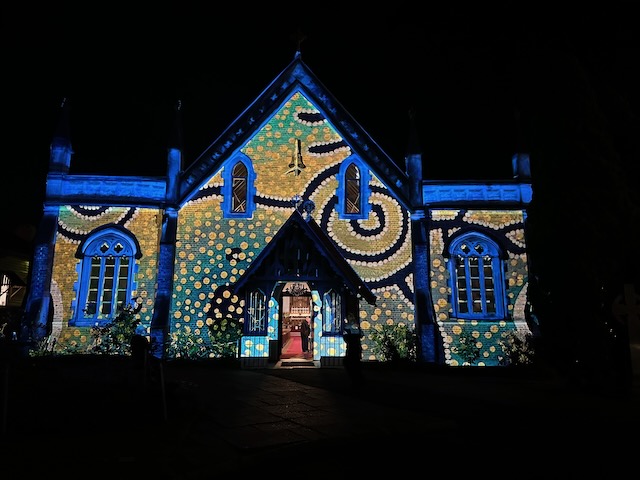
    These past few nights our church walls have been awash with the vivid colours of Indigenous artwork.

    May our hearts also be awash with profound respect for the people for whom this country has always been home.

    And may that respect inspire us to listen to their voice, to embrace the statement from the heart, and to engage in the hard work of reconciliation and justice for everyone who now calls this ancient land home.

Exit mobile version