Author: Gregory C. Jenks

  • Imagine this: Job comforts Jesus

    Imagine this: Job comforts Jesus

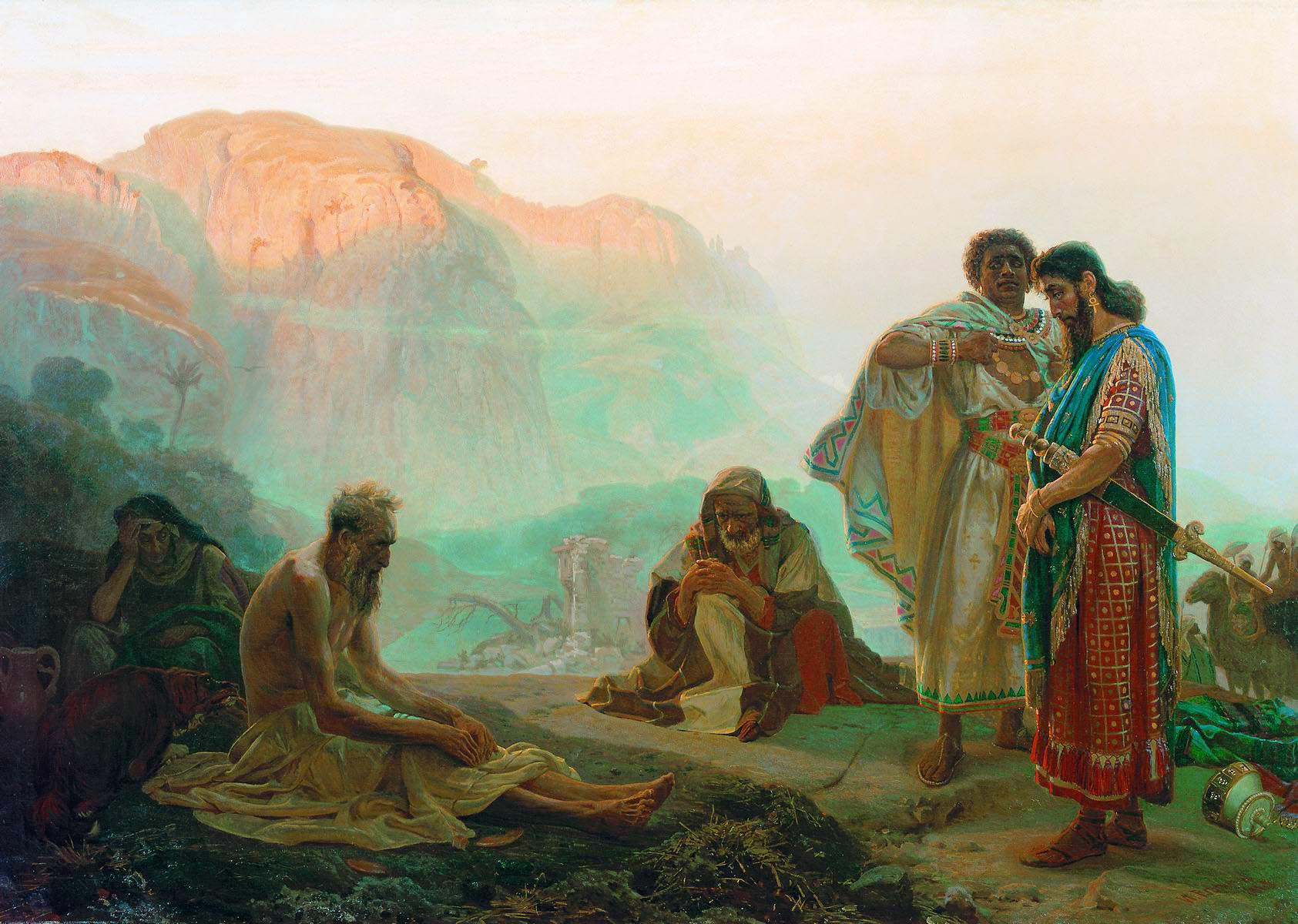
    IMAGE SOURCE: The featured image this week is “Job and his friends” by Ilya Repin (1844–1930 in the Russian Museum. https://en.m.wikipedia.org/wiki/File:Job_and_his_friends.jpg


    Pentecost 20B
    St Paul’s Church, Ipswich
    6 October 2024

    [ video ]

    This week we start a new set of readings in our Sunday services.

    Alongside the passages from the Gospel of Mark, we stay with the wisdom tradition of ancient Judaism and earliest Christianity; but we shift from Proverbs and James to Job and Hebrews.

    During the next 4 Sundays these are the biblical wells from which we shall be drawing as we seek spiritual wisdom for our everyday lives in a world that is vastly different from the times when these documents were composed.


    From the poetry of Job, we have inherited two phrases that remain is use in our culture today, even if fewer people now understand them compared with previous times:

    Patience of Job – Job is a character who seems unflappable by the disasters that befall him. In a mere 30 seconds, a simple Google search will generate 161,000,000 results when you look up this phrase.

    Job’s comforters – this phrase is not so common. You will only get 24,600,000 search results for that phrase in Google. It refers, of course, to the friends who come to visit Job when they hear of the disasters that have befallen him and seek to offer him comfort. Their comfort is essentially to offer him platitudes from their religion that do not really fit with Job’s personal situation at all. Instead of offering comfort, they offer him a huge guilt trip! He must have done something to cause all this, and—in some way—he must deserve what is happening to him.

    We may well aspire to the patience of Job, but we surely do not need the self-serving advice of religious friends who seem more interested in defending God than in standing with us in a time of immense grief.


    In parallel with the 4 excerpts that we shall hear from Job during October, we are also going to have a set of 4 excerpts from the letter to the Hebrews.

    Just as there is no other book like Job in the Old Testament, so there is no other book like Hebrews in the New Testament.

    Job seems to protest the usual teaching that obedience to God will result in a life of blessing.

    Job tells us in bold terms that bad things do indeed happen to good people.

    We know that is true, but we do not say it out aloud very often in church.

    Let me come back to Job shortly.


    First, let me say a little more about Hebrews.

    This unusual document wants us to think deeply about the significance of Jesus, using categories that come from Jewish tradition: including especially angels, Moses, the temple and its sacrifices, and a mysterious character, Melchizedek (who we happened to mention last Sunday).

    As we heard in the excerpt read this morning, Hebrew begins with an affirmation of Jesus as the final and definitive revelation of God.

    Just last week we were celebrating the feast of St Michael and All Angels, and now we are being reminded that Jesus is much more than angel. He is God among us and beyond us:

    Long ago God spoke to our ancestors in many and various ways by the prophets, but in these last days he has spoken to us by a Son, whom he appointed heir of all things, through whom he also created the worlds. He is the reflection of God’s glory and the exact imprint of God’s very being, and he sustains all things by his powerful word.

    In the coming weeks we shall explore a few other aspects of Hebrews:

    • Jesus as our great high priest through whom we have access to the Father
    • Jesus as a priest like Melchizedek, but made perfect through is sufferings
    • Jesus as an eternal priest who is always there for us

    This a powerful and imaginative way to think about Jesus, but it is not derived from historical reality. After all, Jesus was not from a priestly family and never functioned in any liturgical role as a priest. Rather, our writer is taking categories of priesthood and angels from the Jewish tradition and using those categories to think in fresh and imaginative ways about the significance of Jesus.


    One lesson we may take from this is that we have permission to use our imagination. We are not limited to the bare facts. Truth is more than an account of what happened. Meaning should not be mortgaged to historicity. 

    This should not be a surprise for followers of Jesus, the master of parables and aphorisms. 

    The parables offer us truth, not because they happened, but because they invite us to see the world through eyes of faith.

    Perhaps Hebrews is also inviting us to imagine Jesus in a fresh way, and consider how that will shape the way we live?

    But back to Job!


    Keep hold of the idea that we can use imagination to draw deeply from the spiritual wells offered to us by the Bible.

    Here is a simple mediation task for you to practise this week.

    Instead of Job’s friends coming to comfort him, I invite you to imagine Job coming to visit Jesus while he hung on the cross.

    Of course, it never happened. But we can imagine it, and from that act of spiritual imagination we can gain fresh wisdom for our own lives.

    This way of bringing together the wisdom of Job and the passion of Jesus was initially suggested to me by a colleague from Tonga, Jione Havea. I found it a powerful way to imagine new depths of meaning in both stories: the story of Job and the story of Jesus.

    Imagine Job coming to sit and the foot of the cross, dressed in his sack cloth and ashes. What might these two men say to each other? Job sitting on his dung heap and scraping his sores with a piece of broken crockery. Jesus nailed to a tree. 

    Two guys who had done everything right!

    Where is God for each of them?

    What does salvation look like—and feel like—to each of them?

    How might they encourage and comfort one another?

    What if they came and sat at my dining table? What might I learn about faith, hope and life from each of them?

    Am I ready for that conversation?

    Are you?

  • With angels and archangels


    St Paul’s Church, Ipswich
    Saint Michael & All Angels
    29 September 2024

    [ video ]

    At every Eucharist we affirm our place alongside the angels and archangels as the priest says:

    Therefore, with angels and archangels,
    and with all the company of heaven,
    we proclaim your great and glorious name.
    for ever praising you and saying:

    Today—on the feast of St Michael and All Angels—we pause to think about what we are saying and what we mean by those words.

    Do we really believe in angels?

    And if so, what do we believe about them?


    IN THE BIBLE we see diverse traditions about angels.

    The Hebrew word malʾaḵ occurs about 200 times, usually in the singular for and quite often (58x) in the phrase “the angel of the LORD” where it seems to be euphemism for “God.”

    In the Greek New Testament, despite being a much shorter set of documents, the word angelos occurs 178 times. Again, these are mostly singular, and the phrase “angel of the Lord” occurs frequently.

    Alongside angels we also find cherubim and seraphim, as well as a whole cast of non-human spirits and demons. Even Satan is understood to be one of the angels gone feral, so to speak, as we shall see in the readings from Job starting next week.

    In the Dead Sea Scrolls recovered from caves in 1948 and immediately afterwards, we find a whole host of good and bad powers. In some of these texts, the leader of the forces of light is Melchizedek (king of righteousness) while the leader of the forces of darkness is Melchiresha(king of evil).

    In our readings today we hear of the war between the forces of evil led by Satan (here called the great dragon) and the forces of good led by Michael.

    BTW, none of these spiritual entities have feathered wings or dragon-like body parts in the Bible. Those are much later artistic concepts, although the representation of Satan as a serpent or dragon reflects ancient legends where a dragon (an exaggerated crocodile) is an existential threat.

    Indeed, the famous scene of St George slaying the dragon is a variant of the scene from today’s reading in Revelation 12, although both go back to ancient myths of the conflict with the dragon/crocodile.


    IN OUR WORLD we can now explain so much of the cosmos as well as the inner system of the human person, whether physical or psychological. Have we deprived the universe of its angels?

    Maybe not.

    On the door of our fridge, we have a small magnet with the words:

    Every blade of grass has its angel that bends over it and whispers, “Grow, grow.”

    This saying is attributed to the Talmud, a major source of Jewish thought dating to around 500 CE but with some later additions.

    This version is very popular online, but when we look for the source in the Talmud, the nearest reference seems to be:

    Ben Sira said: God caused herbs to spring forth from the earth: with them the physician heals the wound and the apothecary compounds his preparations. R. Shimon said: There is not a single herb but has a mazal [constellation] in the heavens which strikes it and says, “Grow!” Bereshit Rabbah 10.6

    That is a rather more complex piece of teaching, although it preserves the idea that growth here may be helped or hindered by extra-terrestrial powers.

    On the other hand, “striking” is a rather more severe form of nurture than “whisper”!


    RE-ENCHANTMENT of the vast universe is a spiritual project for our times. It may be the mission of St Paul’s Church to help the people of Ipswich reimagine our world as “enchanted,” rather than a mechanistic system driven by chemicals that shape our moods.

    We are slowly learning to move beyond mechanistic explanations of reality to embrace the dance of creation as both an expression of cosmic energy (what people of faith describe as divine love) and as a dynamic process that responds to our attention (or lack of attention).

    On this final Sunday in the Season of Creation, we are invited to widen our concept of creation to include everything we know and understand, as well as all the rest of reality that we are yet to discover and explore.

    Angels and archangels, along with the cherubim and seraphim, are symbols that speak to us of the depth dimension in life and the constant loving presence of God in and through it all.

    There is no place—and no circumstance—where the angel of the Lord cannot bend over us and whisper, “You are blessed. You are loved. Grow. Flourish. Become who we intend you to be.”

    Call them what you will, these expressions of cosmic love are profound and powerful.

  • True wisdom results in right action

    Creation 3
    St Paul’s Church, Ipswich
    15 September 2024

    [ video ]

    All of our readings this morning invite us to make the right choices if we really want to gain wisdom.

    We are called to move beyond correct ideas to right action.

    As Proverbs presents this theme, we hear that the invitation to embrace wisdom has been out in the public domain for anyone and everyone to see and hear. 

    This was no secret tradition kept from the public and handed down behind closed door.

    Wisdom cries out in the street; in the squares she raises her voice. At the busiest corner she cries out; at the entrance of the city gates she speaks … [Proverbs 1:20]

    In a different way, the Letter of James urges people to act smart and not simply rely on their attitudes, beliefs and values to get us home at the end of the day. In the end, what matters is what we do and especially, James would say, how we treat other people.

    Faith without works is dead! [James 2:26]

    The Gospel this morning is the pivotal scene in the Gospel of Mark.

    Jesus takes his disciples up the northern region in the foothills of the Lebanese mountains. 

    Last week we found Jesus in southern Lebanon, at Tyre. This week he is pagan territory once more, at the base of Mt Hermon.

    The ancient name for this place was Paneas, because it hosted a cult site for the god Pan. That name survives still in the Arabic name, Banias.

    In the time of Jesus the name changed back and forth as various wannabee powerbrokers attached their name to the site.

    Mark calls it Caesarea Philippi; the city Philip built for Caesar.

    Philip, son of Herod the Great was actually recycling a great temple built at the site by Herod in honour of Augustus: the Augusteum.

    Later Nero would rename the place, Neronias.

    This was a place where people dreamed of power and influence.

    Eventually it reverted to its traditional name, as the locals always win. The rich and famous eventually fade away, along with their ambitions and their arrogance.

    So why has Jesus taken his disciples up into that area?

    As they make their way to that seat of power, Jesus asks his companions what people think of him. After all the miracles and controversies that have been playing out in the previous half of the Gospel of Mark, what are the crowds saying about Jesus?

    Jesus is not seeking fame, but it seems he has been making an impression.

    Some folk think he is nothing less than John the Baptist returned to life after Philip’s half-brother, Antipas, had him executed.

    That’s not a bad answer, since Jesus had been a disciple of John and really only launched his own mission after John had been arrested. There was indeed some continuity between John and Jesus.

    Others raised the bar even higher, thinking of Jesus as the great prophet Elijah returned to the earth.

    Again, that is not a bad answer. Many Jews around that time expected Elijah to return just before the end of the world. Some Jews still have that belief. When Mark’s readers get to the transfiguration story in the next chapter, Elijah is one of the two heavenly figures who appear alongside Jesus on the holy mountain.

    Others whose views were being canvassed in this 2,000 year-old opinion poll, thought that Jesus must be one of the Old Testament prophets. Moses was probably the main figure they had in mind, but others may have been thinking of Jonah. Indeed, Jesus himself spoke about the sign of Jonah when people asked him to say who he was.

    Finally, Jesus switches focus to the disciples: But who do you say that I am?

    Peter blurts out an answer: You are the Messiah!

    Peter’s answer was correct, but Jesus insists they keep that idea to themselves. It is not something to be talked about.

    Suddenly Marks tells us that it was not just Jesus and the disciples, on the trip but the crowd as well. The people with incomplete and confused ideas about Jesus, have also been travelling with Jesus and disciples as they head north towards Caesarea Philippi.

    His words to the crowd are also words for us to hear:

    If any want to become my followers, let them deny themselves and take up their cross and follow me. For those who want to save their life will lose it, and those who lose their life for my sake, and for the sake of the gospel, will save it. For what will it profit them to gain the whole world and forfeit their life? Indeed, what can they give in return for their life? [Mark 8:34–36]

    Beliefs, ideas and opinions are important, but actions matter more.

    To be a follower of Jesus means that we stop seeking fame, power or wealth. Instead, we lose our lives—we take a step back and then some—so that others come first and the good news can flourish in this world.

    So what does Jesus mean to you?

    And how is your own life forever changed because of that?

  • Rich and poor have this in common

    [ video ]

    Creation 2
    St Paul’s Church, Ipswich
    8 September 2024

    The rich and the poor have this in common

    Here we are on the Second Sunday in the Season of Creation.

    Here we once again taking our place at the table of Wisdom and waiting with anticipation to see what she has prepared for us this week.

    What spiritual wisdom for everyday life shall we take away from these readings this morning?

    I suggest that the key point for us today and this week is found in the opening lines of the reading from Proverbs 2:

    The rich and the poor have this in common:
    the LORD is the maker of them all.

    That simple yet profound truth extends not just to rich and poor people, but to the relationship between humans and all of creation.

    We have this in common with all creation: God gives us life and sustains us in life.

    We are in this together.

    Salvation is not just for humans, but for all creation.

    Read Romans 8:18–23 sometime:

    I consider that the sufferings of this present time are not worth comparing with the glory about to be revealed to us. For the creation waits with eager longing for the revealing of the children of God; for the creation was subjected to futility, not of its own will but by the will of the one who subjected it, in hope that the creation itself will be set free from its bondage to decay and will obtain the freedom of the glory of the children of God. We know that the whole creation has been groaning in labour pains until now; and not only the creation, but we ourselves, who have the first fruits of the Spirit, groan inwardly while we wait for adoption, the redemption of our bodies.

    Talking about ourselves as part of God’s creation can broaden our perspective.

    It can also put us in our place as small parts of a much larger and diverse created order.

    However, the readings today also insist that we pay attention to the gap between rich and poor.

    Rich and poor are also both equally creatures of God and loved by God.

    Variations in wealth can derive from bad luck and even just bad weather. Once we have fallen into debt it is often hard to escape the vicious cycle of interest payments and further loans.

    As an aside, the Bible forbids interest on loans between members of the covenant community.

    Variations in wealth can also arise from family circumstances, with inherited wealth and inherited poverty.

    The Bible also promotes the concepts of sabbatical years (when the land gets a rest) and the jubilee year (after every 49 years: 7 x jubilee years) when all debts are remitted, and all land is restored to the original families.

    How does that biblical theology fit into our own approach to life, and our attitudes to debt? Or indeed, our concern for the wellbeing of the land?

    Variations in poverty and wealth can be due to many other factors, both personal and structural.

    Poverty itself is then a major factor in maternal and child health, educational access, secure employment, proper housing, and dignified aged care.

    It can all seem so complex and remote; and especially if we are in a pretty comfortable space.

    Our reading from the Letter of James this week makes it rather close and personal.

    For if a person with gold rings and in fine clothes comes into your assembly, and if a poor person in dirty clothes also comes in, and if you take notice of the one wearing the fine clothes and say, “Have a seat here, please,” while to the one who is poor you say, “Stand there,” or, “Sit at my feet,” have you not made distinctions among yourselves, and become judges with evil thoughts? Listen, my beloved brothers and sisters. Has not God chosen the poor in the world to be rich in faith and to be heirs of the kingdom that he has promised to those who love him? [James 2:2-5 NRSV]

    Let me place a recent anecdote alongside that text from James.

    About 3 Sundays back we had a guy from the street join us for part of the 7am Eucharist. I had noticed him come into the church just as I was about to walk into the Lady Chapel, but it took him a few minutes to come across to the area just here beside the organ. He stood there watching and listening as I read some of the service and then as I began the sermon. I was unsure whether to interrupt the service and make him welcome, or just to allow him to find his own level of comfort with us. To be honest—and to my shame—I was also very aware that the offering bowl was sitting just there, and that people had placed their offerings in it before they sat down. He stood there watching and listening, and then one of the guys sitting near the back invited him to sit alongside him and shared the service booklet with him. After some time had passed, the visitor got up and left. He returned as we ended the service as he had left his shoes behind, so we all started to chat. He told us his name and a little about his life. Then one of women invited him to come to breakfast with her at a café across rhe street. He began to decline, but she said that she would pay for his meal, so he went off with her for breakfast. He has not been back since, but I hope he does visit us again and I am in awe of the woman who invited him to breakfast.

    The small congregation at 7.00am that day really practised what James was talking about.

    The rich and poor have this in common …
    the priest and the rough sleeper have this in common …
    … the LORD made us both!

  • Celebrating creation

    [ video ]

    St Paul’s Church, Ipswich
    Creation Sunday
    1 September 2024


    Today we switch from winter to spring, despite the last few weeks seeming like summer.

    Today we begin the Season of Creation, which will run from today until early October. More about that in a moment.

    Today we also begin two new sets of readings: with the first reading each Sunday coming from the Wisdom literature of the Jewish Scriptures (what Christians call the Old Testament) and the second reading coming from the Letter of James. James is the NT document most deeply grounded in the Jewish wisdom traditions. More about that in a moment as well.

    On top of all that, today is also Fathers’ Day!

    The wisdom tradition

    There are various streams of literature to be found in the Bible, and especially in the Old Testament:

    Epic Narrative: an extended and essentially continuous story of the covenant people stretching from the creation of the world to the destruction of Jerusalem in 587 BCE.

    Laws: Interwoven with the first part of the epic story of ancient Israel we have materials about the laws that would govern the public and private lives, and especially the religious lives, of the covenant people. The famous Ten Commandments are the classic expression of this stream.

    Prophets: Another major stream within the Bible is found in the prophetic writings which essentially call Israel to account for their failure to observe the laws and keep the covenant with God. They were not foretelling events in the distant future, but describing what is about to happen in the cycle of punishment and restoration. There is passion for justice running through these books, and a vision of Israel having a role as a light to the nations.

    Songs of the Temple: the Psalms form a major stream in their own right, as they gather up the prayer songs of God’s people over several centuries. We now know that not very long before the birth of Jesus the collection of Psalms was still incomplete. From the Dead Sea Scrolls discovered in 1948 we see that up to Psalm 109 was pretty well fixed, but the final 40 or so psalms had not yet been chosen.

    Wisdom Literature: this includes books such as Job, Proverbs, Ecclesiastes and the Song of Songs. Within the OT Apocrypha we have additional wisdom works, including the Wisdom of Solomon and the Wisdom of Jesus Ben Sira.

    It is this final stream from the biblical tradition that we shall be listening to during the next few weeks as we go observe the Season of Creation.

    It offers some different perspectives on meaning and truth, and invites us to embrace wisdom wherever it is found rather than sticking to our own religious community.

    This may prove to be a very important insight for all humans as we seek to grapple with the climate changes that are reshaping our lives and transforming our futures.

    Season of Creation

    As mentioned already, from this Sunday until early October we shall be observing the Season of Creation. 

    This is a time to renew our relationship with our Creator and all creation through celebration, conversion, and commitment together. During the Season of Creation, we join our sisters and brothers across the ecumenical family in prayer and action for our common home.

    This ecumenical and international celebration originated in 1989 when Ecumenical Patriarch Dimitrios I proclaimed 1 September as a day of prayer for creation within the Orthodox churches. 

    The World Council of Churches soon adopted the idea for an extended season, extending through September. 

    Since then, Christians worldwide have embraced the season as part of their annual calendar. In recent years, statements from religious leaders around the world have also encouraged the faithful to take time to care for creation during the month-long celebration.

    The season starts 1 September, the Day of Prayer for Creation, and ends 4 October, the Feast of St. Francis of Assisi, the patron saint of ecology beloved by many Christian denominations.

    Throughout this month-long celebration, the world’s 2.2 billion Christians come together to care for our common home.

    Caring for our common home.

    We look after our own homes and tend our own gardens, but we have a shared responsibility for the care of all creation.

    Both the stories of creation with which the Bible opens agree that humans exist under the providence of God to tend creation.

    This commission to be custodians of the planet has mostly been misunderstood as the grant of sovereignty over the plant. This is to misunderstand the meaning of Scripture. The authority bestowed on humans within creation—like the authority exercised by parents—is not power to dominate and exploit, but responsibility to nurture and protect. Like responsible parents duty-bound to care for their children, humans have a responsibility for the wellbeing of creation, not a licence to control, dominate or exploit.

    For Anglicans this is expressed in the fifth of our five marks of mission:

    To strive to safeguard the integrity of creation, 
    and sustain and renew the life of the earth

    In our parish life and in our homes we are called to do all we can to preserve, sustain and renew this fragile planet we call home.

    This is not a distraction from the Gospel, but rather a core element of the Good News.

    We are not offering free tickets to escape this world, but rather recruiting people to work with God to restore and protect creation.

    We shall be reflecting on this call during these Sundays in the Season of Creation.

    As we do that, we shall be encouraged by the Wisdom texts each week to look deeper and to look farther afield for the wisdom we need to care for creation.

    Wisdom calls us to her table. If only we have the ears to listen:

    Wisdom has built her house, she has hewn her seven pillars. She has slaughtered her animals, she has mixed her wine, she has also set her table. She has sent out her servant girls, she calls from the highest places in the town, “You that are simple, turn in here!” To those without sense she says, “Come, eat of my bread and drink of the wine I have mixed. Lay aside immaturity, and live, and walk in the way of insight.” [Proverbs 9:1-6 NRSV]

  • The grain of wheat that falls

    PNG Martyrs
    St Paul’s Church, Ipswich
    25 August 2024

    [ video ]

    In today’s Gospel—chosen for the festival of the PNG Martyrs—we have a classic piece of spiritual wisdom from Jesus:

    Very truly, I tell you, unless a grain of wheat falls into the earth and dies, it remains just a single grain; but if it dies, it bears much fruit. [John 12:24]

    This saying happens to be one of my favourite biblical texts. It has always touched me profoundly.

    These words take us deep into the mystery of the truth that Jesus lived, and the truth that we are called to live as well.

    To be a solitary and self-sufficient figure—even if we could do that, which mostly we cannot—is to be lonely and pointless. To survive at all costs, might mean that we die without any meaning to our existence at all.

    The point of being alive is not to survive, but to serve.

    This was a theme to which Jesus and his first followers returned time and again.

    Here in John 12 the saying about the grain of wheat is followed by the aphorism about losing life in order to find it. 

    Those who love their life lose it, and those who hate their life in this world will keep it for eternal life. [John 12:25]

    Those who cling to their own existence, who prize it above all else, find that they lose what they most value. Those who dismiss their own importance and live for others, will find they have saved their own life and—in the process—fashioned a life that is worth having lived.

    In the Gospels of Matthew, Mark and Luke we find a similar truth to these words from the Gospel of John Jesus calls on his followers to take up their cross. 

    This metaphor does not refer to personal hardships, aching backs or broken hearts. It proclaims a terrible truth: that the path to life is only open to those who are willing to die for something bigger and greater than themselves.

    Each time we gather at the Table of Jesus this profound spiritual truth is acted out for us: the broken bread, the wine poured out, Jesus’ own life given to us, and through us to others.

    It is not hard to see why the lectionary committee chose this passage for the feast of the PNG Martyrs, those seeds that fell into the rich soil of PNG and became a vast number of people claiming their own identity as people of God.

    And here we are still a world—and indeed in a church—where the wisdom of Jesus seems to find few ears that are willing to hear in the halls of power.

    It was ever thus, of course.

    Those who killed Jesus and those who demanded the death of the PNG martyrs, were powerful and privileged in their own contexts.

    In our prayers today we especially celebrate the faith and the faithfulness, the courage and the hope, of the martyrs.

     We also pray for a share of the same faith, that same courage, that same hope and that same spirit of solidarity and service.

    As a generous faith community in the heart of Ipswich since 1859 we are at our best when we forget about our own survival and spend ourselves for the sake of others.

    This morning as we come to the Table of Jesus to receive the life that he gives away for the sake of the world, let’s seek the grace to live for others and not for ourselves.

    That is how we best honour the martyrs of New Guinea and how we best serve our risen Lord.

Exit mobile version