It is a beautiful accident that our secular Mothers’ Day this year coincides with the Fourth Sunday of Easter, with its theme of Jesus as the Good Shepherd.
Like a mother whose ear is attuned to the call of her own infant, or an infant whose ears are attuned to the sound of its mother’s voice, Jesus describes his sheep as those persons who have an ear for the wisdom he both speaks and embodies:
“My sheep hear my voice. I know them, and they follow me. I give them eternal life, and they will never perish. No one will snatch them out of my hand.”
(John 10:27–28 NRSV)
Normally I focus my sermon on the Gospel, since our core task as Christians is to listen to the wisdom of Jesus. However, today I want us to reflect together on the meaning of the Twenty-Third Psalm, “The Lord is my shepherd”.
You have the text of the Psalm in the bulletin (or on page 243 of the Prayer Book, if you prefer). If you are keeping an eye on the APBA version, you may notice that it differs slightly from the translations found in the Bible.
A Prayer Book for Australia, Liturgical Psalter
1 The Lord is my shepherd:
therefore can I lack nothing. 2 He will make me lie down in green pastures:
and lead me beside still waters. 3 He will refresh my soul:
and guide me in right pathways for his name’s sake. 4 Though I walk through the valley of the shadow of death
I will fear no evil:
for you are with me, your rod and your staff comfort me. 5 You spread a table before me
in the face of those who trouble me:
you have anointed my head with oil,
and my cup shall be full. 6 Surely your goodness and loving-kindness
will follow me all the days of my life:
and I shall dwell in the house of the Lord for ever.
Bible (New Revised Standard Version)
1 The Lord is my shepherd, I shall not want. 2 He makes me lie down in green pastures;
he leads me beside still waters; [Heb waters of rest] 3 he restores my soul. [Or life]
He leads me in right paths [Or paths of righteousness]
for his name’s sake. 4 Even though I walk through the darkest valley, [Or the valley of the shadow of death]
I fear no evil;
for you are with me;
your rod and your staff—
they comfort me. 5 You prepare a table before me
in the presence of my enemies;
you anoint my head with oil;
my cup overflows. 6 Surely [Or Only] goodness and mercy [Or kindness] shall follow me
all the days of my life,
and I shall dwell in the house of the Lord
my whole life long. [Heb for length of days]
For the sake of comparison in the web version of the sermon I am also providing the New International Version translation:
1 The LORD is my shepherd, I lack nothing. 2 He makes me lie down in green pastures,
he leads me beside quiet waters, 3 he refreshes my soul.
He guides me along the right paths
for his name’s sake. 4 Even though I walk
through the darkest valley,
I will fear no evil,
for you are with me;
your rod and your staff,
they comfort me. 5 You prepare a table before me
in the presence of my enemies.
You anoint my head with oil;
my cup overflows. 6 Surely your goodness and love will follow me
all the days of my life,
and I will dwell in the house of the LORD
forever.
Just to keep you all awake, I am going to work with the translation from the Jewish Publication Society so that we hear the sense of these ancient words with their original Jewish accent.
1 The LORD is my shepherd;
I lack nothing. 2 He makes me lie down in green pastures;
He leads me to water in places of repose; 3 He renews my life;
He guides me in right paths
as befits His name. 4 Though I walk through a valley of deepest darkness,
I fear no harm, for You are with me;
Your rod and Your staff—they comfort me. 5 You spread a table for me in full view of my enemies;
You anoint my head with oil;
my drink is abundant. 6 Only goodness and steadfast love shall pursue me
all the days of my life,
and I shall dwell in the house of the LORD
for many long years.
The variations in the same Psalm across these different translations invite us to move beyond the literal words and imagine how we might hear these words with fresh ears, ears and hearts attuned to hear the voice of the Good Shepherd.
So let’s work our way through the six verses of this well-known psalm.
1 The LORD is my shepherd; I lack nothing.
“The LORD” is the conventional way to represent the ancient sacred name of God, which in the Hebrew Bible is written with just its four consonants: YHVH. This “Tetragrammaton” survives as the “Jeho/Jehu” and/or “iah/jah” syllables in many names for individuals and places in the Old Testament: Jehoshaphat, Jeremiah, Zephaniah, etc.
It may once have been pronounced as “Yahweh”, but during the second century BCE it became customary to avoid saying the sacred name. Instead, other synonyms were used: ‘Adonai (Hebrew for “My Lord”), Kyrios or Theos (Greek terms for “Lord” and “God” respectively). In many anceint Hebrew biblical texts the vowels of ‘Adonai were written with the consonants of the Tetragrammaton to create an unpronounceable word as a reminder for readers not to say the sacred name.
In later Christian use that was entirely misunderstood, and the term “Jehovah” was thought to be God’s name.
This mistake survives in classic hymns such as “Guide me, O thou great Jehovah”; and in the theological gibberish that is propagated by the so-called Jehovah’s Witnesses.
This ancient covenant God is understood by the psalmist as his existential shepherd: guiding, protecting and sustaining the person of faith. With such a shepherd god, we never fear anything. We can never be in want. We lack nothing good.
2 He makes me lie down in green pastures;
He leads me to water in places of repose;
In the marginal pastoral lands of Palestine, finding a good supply of green pasture was (and remains for the Bedouin even now) a core responsibility. Along with fresh pasture, the sheep need water in a dry and rugged environment.
The second verse of Psalm 23 draws on this familiar reality to describe the gentle presence of God in our lives.
3 He renews my life;
He guides me in right paths as befits His name.
The familiar words—“my soul he doth restore again”—are better translated in the Jewish Publication Society version.
The divine shepherd renews our life, fresh every morning, and guides in the right paths: the tracks that suit our needs and which lead us to the green pastures and the waters of repose.
The track God chooses for me is the perfect path for me to follow.
4 Though I walk through a valley of deepest darkness,
I fear no harm, for You are with me;
Your rod and Your staff—they comfort me.
The “valley of the shadow of death” has been one of the most evocative phrases in the traditional version of the Twenty-Third Psalm. Notice how the Jewish translation represents that line.
In our darkest moments, whatever they may be, the divine Shepherd is always with us. We are never alone. Never abandoned. Never bereft of hope.
A Palestinian shepherd typically carried a club (rod) to fend off wild animals and a crook (staff) to guide the flock in his care.
Fierce protection and gentle care are the hallmarks of the God who is always with us. Emmanuel.
5 You spread a table for me in full view of my enemies;
You anoint my head with oil;
my drink is abundant.
It is generally agreed that the final two verses of the Psalm involve a change of metaphor from “sheep” in the care of its shepherd to “guests” in the house of the LORD, with a place at the table of God
This metaphor especially resonates with Christians because of the centrality of the Table of Jesus in our faith and practice.
We gather at the Table of the Lord. The Table which Jesus has prepared for us and where Jesus is the host. The Table where we are anointed with oil: the oil of gladness, the oil of healing, the oil of discipleship. This is the Table where we drink the same cup as Jesus drank, the cup which renews us with the life of Jesus. His life poured out for others. Our lives poured out in grateful service.
6 Only goodness and steadfast love shall pursue me all the days of my life,
and I shall dwell in the house of the LORD for many long years.
Psalm 23 concludes with a flourish.
The love of the divine Shepherd and the generosity of the divine host will never fail us.
Notice that is is not an affirmation of life after death, but rather an expression of hope for God’s blessing here in this life.
Here in this life we are guests at the Table of Lord and already living in the Lord’s House.
The earth is not a consolation prize nor a place of exile from which to escape when we can finally go “home”. This is our home. It is the house of the Lord. And it is a good place to be.
So let’s hear this Pslam one more time:
1 The LORD is my shepherd;
I lack nothing. 2 He makes me lie down in green pastures;
He leads me to water in places of repose; 3 He renews my life;
He guides me in right paths
as befits His name. 4 Though I walk through a valley of deepest darkness,
I fear no harm, for You are with me;
Your rod and Your staff—they comfort me. 5 You spread a table for me in full view of my enemies;
You anoint my head with oil;
my drink is abundant. 6 Only goodness and steadfast love shall pursue me
all the days of my life,
and I shall dwell in the house of the LORD
for many long years.
The axiom, “Sarcasm is the lowest form of wit, but the highest form of intelligence”, is usually attributed to Oscar Wilde, the Irish poet and playwright who lived in the second half of the 1800s.
That attribution may not be accurate, but the axiom itself is usually misquoted (stopping at the mid-point) and mostly misunderstood as implying that using sarcasm is evidence of low intelligence. What the axiom perhaps seeks to express is that sarcasm fails as humour, but can reflect an acute intelligence.
Whatever may be the case for sarcasm as an index of intelligence it is a dangerous tool to wield in public debate. It is more likely to offend than persuade, and it can even reverberate with unfortunate consequences for the polemicist who draws that tool from the debating toolkit.
This may indeed have been the fate of a well-known Anglican blogger in Sydney whose delight in deploying sarcasm to attack a media release by the Bishop of Grafton has quite possibly exposed the folly of our blogger’s own worldview.
In attempting to undermine the statement by Bishop Murray Harvey, the Revd David Ould stoops to sarcasm as if that strategy will deflect and rebut the sound spiritual wisdom to be found in the statement by Bishop Harvey:
Here at davidould.net we want to suggest that Dr Harvey should issue some more press releases because there are people out there making bigger threats than Folau. For instance, this guy should get a rocket:
Luke 13:1 Now there were some present on that occasion who told him about the Galileans whose blood Pilate had mixed with their sacrifices. 2 He answered them, “Do you think these Galileans were worse sinners than all the other Galileans, because they suffered these things? 3 No, I tell you! But unless you repent, you will all perish as well! 4 Or those eighteen who were killed when the tower in Siloam fell on them, do you think they were worse offenders than all the others who live in Jerusalem? 5 No, I tell you! But unless you repent you will all perish as well!”
Now there’s a threat if ever I saw one. He doesn’t just have a small list like the narrow-minded Apostle Paul in 1Cor. 6:9-10 (which Folau quotes in his post along with Gal. 5).
No, whoever that hater is in Luke 13 … well he just used hate speech to threaten and vilify everyone.
EVERYONE!
That’s the last thing a Christian should do. Someone should find out who he is and tell him to change his attitude and send a positive message about his faith and promote social inclusion (although what could be more socially inclusive than including all of society in your “threat”?).
As for community well-being, surely telling people that they will perish if they don’t repent can’t be good for anyone. Someone tell Dr. Harvey so he can sort this dangerous bigot out.
What this somewhat reckless rhetorical missile has done is simply to expose a serious problem with the biblical texts themselves. Sometimes—indeed quite often—the Bible says things which are indefensible, incomprehensible or just gutter talk. When the Bible descends to the gutter that does not justify us in doing the same, nor are we obliged to believe or practice anything in particular just because it happens to be written in the Christian scriptures.
In his exaggerated journalesque mode, Mr Ould inadvertently illustrated precisely the core issue with the ugly social media posts by Israel Folau as well as the point correctly—albeit gently—made by the Bishop of Grafton.
The Bible endorses and even commands a range of beliefs and practices which most people of faith would these days find abhorrent. The catalogue of nasties includes (but is not limited to) capital punishment, ethnic cleansing, the willful destruction of fauna and flora, patriarchy and sexism, totalitarian rule by absolute monarchs claiming divine approval, and slavery.
When even a modicum of biblical literacy is applied to the task of biblical intepretation, a much more nuanced reading of Scripture results. But Mr Ould and Mr Folau are not ones for nuance, it seems. It is all so simple and so black and white. Just read the words from the ancient text. No need for brains to be engaged at all.
There is, of course, ‘a more excellent way’ than this mindless recital of ancient words, but it requires us to read the text with some critical awareness of how texts work (and the power of the reader to determine what a text means), how these particular sacred texts were composed and received, how little actual historical credibility the biblical texts really have, and at least some awareness of what we now know to be true about the scale of the universe and the complexity of our shared DNA.
When read with cognitive modesty and some critical awareness, the Christian Bible—like all the sacred texts from the great religions—can be a catalyst for human liberation, rather than manacles on the collective human spirit. I made precisely that point when giving a public lecture in Sydney this past weekend for the Mosman Neutral Bay Inter-Church Council.
Let me begin by acknowledging the Kuringgai people, the indigenous owners and custodians of the land where we are gathered this afternoon. If we were inclined to add up all the dates in the Bible, as Archbishop Ussher tried to do just over 300 years ago, we would come up with a story that reaches back around 6,000 years. The first people of this ancient land have a story that stretches back some 60,000 years. Their story dwarfs the biblical narrative and invites us to look at Scripture differently.
So we honour their elders past and present, as well as the emerging elders of the first nations of the land and especially of this place where we meet today.
I want to thank those responsible for this opportunity to explore with you some of the ways in which the Christian Scriptures can serve as a charter for the human spirit, rather than as manacles for humanity. What I hope will happen this afternoon, is that we shall have a conversation around those issues. In preparation for that conversation, my goal in the next 45 minutes or so is to provide some stimulus material to assist us in beginning that conversation and perhaps also to provide some parameters for it.
In considering what I was going to say here today, I was conscious of the need to choose a topic that is clearly relevant to the life and mission of churches, but also relevant for the public square: a topic that is relevant to the life and mission of the church, and which has some ecumenical dimensions to it, as well as being a topic which might be relevant to the wider community or have some significance for the voice of faith in the public square.
My role is not that of a politician nor indeed a senior figure in the life of the churches nor even a leading ecumenical contributor. My personal background is that I have spent most of my adult life as a religion scholar specialising in biblical studies. My particular interests are the historical origins of the Bible and especially historical Jesus research. These days I am a priest responsible for a cathedral in a small regional town on the north coast of New South Wales about 100 km away from where I was born, so life has been something of a circle.
What I hope we can do in our time together this afternoon is to explore the role of the Bible inside but also beyond those communities of spiritual practice which we call churches.
Core proposition
I can sum up my core ideas for this afternoon’s presentation as follows:
The immense cultural and spiritual significance of the scriptures lies precisely in their capacity to inspire us to move beyond earlier expressions of humanity and to reach new levels of awareness courage and compassion; in short, to be more fully human than ever before. I want to suggest that this is true at both the individual and the collective level. I would also want to suggest that this truth is not limited to the Christian Bible — in all its variations — but also applies to the sacred texts of all the great spiritual traditions. However, as a Christian scholar I will limit my comments to the role of the Christian Bible.
In reviewing some earlier work recently, I realised that this concept has been on my mind for some years.
The Bible was mostly written by ancient Jews, a few of whom were followers of Jesus although probably none of them had ever seen or heard Jesus during his lifetime.
Most of the Bible was prepared for oral presentation via live performance in community gatherings for worship and mutual support (and not for close study by literate and highly educated individuals).
The Bible has very little to do with history even though some historical elements are embedded in it.
Decisions on which texts to include in the Bible were mostly determined by political needs of Jewish communities after Alexander the Great and of emerging Catholic Christianity in the third and fourth centuries ce.
While the Bible has been used to validate prejudice and oppression of various kinds, it can also be used in ways that enhance humanity and encourage respect for the Earth.
The Bible is best read in the company of other people, so that we benefit from the wisdom of others as we seek to hear what the Spirit is saying to the church.
Those words were drafted on 9 May 2009, so almost exactly ten years ago. I was especially interested to read #5, and I look forward to exploring that key insight with you all this afternoon.
Relevance
Perhaps the first thing to be considered is the relevance of my chosen topic. It seems fairly clear that the topic is indeed relevant for the life and mission of the church, whether as separate faith communities or as an ecumenical movement. However, I think it is also highly relevant for the wider community in the place of religion in the public square.
A few examples may suffice to make the point:
The marriage equality debate in which we have been engaged for the past couple of years has seen substantial progress, but there remains considerable unfinished business. This is particularly so with regards to the reception of marriage equality within the life of the churches as well as equality for transgender persons in the wider society.
The pressure coming from conservative Christian groups for their ‘religious freedom’ to be protected is another of the reasons why this topic may be relevant for us this afternoon. The kinds of protections which seem to be desired nowadays are protections born of a looming awareness of the futility of traditional theological positions and their well-earned disrepute in the more general community.
One further and more recent example: Israel Folau.
The recent media storm around his online comments threatening the fires of hell for those whose beliefs or personal lifestyles do not conform with ultraconservative Christian perspectives is just the latest example of why this topic matters.
So, I suggest we explore whether the role of Scripture is to protect the past and regulate the present, or to inspire us in the present to create a more human future?
Process
If we are going to engage in this conversation, we going to have to set aside common pious and devotional concepts about the Bible and indeed about the nature of Christianity. I am sure you will be up for that challenge if you have chosen to participate in the program this weekend.
What I will be asking you to consider is the ‘real-world’ spiritual value of the Bible. In other words, what practical value does the Bible have for the way we live our everyday lives? We may be people of Christian faith, we may be people who identify as spiritual but not religious, we may be people of other faiths or people without faith, or we may simply be considering the value of the Bible for the secular Australian Commonwealth to which we all belong and in whose future well-being our own well-being is to be found. No matter where we are coming from in this conversation, the focus is much the same: what is the practical value of the ancient Christian Scriptures for the kind of society we aspire to be and become?
Using the Bible faithfully
The phrase ‘taking the Bible seriously but not literally’ has become quite well-known in progressive religious circles. That is certainly the exercise in which we will be engaged this afternoon, but I want to up the ante a little bit and raise the stakes for our conversation.
I am proposing that taking the Bible literally is not simply one valid theological option among several. On the contrary, I consider a literal view of the Bible to be a serious theological mistake. This mistake—common though it be in many Christian circles—has inevitable toxic consequences for people of faith, for the church, for the wider society; and indeed for our whole fragile biosphere. We may want to tease out some of these issues in the conversation which will follow shortly.
My goal then, is to speak plainly about matters of deep theological significance and to avoid mealy-mouthed theological terms that fudge things up to the point where nobody can take offence. While I am not seeking to offend, I will not be upset if you are. This is, after all, a festival of wild ideas, is it not?
We are giving ourselves permission to ask questions, to push boundaries, as we seek to gain a sense of the way forward from where we are now to where we need to be in the future. That is one reason why we meet in a public space rather than in church property. Our venue invites us to think outside traditional theological boundaries for the benefit of us all.
Exhibit A: slavery
These days no church would entertain a proposal to reintroduce slavery into our economy and our family structures. At least I hope that is the case. And yet slavery is good for business and it has strong biblical support.
Perhaps you can already guess where I am going with this?
During the US Civil War, the church was split over the slavery issue and indeed some of those divisions have not yet been healed.
The campaign to abolish slavery provides an example of the Bible inspiring a few activists and social advocates to develop new ideas that were controversial, radical, overturned millennia of unbroken tradition, and involved setting aside some parts of the Bible itself for the sake of a deeper truth. No wonder it was controversial.
Perhaps this sounds familiar?
Yet, when we consider the biblical basis for slavery it is actually quite extensive and in no sense a superficial element of the tradition:
We find slavery embedded in the social structures of countless narratives through both the Old Testament and the New Testament.
The institution of slavery includes the sexual exploitation of female slaves by their male owners.
The Hebrew slaves in Egypt were set free by their God, but slavery itself was not condemned. Remarkably, the desert constitution for the future Israelite society includes provisions for the institution of slavery, including both Hebrew slaves and Gentile slaves.
Slavery features in the parables of Jesus and is never condemned by him.
Indeed, slavery becomes a favourite term in the New Testament to describe the relationship of the believer or the disciple to Jesus. These days with our sensitivity around slavery, we tend to translate the Greek term doulosas ‘servant’, but its natural interpretation in context is simply ‘slave’.
When we look to the authentic letters of Paul, and particularly the brief letter to Philemon, we find a fascinating triangle between Paul, Philemon (a Christian slaveowner) and Onesimus (a runaway slave and convert to Christianity). At no stage is slavery called into question.
Looking further afield in the New Testament, including the Deutero-Pauline letters, we find a systemic acceptance of slavery and explicit guidelines within the household codes for relationships between masters and slaves.
We should also note that while the New Testament endorses slavery, it condemns slave traders; which is an interesting distinction to make.
If we were to summarise the biblical position on slavery it would be as follows: slavery is assumed, it is regulated by divine laws, it is widely practised and continues to be accepted even into the New Testament itself. Slavery provides a core metaphor for the personal faith and for major leadership roles within the church, and it is even embraced by Jesus as a metaphor for his own mission and purpose.
All of this is more than that can be said for several other cultural practices that acquire theological significance in the Bible and within later Christian tradition, including: marriage, divorce, and celibacy. In short, anything involving sex or gender. Little is said about those subjects relative to the broad acceptance of slavery.
Biblical literacy
We are all aware of the responsible service of alcohol provisions these days, but I want to suggest that we need a similar program for the responsible service of Scripture.
Indeed, there is such a program, it is called biblical literacy.
Biblical literacy has numerous elements, including at least the following:
It requires attention to how written text function as acts of communication between and among authors and readers. This is an unremarkable literacy skill in other areas of modern life, including media studies and genre analysis at school. Yet it seems oddly and sadly lacking in many Christian churches. Meaning is always negotiated between the author and reader, with all the power being in the hands of the reader who is the one constructing meaning out of the process. The author can seek to shape the form of those negotiations, but the reader is the one ultimately creating meaning from the communication process. As text the Bible is subject to those same dynamics. We determine what it means. It does not determine our meaning.
Typical literacy also requires us to pay attention to the nature and function of language as we create, share, adopt, implement and adapt human knowledge between individuals and across generations. This is essential as we seek to use the Bible authentically.
Biblical literacy further requires that we pay some attention to what may reasonably be known about the composition of those texts that we now value as sacred Scripture. They did not drop out of heaven and they were not dictated by the Holy Spirit. Despite years of teaching biblical studies in seminaries around Australia and elsewhere, I was still shocked the other day to see a Christian leader quote from Psalm 51 as part of his argument against abortion, with the claim that the Psalm represents the direct words of God. This is, of course, nonsense.
In addition to paying attention to how the text may have originally been composed, we also need to pay attention to the process of reception for certain texts which were accepted as sacred while other texts from the same period were excluded from those documents authorised to be read in church or consulted to settle theological disputes. In other words, both the formation of the canon and the history of the interpretation of the canonical texts have a part to play in genuine biblical literacy.
What we have learned about using these texts from the accumulated experience more than 2,500 years of continuous interpretation within communities of spiritual practice must also be brought into the discussion. We are not the first people to read these texts and people of goodwill have been wrestling with them for centuries, constructing life-giving ways of reading the text as a charter for human flourishing in different cultural and social contexts. We ignore that wisdom at our peril.
An essential element of biblical literacy — or perhaps simply religious literacy — is that we consider what impact our new insights into the physical and social realities of being human in our kind of universe have on our contemporary reception and interpretation of these ancient texts. Since we no longer think we live on a flat earth or in an earth-centric universe, we will necessarily construct a different vision of life as we read these texts.
Finally, there is our own lived experience. This informs us as we reflect on past and contemporary interpretations of these venerated ancient texts. When we speak of the inspiration of Scripture, the work of the Holy Spirit is surely as much in the life of the reader and the listening community as it is in the texts themselves. Such a view of inspiration would certainly be consistent with our understanding of how meaning is constructed when a text is being read.
Living with theological difference
Binary gender stereotyping is an issue of wider cultural interest as we are well aware. We saw it in the marriage equality debate and we see it persisting in the culture wars around gender diversity and sexual orientation. It is particularly a controversial topic within the churches at the present time, but there is nothing new about the churches living with profound controversy and conflict.
At other times and in other places different issues have also been very divisive and continue to be so in some cases including: questions of shared meals between Gentiles and Jews, demands for male circumcision for Gentile converts to Christianity, Christian opposition to military service, the use of the vernacular in the liturgy, non-traditional music in worship, icons and images of various kinds, and (as we have seen) slavery.
Biblical and wider theological grounds for same-sex marriage
As we prepare for our discussion after the conclusion of my presentation, I want to suggest a series of basic hermeneutical principles which are particularly relevant to the question of same-sex marriage.
The first is the limits of Biblicism.
By that term I mean an excessive expectation of the authority of Scripture within the life of the church and of individual believers. So, I suggest that we ask the question: What kind of authority does the Bible actually have? And just how is that authority exercised? Is the authority of the Bible prescriptive or descriptive?
When we speak of the truth of the Bible, is that literal truth or metaphorical truth? And what are the extra-biblical considerations that drive our use of the Bible to settle theological debates in the first place? Why are some biblical statements prescriptive but others able to be set aside as cultural requirements or even as ritual texts?
I note, for example, that a famous rugby player who is opposed to homosexuality has tattoos covering his arms despite the explicit ban on such practices in the same Bible that he cites in opposition to same-sex relationships. Surely culture both presupposes and reinforces doctrine, and to dismiss a passage as merely ‘ritual’ is already to have some prior theological assumptions about the place and the value of ritual.
The second set of issues relates to the marginal nature of questions about marriage and gender and sexuality within the Bible more generally and particularly within the Gospels. And in passing, let me say that I do not accept the argument apparently quite popular in this part of the country, that the gospels are descriptive while the letters of Paul are prescriptive. What a convenient distinction. Every part of the Bible is canonical, but we can be very creative in generating strategies to evade those portions which do not suit our cultural and theological perspectives.
When we do find issues relating to marriage or gender or sexuality occurring in the New Testament, they mostly occur as examples where Jesus or his followers are exercising freedom to modify ancient traditions typically found in what we call the Old Testament.
Jesus, for example, (1) opposes divorce even though it is very biblical, (2) he chooses not to marry or have children despite the biblical commands to marry and reproduce, and (3) he welcomes women with unconventional sexual histories into the company of his disciples.
Likewise, the authentic letters of Paul challenge gender stereotypes, encourage celibacy and discourage traditional marriage commitments by calling for sexual abstinence even between married couples. When we get to the Deutero-Pauline letters and the Pastoral Epistles we see that the Pauline school is adopting a more traditional view of marriage and other domestic relationships than either Paul or Jesus, as Christianity becomes more conservative in the early decades of the second century.
Significantly, such matters are peripheral issues and not central to the gospel except when transgressing traditional purity codes becomes a sign of the kingdom of God active among us. Interesting.
Thirdly, there is a whole set of issues relating to marriage in the Bible. As is well known, biblical views of marriage and intimate relationships are diverse and in many respects they contradict mainstream Christian views of family values.
The Bible describes and reinforces particular ancient cultural practices relating to food and to sex. These practices include male domination, female subjugation, levirate marriage, ethnic taboos, concubinage, rape, and the sexual exploitation of vulnerable persons. These cultural views are integral elements of a social system that also included capital punishment, slavery, and ethnic cleansing; but are no longer widely accepted by Christians.
Fourthly, creation theology. A theology which takes seriously the significance of creation, that is God’s activity as creator, also affirms that gender diversity is good and represents a wholesome feature of God’s creation. In such a theological framework gender diversity is not an abomination, deviant or sinful.
It is instructive to note that the original earthling—‘adamin Hebrew, correlating to the term ‘adamah (ground)—was a non-gendered human creature, neither male nor female, in Genesis 2. God was pleased with her workmanship and saw no need for gender difference within humanity, but created gender—according to one of the creation narratives—as a way of addressing loneliness.
As an aside, that story in Genesis 2 tends to suggest that the point of gender and sexual differentiation is companionship rather than reproduction; a point largely overlooked in traditional interpretations of sexuality and marriage.
Fifthly, a bias to the poor. In Scripture God especially cares about the poor.
While the poor typically do not have many assets, it is not their wealth but rather their lack of access to the common weal that constitutes their poverty. The poor and the marginalised are victims of the powerful and privileged classes in Western society and in biblical society.
If we pay attention to the biblical witness of God’s preference for the poor, we cannot ignore the reality that LGBTQI are among the poor and marginalised in our society and in our churches. Of course, they are not the only victims, but they are typically among the victims.
Sixthly, WWJD.
Actually, we know a fair bit about what Jesus would do. It is clear from the gospel records that Jesus deliberately violated sacred Jewish rules, including biblical laws, relating to purity and social intimacy at meals. In addition to his own practice as a deviant Jew who refused to marry and raise a family, there is a total absence of any reference to marriage issues in his teaching, other than his extremely strict views on divorce and remarriage; which many contemporary Christian communities choose to set aside.
In this context, I suggest we do well to recall the tradition of Jesus’ encounter with the Samaritan woman at the well. Her personal life had apparently been a series of relationship disasters, and yet the focus of her discussion with Jesus is not her moral imperfections but the theological differences between Jews and Samaritans. Jesus does not lecture her about her relationship status but invites her into the generosity of God expressed in his own ministry.
Finally, we have the sensus fidelium. The sensus fidelium evolves over time. It is effectively what the faithful have come to understand as the meaning of the faith for them in their situation at that time in history. It can be defined as what has been believed by everybody at all times and in all places, but that is to take a very rough grade of sandpaper and to remove the bumps and the wrinkles of historical reality from the theological systems of the church.
The mind of the faithful does indeed change. It evolves over time. And in our time the mind of the faithful is moving to a more generous and affirming attitude towards LGBTI persons and their intimate relationships. This is not just whistling in the dark. The remarkably high vote in favour of changes to marriage law in Australia during the postal ballot of 2017 demonstrates that most Christians — and specifically most members of those churches affiliated with the National Council of churches in Australia — are in favour of same-sex marriage.
Explicit opposition to the full inclusion of LGBTQI persons in the life of the church, including solemnising their marriages, is increasingly limited to fundamentalist and ultraconservative faith communities as part of the so-called culture wars in Western society. We know how those wars will end as do the Conservatives, which is why they are desperately seeking special laws to protect their right to discriminate.
Conclusion
When we use Scripture in ways that respect the nature of the documents, the history of their composition and reception, and the lived experience of people of faith over thousands of years, there seems no convincing reason to deploy Scripture as a tool of exclusion and oppression. Rather than serving as manacles on humanity, I propose that the Bible can indeed serve as a charter for human flourishing.
So, with all that as background information, now let’s have a discussion about the usefulness or otherwise of the Bible in our lives today.
Thank you to Fr Max for the opportunity to be with you this morning and especially for the privilege of serving as preacher at this service. To lead the gathered people of God as we break open the Word and discern what the Spirit might be saying to the church is indeed an awesome and precious opportunity. So thank you.
Greetings from Christ Church Cathedral in Grafton, it is good to be here with you this morning and to sense the bonds of faith and liturgy that we share as Anglicans across time and place.
Greetings also from the Episcopal Diocese of Jerusalem and the Middle East. As a Canon emeritus of St George’s Cathedral in Jerusalem and a former Dean of the College there, it is always my privilege to bring greetings from our sisters and brothers in the Holy Land.
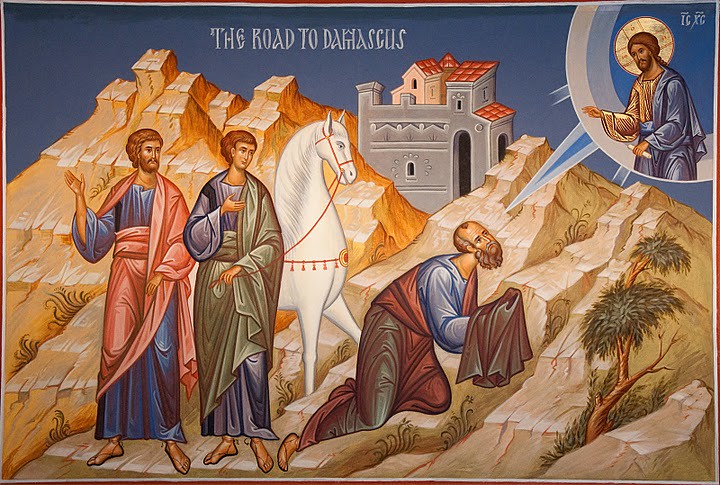
On the road to Damascus
For the past couple of weeks we have been parsing the early Easter experience of those people who found themselves picking up the pieces after Good Friday, and trying to make sense of the weird rumours that the one who had certainly been dead was somehow alive, with God and yet also with them.
We find it hard to make sense of those stories after 2,000 years, but imagine how hard it must have been for the small group of people who did not abandon their hope that God was in Christ reconciling the world to himself, even though many of them had failed Jesus at his most critical time.
For them there was no long tradition of Christian faith and practice to look back upon and from which to draw some credible basis for faith.
Like the dedicated branch members in Isaacs, Lyons and Melbourne and Wills, those first disciples saw their hopes and dreams evaporate. Then the rumours started. There was no social media, but word was passing from one person to another that Jesus was not dead after all.
Not exactly back to his old self, so to speak.
Not walking the dusty roads of Palestine, teaching the crowds and healing the sick.
But spotted here and there, and most often when his disciples gathered to break the bread and to seek strength from God for the world-transforming work to which God had called both Jesus and them.
Instead of dispersing after the death of Jesus, his followers were hanging together and even growing in numbers.
Like the broomstick in the Sorcerer’s Apprentice, the problem seemed to be getting worse with every attempt to deal with the ‘problem’ of the Jesus people.
The authorities began to arrest and kill the followers of Jesus, but they just seemed to multiply.
No longer limited to a few villages in Galilee and a handful of houses in Jerusalem, this sect was now to be found in many parts of the country and was even spreading to regional cities like Antioch and Damascus.
A plan emerges: send young Saul to Damascus with letters of authority to arrest these crazy people and drag them back to Jerusalem for punishment. This nonsense must be stopped.
Another broken broomstick …
Saul will become Paul, the greatest and most influential follower of Jesus that the world has ever seen.
Our first reading in today’s lectionary is the classic tale from Acts 9 of Saul’s “Damascus road” experience as he encounters the risen Lord: Acts 9:1-6.
This is the first of three versions of the call/conversion of Saul/Paul in Acts, and they each tell the story a wee bit differently: chapters 9, 22 and 26.
These variations form part of the narrative art of the author of Luke-Acts, and it is not clear that Paul would have agreed with the ways in which his own “Easter moment” was being portrayed. He was adamant that his ‘gospel’ came direct from God and without any human third parties involved. Acts gets there by the third iteration, but along the way portrays Paul as being nurtured by local runaway Christians in Damascus as he makes sense of his own encounter with the risen Lord.
We have Paul’s own account in his own words in his letter to the Galatians, a region in southern Turkey. This may be the first piece of Christian literature to have survived and is commonly described as the first of Paul’s letters. It may be dated to 49/50 CE, just 20 years after Easter.
You have heard, no doubt, of my earlier life in Judaism. I was violently persecuting the church of God and was trying to destroy it. I advanced in Judaism beyond many among my people of the same age, for I was far more zealous for the traditions of my ancestors. But when God, who had set me apart before I was born and called me through his grace, was pleased to reveal his Son to me, so that I might proclaim him among the Gentiles, I did not confer with any human being, nor did I go up to Jerusalem to those who were already apostles before me, but I went away at once into Arabia, and afterwards I returned to Damascus. (Galatians 1:13–17 NRSV)
Can you imagine a church without Paul?
It seems that God could not, and for sure the church we now are is deeply indebted to this mercurial figure who was not a follower of Jesus and yet became the most influential of the Apostles.
The story of Paul encapsulates the Easter miracle, so we can be glad that the lectionary committee has chosen the passage from Acts 9 for us to reflect upon today.
Of course, as we rejoice in the legacy of Paul, we are reminded that God may be waiting to ambush us—or our church.
The God of Easter, the God who raised Jesus from the dead, the God who called Paul to serve as the greatest exponent of Christ is also the God calls us to live bravely into the future rather than defend the past.
It seems a lot longer, doesn’t it since Easter? Was that really just a week ago? It has been an odd kind of week with ANZAC Day in between and all the other stuff that has happened. It seems a lot longer than just a week ago.
Like the disciples in the first week of Easter we have made our way through our first week of Easter, wondering how we make sense of it all and what difference—if any—it makes to our lives anyway.
As we gather in church today to reflect on all that, three major spiritual streams are converging:
Earth Sunday
Easter 2
Baptism
And all of this in the context of a Eucharist when we gather around the Table of Jesus, take bread made from grain which the earth has given us and drink wine made from the vine sustained by Earth herself.
Gathering at the Table of Jesus also features in the Gospel readings that we hear during these first weeks after Easter Day.
The Table of Jesus is a place of identity: who we are is on display here.
The Table of Jesus is a place of transformation: things of Earth become sacraments of heaven.
The Table of Jesus is a place of encounter: The earliest disciples recognised Jesus alive among them in the breaking of the bread.
The Table of Jesus is also a place where faith and doubt dance eternally: They are not either/or choices, but the dynamic of discipleship as we seek to discern and embrace the risen Lord active in our midst.
So here we are, like the disciples in that Gospel reading which we have just heard, gathered around the Table of Jesus a week after Easter.
We are a mixed mob. So were they.
Some of us have faith that is so strong it seems nothing could ever break it. Some of us have doubts that are so strong that faith seems unreasonable. Most of us, perhaps, are somewhere in the middle: partners in the eternal dance of doubt and faith.
Some of us will think that baptising Jace and Rylee is one of the most important things we can do for them. Others may think it is a quaint old family custom that cannot do much harm. Most of us—myself included—are somewhere in between. We are a mix of doubt and faith, anxiety and hope, strength and weakness; all at the same time, and always.
It was like that in the Upper Room at Jerusalem as the disciples gathered around the Table of Jesus and wondered what sense to make of the weird rumours they had been hearing all week.
Yes, Jesus had been dead.
There was no doubt about that. They saw him on the cross and the Romans did not allow anyone to be rescued before they were dead.
At least they had been allowed to remove the body of Jesus after he was dead. The Romans did not keep him on the cross as food for the birds and as a warning to other people not to step out of line.
Seems it was bad luck for the Temple to have dead men on their crosses during Passover.
Dead and buried, even if done hastily and without all the proper rituals.
No doubt about that.
But then the weird stories started.
Mostly the women. Of course. Always more inclined to drama and fairy tales.
But then Peter said he had seen Jesus too. Crusty old fisherman Pete. The Rock.
And James, the brother of Jesus who was not even one of the disciples.
Then Cleopas and his wife from Emmaus.
Mary Magdalene was on a campaign. She had always loved Jesus, but now she was insisting he still alive even though everyone knew he was dead.
Thomas was a tough nut to crack. No women’s gossip for him. He was not going to believe all this Easter stuff until he could see Jesus for himself and touch the wounds from the crucifixion.
A week later his disciples were again in the house, and Thomas was with them. Although the doors were shut, Jesus came and stood among them and said, “Peace be with you.” Then he said to Thomas, “Put your finger here and see my hands. Reach out your hand and put it in my side. Do not doubt but believe.” Thomas answered him, “My Lord and my God!” Jesus said to him, “Have you believed because you have seen me? Blessed are those who have not seen and yet have come to believe.” (John 20:26–29 NRSV)
I love that ancient Christian story.
It reminds me that doubt is a healthy part of faith. Indeed, it reminds me that faith without any questions or doubt may not be very healthy at all.
That is the eyes-wide-open kind of religion into which we baptise Jace and Ryle this morning.
Parents and godparents are promising to teach them the steps in the dance of doubt and faith, listening for the sacred music at the heart of the universe, and moving their lives in harmony with the God who says, “Here I am. Come and play.”
The Cathedral has a part to play in the dance, but the most important roles are those performed by the parents, godparents and extended family.
How you look at the world will become the way they look at the world.
How you manage your doubts and your beliefs will become their way as well.
Being Earth Sunday, we are reminded that this is not just about us and it is certainly not about buying fire insurance to get human souls out of hell.
At the heart of everything is the fact that the world exists.
Not only is the Earth here, but Earth has developed the capacity to be aware of itself and to know that it is here.
We are the Earth coming to conscious awareness.
Life is not about us over here and Earth over there.
We are Earthlings, and what counts for us as salvation is also salvation for all of creation: for the Earth itself and the universe as a whole.
Easter is not just for humans, but for God’s whole created universe.
At Christmas we celebrate God among us—Emmanuel‚ as sacred Spirit becomes human person; the Creator becomes Earthling.
At Easter we celebrate the transformation of reality that God’s dance makes possible.
Again, we find the dance of doubt and faith drawing us into the future, into God herself.
Have we got this all figured out? No way.
But this too is what we will be sharing with Jace and Rylee in the days, weeks, months and years to come.
So, let’s head down to the font and get this dance started …
The media has recently been awash with stories about the hateful comments made online by Australian Rugby Union star, Israel Folau, about various classes of people being destined for hell unless they repent and conform to a set of beliefs (and related lifestyle choices) promoted by extremely conservative Christians.
His original Instagram post then reinforces his threats of damnation in the fires of hell with a series of citations from the King James Version (KJV) of the Bible.
To be fair, similar claims can be heard at almost any Anglican Church in the Sydney area, as well as in many other congregations around the country where ultra-traditional religious views survive to this day.
Such views are abhorrent, no matter who makes them. They also reflect a profound ignorance of the Bible and of biblical hermeneutics.
Now we find Des Houghton—a Courier-Mail columnist and opinion writer—arguing that criticism of Folau for his hateful views is really an attack on Christianity, and perhaps on all forms of religious faith.
This is going too far.
Religion is neither an excuse for hate speech nor a protection for those who engage in it.
Condemning people to the fires of hell because of their beliefs or their lifestyle—like claiming divine approval for slavery, ethnic cleansing and patriarchy—is an element of Christian faith that progressive believers have long since laid aside as inappropriate; along with burning peoople at the stake and interrogating them under torture.
These are indeed among the darker elements of Judaism and Christianity, but are no longer practices that we can endorse or defend.
Just as polygamy and female genital mutilation are not permitted under Australian law despite their status as traditional religious practices, hate speech that threatens people with hellfire cannot be excused as ‘protected religious activity’.
Sadly our religious leaders—bishops and moderators alike—have been strangely silent in response to the hateful social media posts by Israel Folau [but see the Media Statement by the Bishop of Grafton]. For sure some will secretly agree with him although they mostly do not speak so openly about their views these days. Most have simply been silent, and perhaps thereby were mistakenly assumed to agree with his views.
The Bible does not justify hate speech even when the Scriptures themselves descend to the gutter in the heat of some particular conflict.
Our society has moved on and the views promoted by people such as Israel Folau serve best when they remind us of how far we have come. Theocracies are one of the most dangerous forms of human society, as we see daily in both Saudi Arabia and Iran.
The best response to such extremist nonsense is perhaps ridicule rather than prosecution. Laugh them off the stage and move your discretional spending to other recreational pursuits.
In two weeks time I will be in Sydney to speak at the Festival of Wild Ideas, an event sponsored by the Mosman/Neutral Bay Inter-Church Council. My topic for that address is: Reading the Bible to promote human flourishing.
The proposal at the core of my presentation is that the immense cultural and spiritual significance of the Scriptures lies precisely in their capacity to inspire us to move beyond earlier expressions of humanity and to reach new levels of awareness, courage and compassion; in short to be more fully human than ever before.
Needless to say I will use the Bible very differently from Mr Folau and I shall come to very different conclusions about God’s desire to bless us profoundly across all of our diversity as humans.
A full text of that address will be posted here after the event.