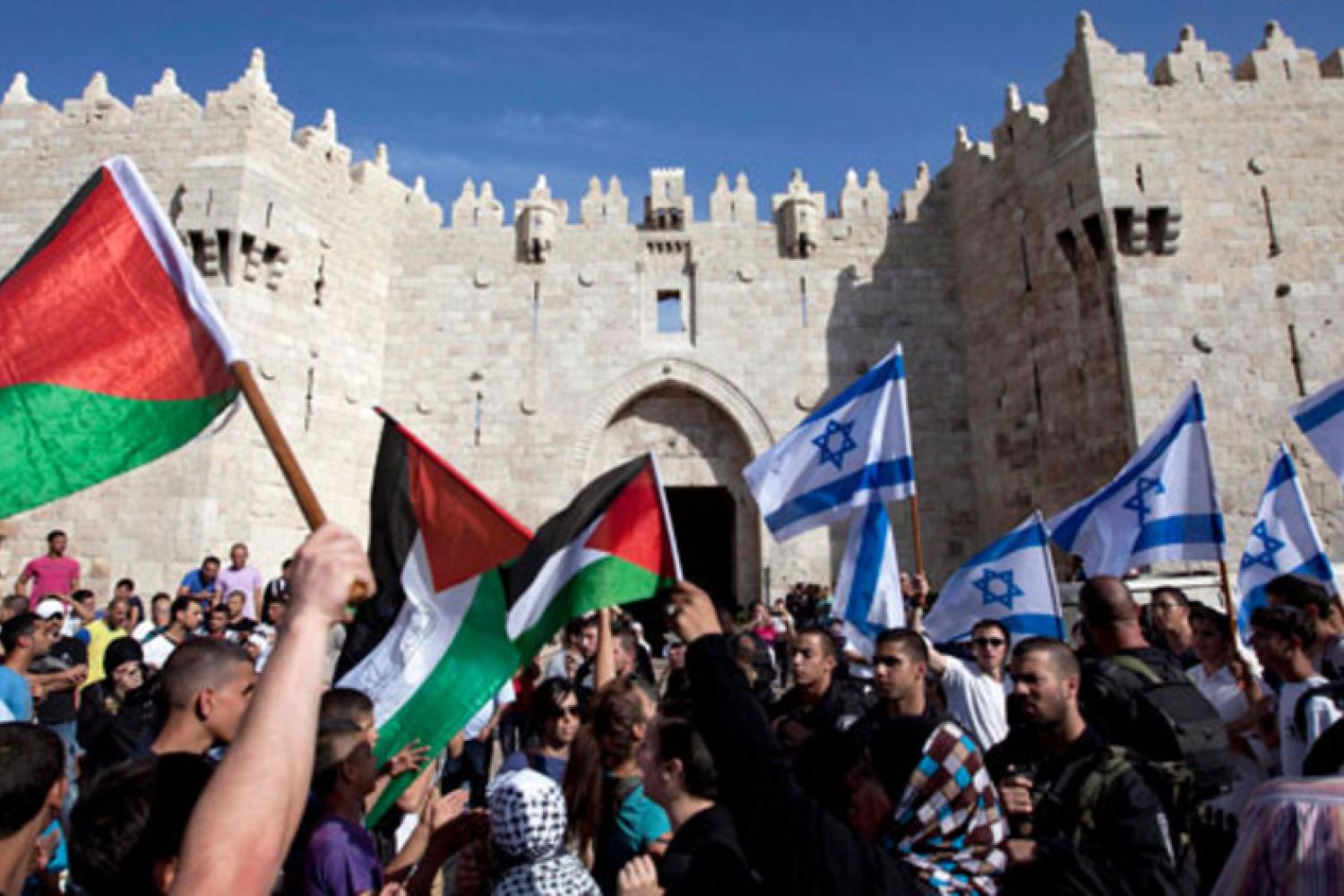
Tag: Israel-Palestine

  • Creating a shared future in Palestine

    Creating a shared future in Palestine

    The final in a series of brief blog posts offering a perspective on the conflict in Palestine.

    Human rights and the future of Palestine | Location location | A time between empires | Zionism as a colonial project | Jewish migration to Palestine | Dividing Palestine | The war of 1948 | Wars and rumors of war | Palestinian resistance | Creating a shared future in Palestine

    Resolving the conflict in Palestine has occupied and defeated the best minds of several major nations. The British could not find a solution during their Mandate administration and clearly the USA has not been able to do any better since 1948. Nor have the Europeans, the UN or the Russians.

    The Israeli activist, Jeff Halper, has suggested that Israel is seeking to achieve three outcomes, any two of which (but only two of which) they can have:

    1. Control of the ‘biblical lands’ from  Dan to Beersheba
    2. A distinctively Jewish state
    3. A democratic society

    As Halper says, Israel can control all of the biblical lands and create a distinctively Jewish state, but such a society will not be democratic. If it opts for the land with democracy, then the state will not be Jewish. It may, of course, relinquish its control of all the biblical lands and create a state which is both distinctively Jewish and democratic. The latter option is also known as the Two State Solution and is clearly not the preferred option of any recent Israeli government. 

    I propose a variation of Halper’s three options, by suggesting there are only four logical possibilities. None of them will be easy to achieve. Some are worth the effort.

    Status quo

    Israel achieved dominance by military force and has sustained that dominance with the diplomatic support of the US. By adopting the 2018 Nation State Bill, the Israeli Knesset has opted to define Israel as the nation state of the Jewish people with its non-Jewish citizens having limited civil and political rights. Only Jews are permitted to exercise national self-determination with the State of Israel. While this law does not address the question of Israel’s borders, it reflects an assumption that Jewish values and Jewish rights will prevail wherever Israeli sovereignty is effective should there be any conflict with the civil or political rights of non-Jews. Irrespective of where the borders of such a Jewish state may be, any Palestinian living within such a state must accept that the nation is for Jews and not for them. Such a Jewish nation state may choose to retain military control of the Palestinian territories, even if local Palestinian areas are allowed some form of limited local autonomy. The closest historical parallel is, of course, the apartheid regime in South Africa. Very few people, including only a small minority of Jews, are likely to accept this as a permanent outcome of the conflict in Palestine.

    Two States

    The current preferred option for all the stakeholders is the so-called ‘two-state solution.’ This was the basis of the Oslo Accords but it has not been fulfilled in practice. We do not have two states living side by side in peace and security. This solution is widely seen as being on life support, if not already dead. It could be revived with sufficient political will from the international community, but only if the US stops rewarding Israeli intransigence with protection from the decisions of the UN Security Council.

    One State

    There is growing for support for a single unified state that encompasses all the people living between the Jordan River and the Mediterranean, and possibly makes some provision for the eventual return and integration of the Palestinian refugees displaced in 1948 and 1967 (and their descendants). This need not require a single unitary nation-state with all decisions being made on the basis of universal suffrage. There are various models that offer ways forward which hold promise of good outcomes for the people. One such model recognizes that the Jewish and Palestinian populations tend to be unevenly distributed across the total area and provides for regional councils (cantons) which reflect the cultural and economic dynamics of their particular demographics. Most of these would be close to 100% Jewish or 100% Palestinian, while a few would be mixed. Jerusalem might be a unique case due to its religious profile. Within each canton people could choose to have regulations that reflect their identity and values, while certain functions (including foreign affairs, defense, energy and water) would be handled by a national assembly whose powers are limited to such matters and cannot legislate those affairs delegated to regional councils. This limited national federation would be elected by universal suffrage of all the people living across all of the regional cantons, but its capacity to shape the ethnic and religious character of particular regions would be curtailed. Such a proposal represents a modification of the concept of ‘nation,’ just as the European Community has done within its member states.

    Confederation

    In the medium to long-term future there are possibilities for a regional confederation. This could be achieved whether the intermediate stage was a two-state model or a federation with autonomous cantons. The confederation could comprise, in the first instance, Israel and Palestine. It could easily be extended to include Jordan, and perhaps also Lebanon. Possibly even Syria might be considered as a member of such a regional confederation. The economic and cultural impact of such collaboration between current combatants could be immense as well as very positive. It may even prevent the rise of another empire seeking to impose order on the unruly Levantine region in the next 50 to 100 years. The current religious and political extremists would hate such an outcome, and that just may be the strongest argument in its favor.

    Human rights and the future of Palestine | Location location | A time between empires | Zionism as a colonial project | Jewish migration to Palestine | Dividing Palestine | The war of 1948 | Wars and rumors of war | Palestinian resistance | Creating a shared future in Palestine

  • Palestinian resistance

    Part of a series of brief posts offering a perspective on the conflict in Palestine

    Human rights and the future of Palestine | Location location | A time between empires | Zionism as a colonial project | Jewish migration to Palestine | Dividing Palestine | The war of 1948 | Wars and rumors of war | Palestinian resistance | Creating a shared future in Palestine

    During the British Mandate

    As Jewish migration developed momentum during the British Mandate period, and as the British commitment (in the 1917 Balfour Declaration) to support the “establishment in Palestine of a national home for the Jewish people” alarmed the indigenous population, there was growing unease among the Palestines. There were sporadic outbreaks of violence and several major cases of civil violence.

    The Shaw Enquiry which was set up after the riots in 1929 observed as follows:

    In less than 10 years three serious attacks have been made by Arabs on Jews. For 80 years before the first of these attacks there is no recorded instance of any similar incidents. It is obvious then that the relations between the two races during the past decade must have differed in some material respect from those which previously obtained. Of this we found ample evidence. The reports of the Military Court and of the local Commission which, in 1920 and in 1921 respectively, enquired into the disturbances of those years, drew attention to the change in the attitude of the Arab population towards the Jews in Palestine. This was borne out by the evidence tendered during our inquiry when representatives of all parties told us that before the War the Jews and Arabs lived side by side if not in amity, at least with tolerance, a quality which to-day is almost unknown in Palestine.

    Shaw Enquiry

    The Palestinian resistance was increasingly directed towards Britain and took the form of demands for independence, but there were major incidents that involved considerable numbers of Jewish casualties in Jaffa, Hebron and Jerusalem.

    1948 War

    With the failure of diplomacy to avert the UN partition plan, the Palestinians participated in the armed conflict following Israel’s declaration of independence. Unlike the irregular Jewish forces, the Palestinians had very little military training and even less equipment. While the Arab Legion had considerable success, the troops which had been deployed by Egypt, Iraq and Syria were no match the better organized and better led Jewish forces. Many of the latter had been trained by the British and seen action against the Axis powers in World War Two.

    Palestinian Liberation Organization

    The PLO was established in 1964 with the objective of defeating Israel by armed struggle with a view to restoring Palestine sovereignty. It quickly became the principal representative of the Palestinian people, and eventually Jordan relinquished its claim to sovereignty over Jerusalem and West Bank in favor of the PLO. While the PLO never achieved any significant military success against Israel inside Palestine, it gained notoriety through several terror attacks including hijacking of airliners and the killing of Israeli athletes during the Munich Olympics in 1972. At a time when the Arab states seemed impotent in the face of Israel’s military supremacy, the PLO enjoyed broad popular support. After being expelled from Jordan in September 1970, the PLO established a strong presence in Lebanon where it played a significant role in the Lebanese civil war. The PLO was expelled from Lebanon after the 1982 Israeli invasion and its base of operations was then in Tunisia.

    Eventually the PLO opted for a diplomatic solution, and accepted UN Resolution 242, which proposed a two-state model with “secure and recognized boundaries.” Since 1993 the PLO has recognized Israel’s right to exist, accepted UN Resolutions 242 and 338, and has renounced armed struggle in its quest for a Palestinian state. Both Israel and the USA have recognized the PLO as the representative of the Palestinian people.

    First Intifada

    The ‘Intifada’ was essentially a spontaneous civil uprising in response to multiple irritants arising from the conditions of Palestinians under Israeli military occupation in Gaza, East Jerusalem and the West Bank. It largely involved demonstrations by unarmed young Palestinians and reflected a loss of confidence in the capacity of stablished Palestinian elites to improve the situation. Israel responded to the Intifada with increased police and military activity. More than a thousand protestors were killed, many thousands were jailed, and hundreds were exiled. Several hundred Palestinians were also killed by the PLO on suspicion of collaboration with Israel. While the Intifada had few tangible outcomes, it was a public relations disaster for Israel as stone-throwing Palestinian youths evoked the biblical images of David confronting a Goliath dressed in Israeli military fatigues. It most likely contributed to the success of the secret discussions leading to the Oslo Accords, as it energized the Palestinian leadership and challenged the Israeli narrative.

    The Oslo Accords

    The 1993 Oslo Accord represented the first direct agreement between Israel and the PLO. This led to the establishment of the Palestinian Authority with some degree of self-rule in Gaza and the West Bank, with continuing Israeli control of security, taxation, etc. The status of Jerusalem (along with Palestinian refugees and other matters) was to be resolved as part of “permanent status negotiations” beginning no later than 1996. The provision of the Oslo Accords, including a second set of agreements signed in 1995, have never been fully implemented. Israeli Prime Minister, Yitzhak Rabin who signed the Oslo Accords with Yasser Arafat at the White House in 1993 was assassinated by a right-wing Jewish extremist in November 1995. 

    Jewish settlements in the West Bank

    While there had been some Jewish settlements beyond the Green Line (especially Efrat near Bethlehem, Gush Etzion near Jerusalem and Ma’ale Adumim near Bethany) after 1967 and prior to the Oslo Accord, there has been a marked increase in Jewish settlements—including considerable expansion of existing settlements—since 1993. These Jewish colonies are intended to create ‘facts on the ground’ to ensure a more favorable outcome for Israel in the event of a final peace agreement, and those being created in a ring along the eastern boundary of Jerusalem are designed to isolate Arab East Jerusalem from the West Bank. These settlements often begin as military outposts, with Palestinian land being appropriated by the military occupation authority for security reasons. Others have started as illegal land grabs by small groups of activists. Generous subsidies and tax concessions are in place to encourage Israeli Jews to move to these peripheral settlements, many of which have been connected to Jerusalem by commuter rail and road networks. While located inside the boundaries of Palestine (in Area C), these settlements—which are illegal under international law—are under Israeli civil law, while their Palestinian neighbors are under military law even if living in Area A or B.

    Second Intifada

    Frustrations with the lack of tangible improvements for Palestinians exploded with a more violent second Intifada following a provocative visit to the al-Aqsa Mosque by the Israeli politician Ariel Sharon in September 2000. There were outbreaks of armed conflict between Israeli and Palestinian forces in areas such as Bethlehem and Jenin, while the whole period saw numerous suicide bombing attacks against civilian targets inside Israel. One of the outcomes was the construction of a physical barrier, more or less along the lines of the 1949 armistice agreement, to prevent easy movement of Palestinians into Israel from the West Bank. Israel increasingly discouraged the employment of Palestinians from the West bank on projects inside Israel and those seeking daily entry were subjected to strict security measures. Following the death of Yasser Arafat in 2004, the intifada subsided, with the conflict between Hamas and the PLO becoming a major fault line in Palestinian society. Hamas won the 2006 Palestinian elections, but the Palestinian Legislative Council has not convened since Hamas expelled the PLO from Gaza in 2007.

    Hamas

    The Islamic Resistance Movement (for which HAMAS is an acronym), was founded in 1987 during the First Intifada. Whereas the PLO was essentially a secular national movement, Hamas has clear religious foundations (Sunni Islam) and has also rejected the recognition of Israel by the PLO. It seeks to establish an Islamic state incorporating the whole of historic Palestine. Where the PLO leadership is widely seen as corrupt and ineffective, Hamas enjoys widespread popular support and won the 2006 elections for the Palestinian Legislative Council. The Council has never been summoned and the PLO has ruled by presidential decree, despite losing control of Gaza to Hamas in 2007. Hamas is now quite active on the West Bank and was expected to win the 2021 Parliamentary elections, which were cancelled in May this year. Hamas has been supported by Iran and Qatar, but is regarded as a terror organization by the US and Israel. Australia and the UK regards its armed wing as a terror organization, but not Hamas itself.

    Hezbollah

    Hezbollah (‘Party of Allah’) is a Shia Islamic resistance movement, based in Lebanon and with strong ties to both Syria and Iran. Hezbollah has become the dominant force in Lebanese politics, and won a majority of seats in the 2018 elections. It has been active in the Syria civil war in support of the Bashar al-Assad regime. Hezbollah was created in the aftermath of the 1982 Israeli invasion of Lebanon and has considerable military experience as well as substantial missile capacities. Like Hamas in Gaza, Hezbollah has engaged in occasional inconclusive military exchanges with Israel.

    Human rights and the future of Palestine | Location location | A time between empires | Zionism as a colonial project | Jewish migration to Palestine | Dividing Palestine | The war of 1948 | Wars and rumors of war | Palestinian resistance | Creating a shared future in Palestine

  • Wars and rumors of war

    Part of a series of brief posts offering a perspective on the conflict in Palestine

    Human rights and the future of Palestine | Location location | A time between empires | Zionism as a colonial project | Jewish migration to Palestine | Dividing Palestine | The war of 1948 | Wars and rumors of war | Palestinian resistance | Creating a shared future in Palestine

    1956 Suez Crisis

    In the absence of a formal peace treaty between the protagonists of 1948, the various armistice agreements mostly sufficed to maintain calm. There were occasional incidents and the survival of Israel as a distinctively Jewish state within the Middle East was far from certain. Cold War politics impacted on the situation as the USSR and its allies tended to support the Arabs, while the USA and its allies tended to support Israel. Jordan was unusual as it enjoyed good relations with both Britain and the USA, while Iran was also firmly in the Western sphere of influence prior to the Islamic Revolution 1979.

    The Suez Crisis of 1956

    In response to the nationalization of the Suez Canal by the Egyptian government in July 1956, Israel invaded Egypt with the active support of Britain and France. Despite initial military success, the  campaign was abandoned due to opposition from both the USA and the USSR.

    The Six Day War of 1967

    When Egypt reinstated an earlier naval blockade of Israeli shipping in the Straits of Tiran leading into the Gulf of Aqaba tensions soared once more. On 5 June 1967 Israeli forces launched a pre-emptive attack that destroyed most of the Egyptian air force and this was followed by a land invasion of the Sinai Peninsula, the capture of East Jerusalem from Jordan and the capture of the Golan Heights from Syria. 

    This brief military operation was a stunning success and gave Israel uncontested control of all Palestinian lands west of the Jordan River. East Jerusalem was annexed by Israel on 27 June 1967 and the reunified city was declared the “undivided and eternal capital” of the Jewish people. Very few countries have recognized Jerusalem as the capital of Israel or the annexation of East Jerusalem. Since June 1967 the Jewish character of the city has been intentionally developed, while the rights of its Palestinian residents have been curtailed.

    Since the 1967 war, Israel has maintained a significant edge in its military dominance of the region, with no Arab nations able to match its fire power.

    The War of 1973

    In October 1973, Egypt and Syria launched a coordinated series of attacked in the Sinai and the Golan. After some initial success, the Arab coalition forces were eventually defeated with Israel forces advancing deep into both Egypt and Syria. Despite the eventual success of the Israeli military, this conflict gave new impetus to moves for a diplomatic solution based on the principles of land for peace. Under the Camp David Accords signed in 1978, a formal peace treaty was signed between Egypt and Israel, and the Sinai was returned to Egypt.

    1982 Invasion of Lebanon

    Israel invaded Lebanon in July 1982, citing numerous provocations including an assassination attempt against its ambassador to the UK. The objectives of the invasion were to break the power of the PLO (which had been shelling the northern areas of Israel from bases in Lebanon), install a Christian government and sign a peace treaty with Lebanon. The PLO was eventually expelled to Tunisia and its influence greatly weakened. It proved impossible to install a pro-Israel Christian government, and Israel withdrew from Beirut to the area south of the Litani River where it established a security zone in collaboration with a pro-Israel militia force, the South Lebanon Army. The campaign was marked the massacres by Christian militia (supported by Israeli forces) at the Sabra and Shatila refugee camps, and an international investigation later attributed considerable responsibility for these events to the Israeli general (and later politician), Ariel Sharon. Israel sustained its control of the security zone in southern Lebanon until 1990 and the war became increasingly unpopular with the Israeli public. While Israel largely succeeded in its aim of eliminating PLO influence, its intervention in Lebanon is widely seen as contributing both to the rise of Hezbollah (filling the vacuum left after the collapse of the PLO) and an extended intervention in Lebanese politics by Syria.

    Palestinian Fatah fighters in Beirut

    Human rights and the future of Palestine | Location location | A time between empires | Zionism as a colonial project | Jewish migration to Palestine | Dividing Palestine | The war of 1948 | Wars and rumors of war | Palestinian resistance | Creating a shared future in Palestine

  • The war of 1948

    Part of a series of post offering a perspective on the conflict in Palestine

    Human rights and the future of Palestine | Location location | A time between empires | Zionism as a colonial project | Jewish migration to Palestine | Dividing Palestine | The war of 1948 | Wars and rumors of war | Palestinian resistance | Creating a shared future in Palestine

    An Israeli soldier stop Arabs in a street in Nazareth, Palestine, July 17, 1948, as they are travelling after the allotted curfew time. Israeli forces had occupied the town earlier that day.

    On 14 May 1948, David Ben-Gurion—who was then Executive Head of the World Zionist Organization and Chairman of the Jewish Agency for Palestine—proclaimed the Declaration of the Establishment of the State of Israel. This was to take effect when the British mandate expired at midnight on the same day.

    The declaration did not specific the borders of the Jewish State, but it was indicated that this new state would exist within the provisions of UN Resolution 181.

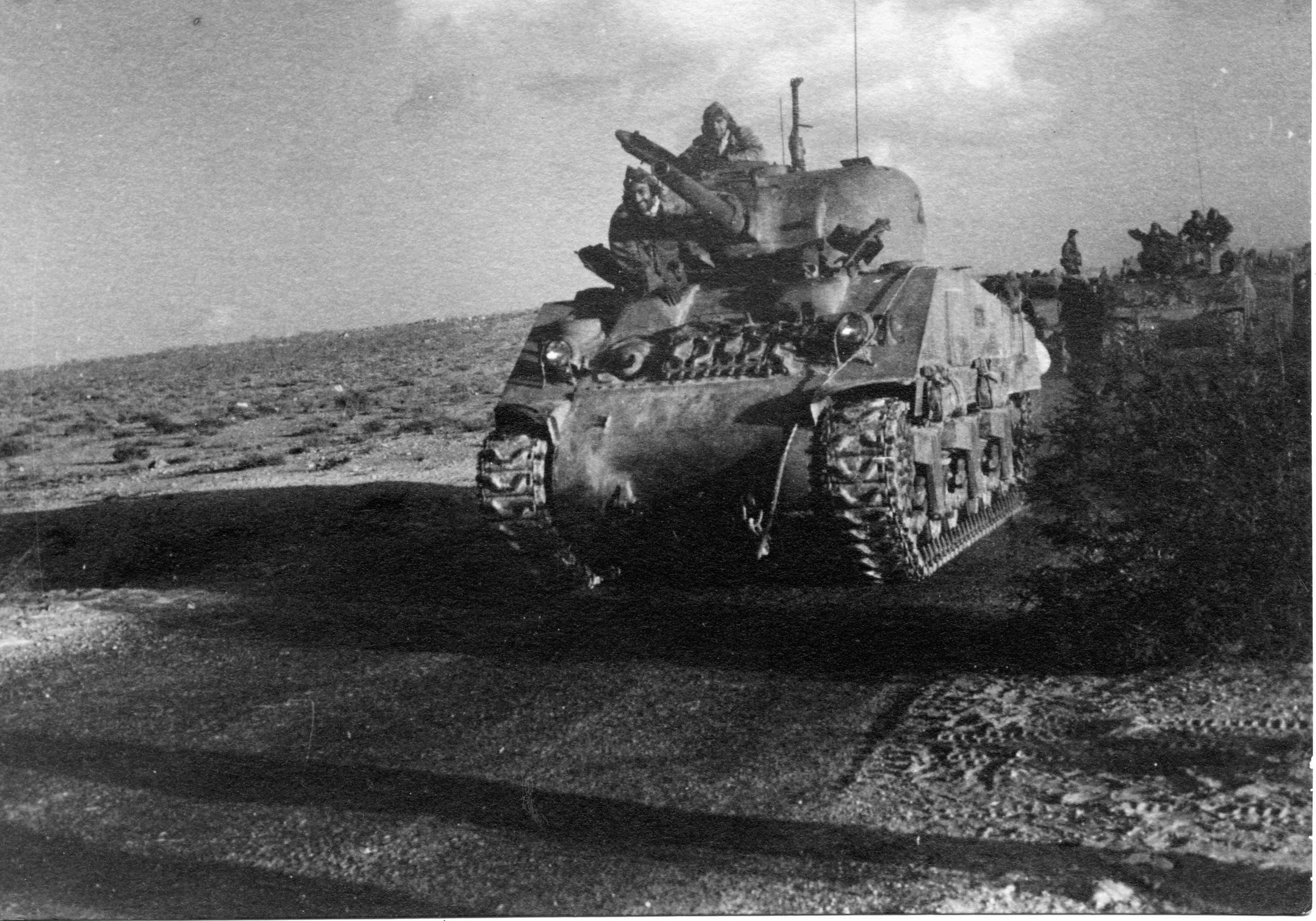
    Military forces from Egypt, Transjordan, Syria and Iraq attempted to intervene to prevent the partition of Palestine as agreed by the UN plan, but their forces were defeated, and the 1949 armistice agreement saw Israeli control over a much larger area. That territory is commonly described as the “pre-1967 borders.” 

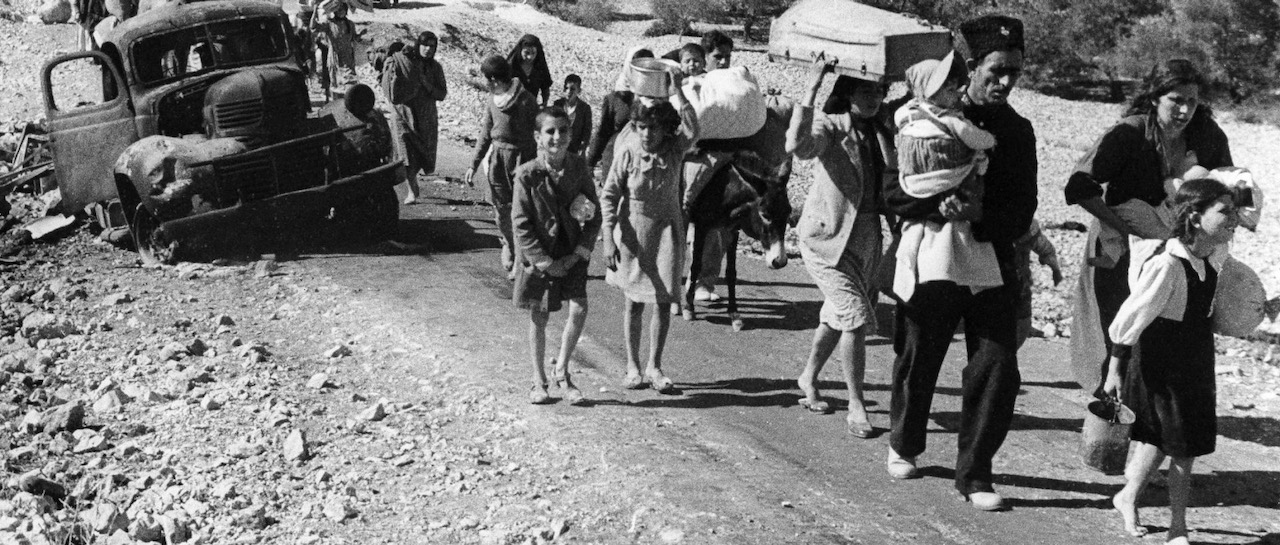
    During the conflict an estimated 750,000 Palestinians were expelled from areas under Israeli control. Many found of them refuge in Gaza, East Jerusalem, the West Bank, Jordan, Lebanon and Syria. They came under the care of UNRWA, the UN Relief and Works Agency for the Palestinian Refugees. In 2021 UNRWA continues to support almost 6 million Palestinian refugees, including the children and grandchildren of those displaced in 1948 as they have not been allowed to return to their homes.

    This left around 150,000 Palestinians inside the area of Palestine controlled by Israel, of whom around 35,000 were internally displaced persons. These IDPs found refuge in major Arab centers such as Nazareth, whose population grew from 15,500 in 1946 to 20,000 in 1951 and 25,000 in 1961. 

    The Palestinian population within Israel lived under strict military rule from 1950 until 1966. Under these regulations, Palestinians could not leave their own village without permission from the military governor. Since 1966 there has been freedom of movement within Israel (and at times after the June 1967 war, within the whole of historic Palestine). In many cases their villages were razed, partly being used for military training to prepare for future conflict with Israel’s neighbors. The iNakba app provides details of some 500 villages which were erased by the Israeli state after 1948.

    Neither the internally displaced Palestinians nor those who fled to neighboring countries to escape the conflict have been allowed to return to their homes or reclaim their property. In many cases their former homes were given to Jews who had also been displaced from areas remaining under Arab control or arriving from overseas.

    As part of the wider disruption across the Middle East following the partition of Palestine, around 800,000 Jews relocated from Arab nations to Israel.

    For Israeli Jews, the war of 1948 is known as the War of Independence, while for the Palestinians it is known as the Nakba (The Catastrophe).

    Although the UN partition plan envisaged the creation of a Palestinian state alongside the Jewish state, this was not created at the time. Egypt remained in control of Gaza at the SW edge of Palestine, Syria held some territories in the far north, and Jordan controlled the West Bank, including the Old City of Jerusalem.

    The Palestinian Declaration of Independence was only finally proclaimed on 15 November 1988.

    Arab refugees stream from Palestine on the Lebanon Road, Nov. 4, 1948.

    Human rights and the future of Palestine | Location location | A time between empires | Zionism as a colonial project | Jewish migration to Palestine | Dividing Palestine | The war of 1948 | Wars and rumors of war | Palestinian resistance | Creating a shared future in Palestine

  • Dividing Palestine

    Part of a series of brief posts offering a perspective on the conflict in Palestine.

    Human rights and the future of Palestine | Location location | A time between empires | Zionism as a colonial project | Jewish migration to Palestine | Dividing Palestine | The war of 1948 | Wars and rumors of war | Palestinian resistance | Creating a shared future in Palestine

    During World War One, Britain encouraged both Arab nationalism and Jewish Zionism as part of their military struggle with the Ottoman Empire. Both were promised national independence in Palestine in return for the support of the British war effort.

    During World War One, the Great Arab Revolt against Ottoman ruled was led by Hussein, the Sharif of Mecca and his three sons Abdullah, Faisal and Ali. In return the British had promised support for an independent Hashemite state stretching from Syria to Yemen. 

    Meanwhile, the Balfour Declaration of 1917 indicated that the British government viewed “with favour the establishment in Palestine of a national home for the Jewish people” and promised to “use their best efforts to facilitate the achievement of this object, it being clearly understood that nothing shall be done which may prejudice the civil and religious rights of the existing non-Jewish communities in Palestine …”

    While this declaration had no legal status under international law, it did represent an explicit endorsement of the idea of a Jewish national home within historic Palestine. 

    Delivering on the declaration was one of the terms for the mandate given to Britain by the League of Nations to provide “administrative advice and assistance … until such time as they are able to stand alone.” The British understood their role to include the establishment of a national home for the Jews while also preserving the civil and political rights of Palestinian Arabs, but this became increasingly fraught as tensions grew between the two local communities in Palestine.

    In 1921—as a partial fulfilment of their promise to Hashemites, and despite their commitment to creating a Jewish homeland in Palestine—the British Mandate authorities established the portion of Palestine east of the Jordan River as the Emirate of Transjordan, ruled by Abdullah I as its first Emir. This emirate remained a British protectorate until 1946 when it gained its independence and adopted the name “Hashemite Kingdom of Jordan.” 

    With the establishment of the United Nations, Britain relinquished its mandate to develop the autonomous political and social infrastructure of Palestine.  Resolution 181 (II) on 29 November 1947 agreed to a partition plan to create separate independent Arab and Jewish states within Palestine, while reserving Jerusalem and its suburbs as a special International Zone (‘Corpus Separatum’) outside either national state. Although Arabs comprised 67% of the population, they were allocated just 43% of the territory. The partition was accepted (with some reservations) by Jewish groups but was rejected by the Palestinians and all other Arab nations.

    After the war of 1948 (see next post), Palestine was divided: with 78% of historic Palestine under Israeli control and the remaining 22% split between areas controlled by Jordan (East Jerusalem and the West Bank) and Egypt (Gaza). Following the Six-Day War in June 1967, all of historic Palestine was under one power, although expressed through a Military Occupation in the areas beyond the ‘Green Line’ of the 1949 Armistice. The Green Line is widely regarded as the de facto international border between Israel and Palestine following UN Resolution 242

    Under the Oslo Accords, the areas occupied by Israel in 1967 were divided into three categories: Areas A, B and C. Area A was designed to be exclusively administered by the Palestinian National Authority, while Area B was to be jointly administered by the Palestinian Authority and Israel. Area C was to be administered solely by Israel. These arrangements have not been fully implemented, as Israeli military forces routinely enter Area A.

    During the Second Intifada (2000–2005), Israel constructed a physical barrier more or less along the Green Line to prevent easy movement of people from the West Bank into Israel and Jerusalem. The wall cuts deep into Palestinian lands on the West Bank to include Israeli settlements as well as natural water reserves, and in places separates Palestinians from their fields or other members of their family.

    Human rights and the future of Palestine | Location location | A time between empires | Zionism as a colonial project | Jewish migration to Palestine | Dividing Palestine | The war of 1948 | Wars and rumors of war | Palestinian resistance | Creating a shared future in Palestine
  • Jewish migration to Palestine

    This post is part of a series offering a perspective on the conflict in Palestine

    Human rights and the future of Palestine | Location location | A time between empires | Zionism as a colonial project | Jewish migration to Palestine | Dividing Palestine | The war of 1948 | Wars and rumors of war | Palestinian resistance | Creating a shared future in Palestine

    Jewish community in Ottoman Palestine

    There has been a continuous Jewish presence in Palestine from antiquity to the present time, with occasional waves of Jewish migration long before the rise of Zionism as a national movement. Similarly, there were ancient Jewish diaspora communities in many cities across the region, including Cairo, Aleppo, Damascus and Babylon. These Oriental Jewish communities had a very different historical and cultural experience from the Jews in Europe, as Christian anti-Semitism was not part of the Islamic outlook.

    Towards the end of the Ottoman period there was a significant Jewish minority in Palestine. In 1880 the Jewish population was estimated at between 20,000 and 25,000 people. From 1890s onwards Jews were the majority group in Ottoman Jerusalem. 

    Anti-Jewish pogroms in Russia triggered additional migration, with around 35,000 Jews arriving between 1882 and 1903. A further 35,000+ arrived between 1904 and 1914. These two waves of early Zionist migration were mostly from Russia and Eastern Europe.

    By 1914 there were around 80,000 Jews in a total population of 722,000. The British mandate census in 1920 indicates a population around 700,000, of whom 76,000 were Jews.

    Hopes for a Jewish national home in Palestine, together with the need to escape the genocidal policies of Nazi Germany and its allies during World War Two, triggered a significant increase in Jewish migration to Palestine during the period of the British Mandate. 

    Around 40,000 additional Jews arrived between 1919 and 1923. These people were also mostly from Eastern Europe, whereas increasing numbers of Jews from Poland and across Europe more generally were a feature of 82,000 people who arrived in the period from 1924 to 1929. This rate of migration surged to 250,000 immigrants during the 1930s with the rise of Nazism in Germany and related anti-Semitic developments elsewhere in Europe.

    During the 1920s and 1930s there was increasing tension around the rapid rise in the Jewish population, culminating in a decision by the British Mandate authorities to restrict Jewish migration during the early 1940s. Clandestine Jewish migration continued with an estimated additional 110,000 Jews migrating to Palestine illegally between 1933 and 1948.

    By 1945, the total population of Palestine was 1,764,520, of which 553,600 were Jews. In 1944 Jews comprised about two-thirds of Jerusalem’s population. These were the numbers which informed the UN Partition Plan.

    Human rights and the future of Palestine | Location location | A time between empires | Zionism as a colonial project | Jewish migration to Palestine | Dividing Palestine | The war of 1948 | Wars and rumors of war | Palestinian resistance | Creating a shared future in Palestine
    Eugene Abeshaus (USSR and Israel, 1939–2008), Jonah and the Whale in Haifa Port, 1978. 
    Creative Commons Licence
Exit mobile version