Our liturgical headline this Sunday is the feast day to commemorate the death of Mary, mother of our Lord.
For Christians in the East, this the feast of the Falling Asleep of the Virgin, the Dormition. For Roman Christians in the West, it is the Feast of the Assumption. For Australian Anglicans it is the last of a series of six Marian festivals which retain “red letter” status in our calendar:
Like all the other Marian feasts, this festival is a mix of fact and pious imagination.
The factual element is simply that Mary surely died at some stage during the first century. It is actually remarkable that she was still alive around the time of Easter, since peasant women rarely lived into middle age or beyond. We can presume she died within a decade or so of Easter.
The rest is pious imagination from much later times, reflecting devotion to Mary as the ever-Virgin Mother of God (Theotokos in Greek).
Truth to tell we know almost nothing about Mary, and we know even less about her personality, her emotions or her personal religion. That, of course, has not prevented the hagiographers from providing intimate details of her life and inner disposition.
The ancient Christians—and many modern believers—like to imagine Mary as perfect in every way, as befits (they imagine) the mother of our Lord.
Solomon
In the first reading, which comes from the regular lections for this Twelfth Sunday after Pentecost, we have a very different character: Solomon, the fabled ruler of Jerusalem.
Here too the character is mostly sketched by pious imagination. There is very little history, if any, in the way that the Bible describes Solomon.
However, Solomon could hardly be more different from Mary of Nazareth, mother of the Lord.
To take one simple point of difference: Mary is widely believed to have been a virgin when Jesus was conceived and to have remained a virgin throughout her whole life. Solomon, on the other hand, famously had 700 wives (all of them princesses) and 300 concubines (1 Kings 11:3).
Despite that remarkable conjugal achievement, as the Bible tells the tale, Solomon was the wisest man who ever lived.
Yet the same Bible describes his reign as a failure and his legacy as civil war.
Truth beyond factuality
Neither character’s story is based in history.
These tales are the stuff of legend, and they are spun by powerful men who despised and feared the feminine. They seem mostly to be repeated and defended today by men with those same mindsets.
Yet the point of these pious fictions is not what they pretend to tell us about either Mary or Solomon.
The point of these stories is that they invite us to imagine what constitutes a good life.
Today we reflect on the death of a peasant woman from a remote Galilean village, and the career of a powerful king who collected women as trophies the way some people collect sports cars or race horses.
So what is the good life?
And what part does religion play in us attaining the good life?
Is the Cathedral offering medication for anxiety, or wisdom for life?
Are we selling fire insurance for the next life, or making meaning out of this life here and now?
Are we pretending to have the answers for everyone’s questions, or are we seeking to form a spiritual community which follows a path that allows us to live with the questions and not need to have all the answers?
In the story of Mary, the good life is to SAY YES to God.
In the story of Solomon, the good life is to SEEK WISDOM not power.
As we come to the Table of Jesus this morning, I am seeking wisdom for life.
This week we have another biblical curve ball served up the lectionary committee. Thanks, guys!
In both the first reading from 2 Samuel 6 and the Gospel we have rich and powerful men behaving badly. Like footballers. Like politicians. Like rich and powerful blokes.
The Gospel passage starts innocently enough: Antipas wants to meet Jesus.
Who didn’t; and who doesn’t?
But then Mark gets into the gossip. We all love gossip.
Matthew (to his credit) cleans it up a bit, while Luke simply omits that whole scene from his Gospel.
It seems to me that Herodias was not the only person dancing. There was also a weird kind of threesome involving Antipas, John and Jesus.
Let’s review the dance cards.
Antipas
Herod Antipas if you don’t mind. Better still, just call me, Herod!
Antipas was one of three surviving sons of Herod the Great. In the competition over succession following the death of Herod I, Antipas got second prize. His brother Archelaus was given a half-share of their father’s kingdom, while Antipas and their half-brother Philip each received one quarter. Hence the title, Tetrarch (ruler of a fourth).
Antipas spent much of his 40+ years as a ruler trying to secure the Roman appointment as “King of the Jews,” but ended up in exile after his nephew—Herod Agrippa I—accused him of planning a rebellion and snatched the prized title for himself.
The territory assigned to Antipas was in two pieces: a southern region (Peraea) on the eastern banks of the Jordan River, plus Galilee in the north.
Antipas was obsessed with royal power and ended up losing everything. He is a tragic figure.
John
John was a Jewish prophet who was active in the southern area controlled by Antipas.
From the perspective of Antipas, John was a troublemaker and a potential rebel. John was stirring up opposition to Antipas on the basis of him divorcing his first wife, a Nabataean princess, and marrying Herodias, his sister-in-law.
Actually, Antipas had bigger problems than John since his former father-in-law was less than impressed and invaded Antipas’s territory. The Roman Legate in Syria did eventually intervene to rescue Antipas and compelled Aretas to withdraw, but he also seemed hostile towards Antipas and delayed intervening until after Antipas had suffered serious losses.
John’s public criticism was not helping Antipas get over the public humiliation.
Worse still, John was telling everyone who would listen that God was about to send the Messiah and establish a new kingdom that would reflect the covenant values of God.
Just as his father had wished to do before him with the visting Magi, Antipas detained the troublesome prophet and eventually had him executed. The murder is historical fact, but the events of Mark 6 seem to be legend.
Antipas would be amazed to think people are still talking about John and Jesus after 2,000 years, while hardly anyone has heard of him!
Jesus
When John was arrested by Antipas that seems to have been the trigger for Jesus to begin his activity in the northern region of Antipas’ micro-kingdom (see Matthew 4:12-17):
Now when Jesus heard that John had been arrested, he withdrew to Galilee. He left Nazareth and made his home in Capernaum by the sea, in the territory of Zebulun and Naphtali … From that time Jesus began to proclaim, “Repent, for the kingdom of heaven has come near.” [Matthew 4:12–13, 17]
Jesus was a protégé of John, and he steps into the gap caused by the arrest of John. From his own prison cell, John sent disciples to ask Jesus whether he was “the one who is to come”:
When John heard in prison what the Messiah was doing, he sent word by his disciples and said to him, “Are you the one who is to come, or are we to wait for another?” [Matthew 11:2–3]
Jesus based himself at Capernaum, which was about halfway between the new city Antipas had founded at Tiberias and the “safe zone” in the NE region of Palestine ruled by Philip the Tetrarch, Antipas’ step-brother and bitter rival for the throne.
Several of the disciples of Jesus came from Bethsaida inside the territory of Philip, and according to Matthew the parents of Jesus came from the southern region originally allocated to Archelaus. The circle of Jesus had no reason to support Antipas, and all the more so after he arrests and then murders John.
Antipas hears rumors about a John 2.0, a guy called “Jesus” (Joshua in Hebrew). Antipas wonders whether John has been raised from the dead. He wants to meet Jesus.
Jesus was also talking about imperial power, and speaks incessantly of the reign/empire of God (basileia tou theou) which was not only coming very soon but was already here!
Indeed, Jesus tells people to act as if the reign of God is already here.
That means, of course, acting as if Herod Antipas is no longer the Tetrarch and will never become king.
Antipas meets Jesus
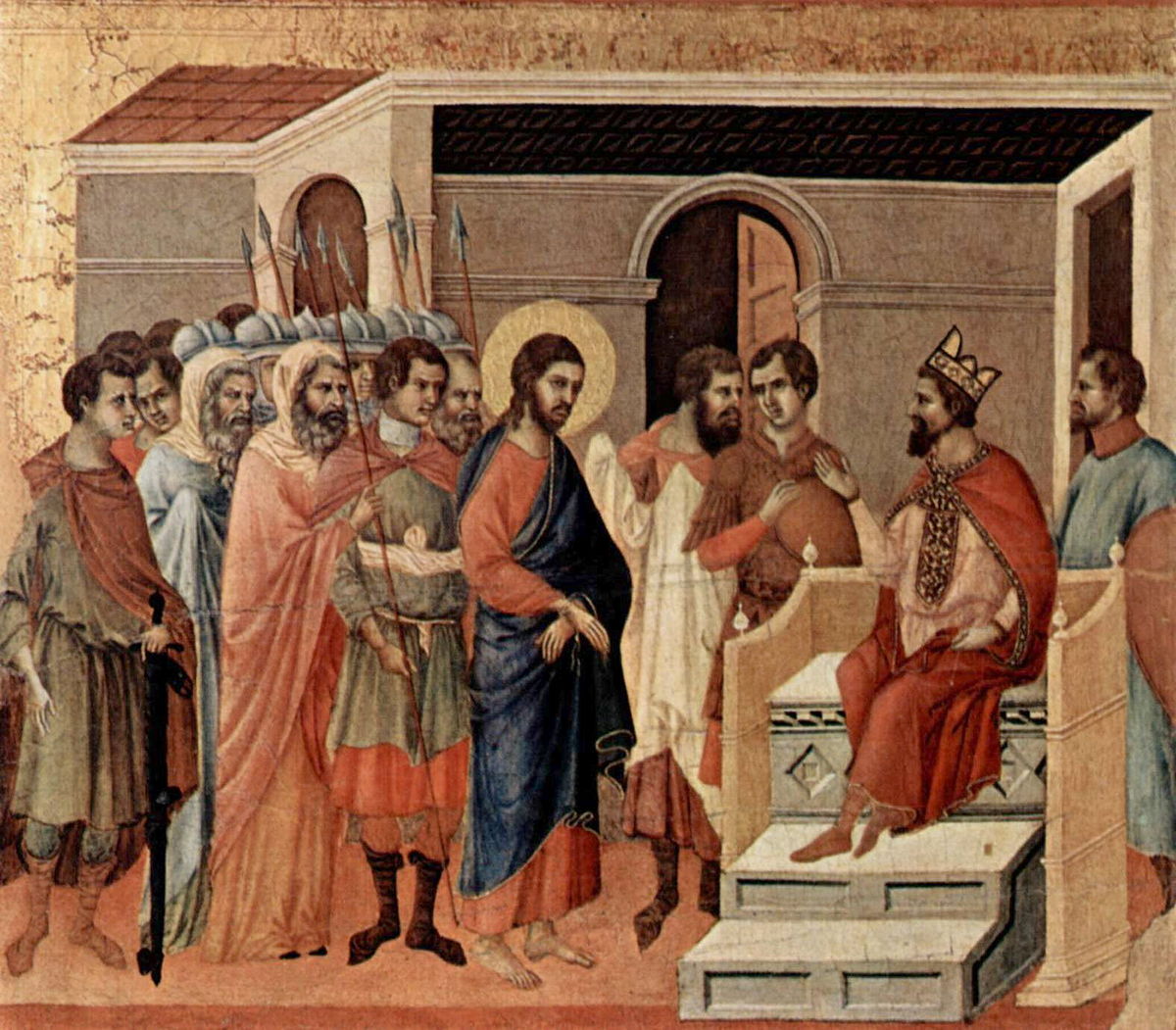
In the Gospel of Luke, there is one scene where Antipas finally gets to meet Jesus. Like Jesus, Antipas is in Jerusalem for Passover when Jesus is arrested by the Temple authorities and handed over to the Roman procurator, Pontius Pilate. When Pilate hears that Jesus is from Galilee he passes the problem of what to do with Jesus across to Antipas:
When Pilate heard this, he asked whether the man was a Galilean. And when he learned that he was under Herod’s jurisdiction, he sent him off to Herod, who was himself in Jerusalem at that time. When Herod saw Jesus, he was very glad, for he had been wanting to see him for a long time, because he had heard about him and was hoping to see him perform some sign. He questioned him at some length, but Jesus gave him no answer. The chief priests and the scribes stood by, vehemently accusing him. Even Herod with his soldiers treated him with contempt and mocked him; then he put an elegant robe on him, and sent him back to Pilate. That same day Herod and Pilate became friends with each other; before this they had been enemies. [Luke 23:6–12]
This episode, of course, is the scene in Jesus Christ Superstar when Herod invites Jesus to perform a miracle, or maybe just walk across his swimming pool!
Jesus, I am overjoyed You’ve been getting quite a name All around the place.
Healing cripples Raising from the dead. And now I understand You’re God … At least that’s what You’ve said.
So You are the Christ You’re the great Jesus Christ. Prove to me that you’re divine Change my water into wine.
That’s all you need do And I’ll know it’s all true. C’mon King of the Jews.
Jesus, you just won’t believe The hit you’ve made around here. You are all we talk about The wonder of the year!
Oh, what a pity If it’s all a lie … Still I’m sure that you can rock The cynics if you try.
So if you are the Christ You’re the great Jesus Christ Prove to me that You’re no fool Walk across my swimming pool.
If You do that for me Then I’ll let you go free. C’mon, King of the Jews!
I only ask things I’d ask any superstar. What is it that you have got That puts You where You are?
I am waiting, yes, I’m a captive fan I’m dying to be shown That You are not just any man.
So if you are the Christ Yes, the great Jesus Christ Feed my household with this bread
You can do it on your head. Or has something gone wrong? Why do You take so long? Come on, King of the Jews!
Hey, aren’t you scared of me, Christ? Mr. Wonderful Christ … You’re a joke, You’re not the Lord! You are nothing but a fraud!
Take Him away He’s got nothing to say Get out, You King of the … get out Get out, You King of the Jews Get out, You King of the Jews Get out of my life!
Antipas wanted to meet Jesus.
As Luke tells the story there is no meeting of minds. Their ideas of power are light years apart. Antipas wants to control others and enjoy power for himself.
Jesus sees power as loving service, tender care, liberating the prisoners, healing the sick. When he replied to the messengers from John, Jesus said:
Jesus answered them, “Go and tell John what you hear and see: the blind receive their sight, the lame walk, the lepers are cleansed, the deaf hear, the dead are raised, and the poor have good news brought to them. And blessed is anyone who takes no offense at me.” [Matthew 11:4–6]
So Antipas got to meet Jesus.
Sadly, Antipas had eyes but could not see, and ears but could not hear.
Antipas and Pilate were reconciled after years of rivalry. They saw the world the same way.
As we meet Jesus at the Table this morning, he invites us to see the world differently and live as if the rich and powerful were not in charge. Dare we do that?
Around the country today, Anglicans are joining the celebrations to mark 150 years since the first contact between Christianity and the people of the Torres Strait Islands.
Rather than detract from the NAIDOC observances, these celebrations of 150 years since the Coming of the Light focus our attention on one specific example of the encounter between the Indigenous peoples of this ancient land and those who came from other places.
Today we zoom up close to hear and reflect upon one of many stories from the past 200+ years. That story is unique but it also part of the rich tapestry of our now shared journey as one nation, and it offers us some clues for future action.
July 1871
People have been living on the islands of the strait between the lands we now call Australia and Papua since before the time of Abraham. I mention that simply to help us put this unique culture alongside the spiritual timelines of our own sacred stories.
That 2,500 years of continuous presence is one small part of the 60,000+ year-long human story in this ancient land, but it is important to appreciate the deep history of the Islanders at the top end.
The events we commemorate today—and which are reenacted every year in the Islands—occurred late afternoon on Saturday, 1 July 1871. I shall read from an account distributed by ABM:
In 1871, Revd Samuel McFarlane and Revd Archibald Murray of the London Missionary Society, together with eight New Caledonian mission teachers, arrived off the coast of Erub, or Darnley Island, in the far eastern Torres Strait. Their ship, the ‘Surprise’, anchored off Kemus Beach and lowered its boat for MacFarlane and others to go ashore. From a small hill, a warrior called Dabad was watching. He called his men to follow him and made his way down to the water’s edge. McFarlane waded ashore over the volcanic rock pools. He dropped to his knees on the beach before the fearsome looking islanders—the Erubians. McFarlane grasped his Bible in both hands and thrust it towards Dabad. (McFarlane wrote later: “Never did men feel more than we did then their absolute dependence on Divine Help,”). Then something remarkable happened: Dabad stayed his spear and accepted the book which he could not read but which would bring new Light, to all these warring islands This was the new era for the islands of the Torres Strait—which would be known as the Coming of the Light.
In the words of Aunty Rose Elu (2021 Queensland Senior Australian of the Year):
The chiefs used a word which meant ‘no more bloodshed’ we will not kill these people; they are bringing something—something we need to learn. What is it? We will get them to tell us … one of the things that happened then was that the warfare stopped.
For us the celebration of the Coming of the Light is just like celebrating Christmas day. On Christmas day God came to us in the form of a baby and on July 1 God came to the Torres Strait in the form of a book
When the Light comes
As we reflect on 150 years since that pivotal encounter, various insights come to mind:
As the current Torres Strait Islanders say, “God was on both sides of the beach” on that day back in 1871. God was already present with the people in the Torres Strait, and yet in another sense God was also present in a special way in the book which told the story of Jesus, and the story of God among the Jewish people before that.
That may well be a mindset we need to embrace as we seek to engage with our neighbours and families. God is already present in their lives, in their culture and in their history. They may not know much about Jesus or the Bible, but God is not absent from their lives, Our task is to connect and expand, not to eradicate and replace.
Then and now the Christian community in the Torres Strait is an indigenous church. This is a precious gift to the national Anglican Church of Australia. We have within our family an authentic Christian Church whose cultural DNA is not the high culture of Victorian England. Most of those who landed on Erub Island that Saturday in 1871 were Melanesian Christians, who shared so much of the broader culture and colonial experience of the people with whom they were sharing their faith. In the past year another group of Melanesian Brothers has arrived on Thursday Island to continue and to rejuvenate the legacy of those first missionaries.
Again, I am quoting from material on the ABM website:
The Brothers aim to live the Gospel in a direct and simple way, following Christ’s example of prayer, mission and service. They live alongside the people they are serving, respecting their traditions and customs. The Brothers follow a daily cycle of prayer and daily Eucharist and they take vows of poverty, celibacy and obedience with many serving between 7 and 20 years. Some take life vows. They not only offer spiritual teaching but also practical assistance. They plant, harvest, fish, build, eat and share with everyone in their care.
A mission to us by those we once imagined ourselves to be teaching, is now on the cards. How does the light come to us from the Torres Strait? Let me offer one example.
Most of us will recognize the name, Eddie Mabo. Eddie was born on Mer Island in the Torres Strait and was a traditional custodian of his ancestral lands. In his campaign for recognition of his traditional land rights, Mabo shone the light of Christ on the legal lie of terra nullius on which we had built a nation and created our “common-wealth.” With the coming of the light, we have new opportunities for reconciliation and justice for all the people who call Australia home.
What is required of us?
Around the same time that the islands in the Torres Strait were being settled, the Prophet Micah spoke to the people of Jerusalem:
He has told you, O mortal, what is good; and what does the LORD require of you but to do justice, and to love kindness, and to walk humbly with your God? [Micah 6:8]
Notice the order of the three things which God requires of us, according to Micah:
First, do justice … Then, love mercy … Finally, walk humbly with our God …
We cannot get to stage three without first engaging with steps one and two.
Jesus reaffirms this in the Beatitudes:
Blessed are the poor in spirit, for theirs is the kingdom of heaven. Blessed are those who mourn, for they will be comforted. Blessed are the meek, for they will inherit the earth. Blessed are those who hunger and thirst for justice,† for they will be filled. Blessed are the merciful, for they will receive mercy. Blessed are the pure in heart, for they will see God. Blessed are the peacemakers, for they will be called children of God. Blessed are those who are persecuted for the sake of justice,† for theirs is the kingdom of heaven.[Matthew 5:3–10]
† I am translating dikaiosunē as “justice” rather than “righteousness” to convey the primary meaning of the Greek term.
In the Uluru Statement from the Heart (which has been printed in today’s service book), we can discern three kinds of things which the wider community was being asked to do. These were primarily directed to the Government, which has conspicuously failed to act. Perhaps as a church we can lead where the government fails, and they can catch up when they see the light.
The first thing was listen. This was expressed in terms of a voice to the parliament, but we also need a voice to the church. We can choose to remember, and cease choosing to forget. This starts here. It is very local. I refer you to the information printed in the service book immediately after the Uluru Statement from Heart, about local actions we are taking as a Cathedral to listen and remember. We might describe this as “letting the light come …”
Then we need to tell the truth. We need to speak plainly about the violence by which the land was taken from the Indigenous peoples, their women raped and their children stolen. This will be painful and hard. But we can do no less. With the coming of the light, the shameless acts done in the darkness of the past will be exposed. Other steps will be less painful, such as using the names given to this country by the First Nations, rather than imposing names from the British Isles, or—in the case of our town—the name of an English duke and sometime Prime Minister. Jadalmany instead of Grafton, perhaps?
Beyond listening and truth-telling, there will be a need for reconciliation as we act together to create a better shared future. Then we shall indeed find ourselves in a “bran neu dae” as our Reverend Yaegl Elder, Lenore Parker, expressed so beautifully at the end of her prayer which you can find on page 218 in A Prayer Book for Australia:
God of holy dreaming, Great Creator Spirit, from the dawn of creation you have given your children the good things of Mother Earth.
You spoke and the gum tree grew.
In the vast desert and dense forest, and in cities at the water’s edge, creation sings your praise.
Your presence endures as the rock at the heart of our Land.
When Jesus hung on the tree you heard the cries of all your people and became one with your wounded ones: the convicts, the hunted, and the dispossessed.
The sunrise of your Son coloured the earth anew, and bathed it in glorious hope.
In Jesus we have been reconciled to you, to each other and to your whole creation.
Lead us on, Great Spirit, as we gather from the four corners of the earth; enable us to walk together in trust from the hurt and shame of the past into the full day which has dawned in Jesus Christ. Amen.
We are told that beauty is in the eye of the beholder.
Actually many different forms of value very much depend on the observer: what seems useful, pleasing and attractive will vary between different people, across time and in different cultures.
All three of our readings today have at least one common thread which concerns how we see things.
Last week the religion experts from Jerusalem were warned about the risk that they would not be able to see God at work in their midst because they mistook the Spirit of God doing something new as the work of the Devil.
This week we build on that theme, and reflect on how we assign (or withhold) value when we are observing what is happening around.
Samuel goes to Bethlehem
The prophet Samuel (who was himself overlooked by an elderly priest when he was just a child) sets out for Bethlehem on an undercover mission that puts his own life at risk.
He is going to look for someone else to replace Saul as king over the tribes of Israel, and if King Saul discovers what sneaky tricks Samuel is up to then his own life will certainly be in peril.
This is no Christmas story, even though it is in Bethlehem.
It seems that Samuel has done some research before his trip, because he goes looking for one particular man (Jesse) from among whose children Samuel expects to find the next king.
As this kind of story often requires, Jesse has lots of children, including eight sons.
The proud father presents his seven older sons, and Samuel is very impressed. But a little voice in his head keeps saying saying NO to each of these seven impressive young men. When Samuel eventually asks whether Jesse has any other sons, the old farmer admits that there is one not present despite all of the sons having been invited to attend the event.
He’s just a kid and he is busy looking after the sheep.
We know how this story is going to end. The youngest boy is called into the party, and to everyone’s amazement he is identified as the person chosen by God to replace Saul as king.
This is a great example of a story which is true on so many levels even if it did not actually happen.
Seeing Jesus differently
Towards the end of our second reading, Saint Paul mentions—almost in passing—that while he might once have looked at Jesus from a human point of view, he does not do that any longer.
It is certainly possible to look at Jesus from a human point of view.
Lots of people do that, and people who will never be Christians can still find great meaning for them in paying attention to Jesus.
But Paul had learned to look at Jesus from another perspective; to appreciate Jesus as the risen Lord, the One who is always present with us through his Spirit, and the One through whom God was choosing to make everything new. He goes on to say:
So if anyone is in Christ, there is a new creation: everything old has passed away; see, everything has become new! All this is from God, who reconciled us to himself through Christ, and has given us the ministry of reconciliation; that is, in Christ God was reconciling the world to himself, not counting their trespasses against them, and entrusting the message of reconciliation to us. So we are ambassadors for Christ, since God is making his appeal through us; we entreat you on behalf of Christ, be reconciled to God.
2 Cor 5:17–20
How we look at Jesus is our choice, but if we look at him in that way then everything changes.
As parents and godparents, how do we want Sawyer to see Jesus?
The mustard seed
Our gospel passage offered another example where how we look determines what we see.
The parable of the mustard seed is one of the things we can be pretty certain Jesus actually said, although in the several versions of this little parable we can already see people developing the story in different ways.
For most people this is a story about something that starts out really small (a mustard seed) and grows into a huge tree. “From little things big things grow,” comes to mind!
If you look at the parable that way you will find yourself among a large crowd of people, but Jesus may not be there as that was almost certainly not what he was seeking to express.
More likely Jesus had one of the following in mind and perhaps all three of them:
smallness – the mustard seed is indeed small, but so is the shrub that grows from the seeds and it is never such a large plant that it competes with the ancient trees
inclusive – the mustard bushes become a haven for birds and other small creatures, who the farmer would much prefer to be somewhere else
pervasive – these plants are pervasive and will take over the whole field if left unchecked because once they got a established in a small corner of there field they keep on spreading …
How do you see God’s active presence among us? asks Jesus.
Do we imagine God as big and powerful, or as small but pervasive, gathering up the marginal people to form communities of hope in a world that runs on fear?
And how do we see Jesus, and how might we imagine a church that starts again from just a few small seeds? Are we hoping to become once more a large and powerful institution, or shall we be content to be small, inclusive and pervasive?
This is the Year of Mark in our three-year cycle of readings, but it has been a while since we had a Gospel reading from Mark. More than 3 months have passed, in fact.
Today we drop back into the Markan narrative, and it is all a bit confusing. It is as if we have arrived late at a party which has been underway for quite some time. And indeed that is the case.
We have just listened to the last couple of paragraphs of Mark chapter 3. They offer a scene of confusion and controversy, as experts from Jerusalem as well as his family from Nazareth try to shut Jesus up.
The story so far
Through the opening section of his account, Mark has depicted Jesus as someone who is having an impact everywhere that he goes and with everyone that he meets:
Baptized by John (Advent 2 on December 6, Baptism of the Lord on January 10)
Testing in wilderness (First Sunday in Lent, February 21)
Fishermen by lake called as disciples (January 24)
Man with a demon healed (January 31)
Crowds gather seeking healing (February 7)
A leper is healed (February 14)
Then a series of episodes we did not hear this year due to the dates for Lent and Easter:
Paralyzed man healed (Sunday #7)
Call of Levi the tax-collector (Sunday #8)
Healing of man with withered hand (Sunday #9)
The scene today
Jesus has been making an impression on people!
At the end of all that activity, the sentence just before today’s excerpt says simply, “then he went home.”
Interestingly, “home” for Jesus was not Nazareth now, but a house in Capernaum. It was probably the home of Simon Peter, where Jesus had established himself during the early weeks of his work down by the lake.
As it happens, we think we know exactly which house that was. If we are right, that would be one of the very few times when we can take a text from the Bible and say, “This is the spot where it happened. Here is the house where Jesus stayed.”
So Jesus had gone home.
But he is not going to get any time alone.
There were so many people crowded around that little house that Jesus called home. They could not even eat for the crowd of people. It filled every corner of their small courtyard and there was nowhere to prepare any food.
Then two sets of special visitors arrive.
This is clearly a story that is spread over several days as people coming from out of town need time to get there.
The family of Jesus hear what has been happening, and they are concerned for his well-being. As Mark expressed it:
When his family heard it, they went out to restrain him, for people were saying, “He has gone out of his mind.”[Mark 3:21]
People were saying that Jesus had become deranged, and his family wanted to take him home for care and treatment: “your mother and your brothers and your sisters …” (v. 32)
The religious experts from Jerusalem (“scribes”) also arrive. They agree with the rumour spreading among the people, but they have not come with the same desire to protect Jesus and get him away for his own well-being. They have come with a diagnosis ready to declare, as they announce that Jesus is possessed by a demon, and not just any demon but the prince of demons:
And the scribes who came down from Jerusalem said, “He has Beelzebul, and by the ruler of the demons he casts out demons.” [Mark 3:22]
This not going to end well.
Mark has set up the scene is such a way that Jesus has no option but to reject both the religion experts from Jerusalem as well as his own family. If he agrees with either of them then his mission is over.
Since this is only the last part of chapter 3, we can guess how this is going to develop.
First of all, Jesus challenges the convenient diagnosis of the religion experts. Since he has been casting out demons from other people himself, how can he be possessed by the prince of demons? “A house divided against itself will not survive.” More than that, choosing to describe himself as a home invader, Jesus points out that he could only plunder the house of the strong man if has first overpowered the homeowner.
That may not have been the best self-defense Jesus could have used, but he follows it up with a powerful warning:
“Truly I tell you, people will be forgiven for their sins and whatever blasphemies they utter; but whoever blasphemes against the Holy Spirit can never have forgiveness, but is guilty of an eternal sin” [Mark 3:28–29]
There is no helping anyone who mistakes the Spirit of God for the power of darkness.
We are not told how the religion experts evaluated Jesus’ response to their hasty judgments, because the story moves across to the other set of visitors who have just arrived from Nazareth:
Then his mother and his brothers came; and standing outside, they sent to him and called him. A crowd was sitting around him; and they said to him, “Your mother and your brothers and sisters are outside, asking for you.” [Mark 3:31–32]
Notice, by the way, two people who are missing from that family group: there is no mention of a father, and no mention of a wife. Those who come to rescue Jesus from himself are his mother, his brothers and his sisters. We find the same cast of characters in Mark 6 when Jesus does finally make a visit to his hometown of Nazareth:
They said, “Where did this man get all this? What is this wisdom that has been given to him? What deeds of power are being done by his hands! Is not this the carpenter, the son of Mary and brother of James and Joses and Judas and Simon, and are not his sisters here with us?” And they took offense at him. [Mark 6:2–3]
As Mark tells the story, these are the people who come to bring Jesus home. And in neither place are we told the names of his sisters.
We know that Jesus is not going to accept their kind offer to take him home for a rest! In fact, he will not even speak with them!
And he replied, “Who are my mother and my brothers?” And looking at those who sat around him, he said, “Here are my mother and my brothers! Whoever does the will of God is my brother and sister and mother.” [Mark 3:33–35]
Impasse
Insights
Jesus has come home to Capernaum, to Peter’s place, for a rest.
He gets no rest. The crowd thinks he is going mad. The religion experts from Jerusalem think he has sold out to the Devil. His own family want him to come home and abandon this kingdom of God nonsense.
Where are we in that scene?
Are we the religion experts, who think we know how God’s work is supposed to be done? Have we put God into a little box? Is our God only allowed to act in the ways we remember him doing in the past? Worse still, might we mistake a new thing that God’s Spirit is doing among us as the work of the Devil? If so, what hope is there for us?
Are we the family from Nazareth? We care about Jesus, but we think he has gone a bit extreme ever since he went to that revival meeting with John the Baptizer down south! Let’s bring Jesus home, give him some of mum’s cooking, and let him rest up until he settles down …
Are we the perhaps the strange young man from Nazareth, who has no religious training, but whose soul resonates with the call of God on his life? In saying yes to God, Jesus calls others to prepare for the coming of the reign of God, the kingdom of heaven.
Are we perhaps in the crowd that has been gathering around Jesus? We found healing. Our demons disappeared. The ailments which crippled us, vanished. We want more. We crowd around the house that Jesus calls home …
I hope you are with me in the crowd.
Like me, I hope you are glad that Jesus chose to stay with us rather than go home with his family.
We are now very much in the second half of the Great Fifty Days of Easter; that “week of weeks” which stretches from Easter to Pentecost.
Over the first few weeks of Easter we listen to the appearance stories:
Easter 1 – Empty Tomb & Mary in the Garden
Easter 2 – John 20:19-31 (Doubting Thomas)
Easter 3 – Luke 24:36-48 (Emmaus) & John 21:1-19 (Lakeside)
Then the focus shifts to how the risen Lord is experienced today:
Easter 4 – John 10 (Good Shepherd)
Easter 5 – John 14 (Home with many rooms), John 15 (True Vine), John 13 (New Commandment to love on another)
Easter 6 – John 14:15-21 (Advocate), John 15:9-17 (Love one another), John 14:23-29 (Advocate)
Easter 7 – John 17:1-11, John 16:16–24, John 17:20-26 (unity with the Father)
The True Vine
Today we encounter a new metaphor in Gospel of John: Jesus as the true or authentic vine. This idea is not found anywhere else in John, and actually is never used by anyone else in the NT. It was not one of Jesus’ regular talking points, but it has been used with great effect about the midpoint of the extended Farewell Discourse in John chapters 13 to 16.
While this is not a common theme in the NT, it draws on ancient biblical tradition. Sometimes the vine is a symbol for the people of God, but most of the time it is a symbol for life going well. A healthy vine with lots of fruit suggests peace and prosperity, while a sick vine that is struggling to survive suggests hard times.
All this reminds us how the ancient symbols of our faith are derived from nature and agriculture, and perhaps also how hard it is to find new ways to speak of faith in our world of silicon chips and urban populations.
This is quite an intimate metaphor. At its heart is the idea of connection with God: of an essential harmony between our spirits and the sacred love at heart of all reality. As such it fits well with the theme of these final weeks of Easter.
The metaphor of the vine takes us beyond belief and action, to focus on simply being who we are as we allow the life of God to be passing through us for the benefit of others.
A misunderstood metaphor
As a teenager this metaphor freaked me out. In my conservative Evangelical church being fruitful meant converting others to believe like us. The pressure was on: to avoid being pruned and burned we needed to go get converts (“bear fruit”)!
BTW, we were not speaking about bringing people to faith for the first time. This was mostly about persuading Anglicans and Catholics to switch across to our little Evangelical sect, renounce their infant Baptism and their sacraments, and start all over again in the Christian life with us.
All that made me very uncomfortable. It seemed my spiritual status in that group was on the line, and that God was always looming with pruning shears and matches.
Fruit of the Spirit
Yet when a grapevine is fruitful, we are not expecting it to be multiplying vines. Rather, we expect it to bring reflect the inner vitality of the vine in the form of leaves, buds and grapes. We want lovely sweet grapes from a grapevine, not dreams of expansion.
Eventually, I came to see that the result of God’s Spirit in us is our own transformation. Healthy holiness is not persuading others to think like me, not poaching people from one church to another, not converting people from other faiths or no faith. It is simply about being the best version of me that I can be with God’s help.
Paul’s words in Galatians 5 are very helpful, and I deliberately cite them in a longer form than we usually hear them:
By contrast, the fruit of the Spirit is love, joy, peace, patience, kindness, generosity, faithfulness, gentleness, and self-control. There is no law against such things. And those who belong to Christ Jesus have crucified the flesh with its passions and desires. If we live by the Spirit, let us also be guided by the Spirit. Let us not become conceited, competing against one another, envying one another. [Galatians 5:22–26]
As these Great Fifty Days draw to us a close may we experience a deepening of our own connection with God, a fresh sense of God’s life flowing through us, a transformation of our character and profound inner renewal.
May we remain connected to the Vine and may the Father’s gentle touch help us to be even more responsive to the work of God’s spirit within us.
May we never forget that our task is not convert others, but ourselves.
Postscript: There is a beautiful poem by Malcolm Guite on the Vine, which a friend shared with me after reading this sermon after it was posted online. I encourage you to read that poem and reflect on its significance during the coming week.