Tag: Grafton Cathedral

  • Imagine a church without Paul

    Imagine a church without Paul

    Easter 3C
    St Luke’s Church, Mosman
    5 May 2019

    Thank you to Fr Max for the opportunity to be with you this morning and especially for the privilege of serving as preacher at this service. To lead the gathered people of God as we break open the Word and discern what the Spirit might be saying to the church is indeed an awesome and precious opportunity. So thank you.

    Greetings from Christ Church Cathedral in Grafton, it is good to be here with you this morning and to sense the bonds of faith and liturgy that we share as Anglicans across time and place.

    Greetings also from the Episcopal Diocese of Jerusalem and the Middle East. As a Canon emeritus of St George’s Cathedral in Jerusalem and a former Dean of the College there, it is always my privilege to bring greetings from our sisters and brothers in the Holy Land.


    On the road to Damascus

    For the past couple of weeks we have been parsing the early Easter experience of those people who found themselves picking up the pieces after Good Friday, and trying to make sense of the weird rumours that the one who had certainly been dead was somehow alive, with God and yet also with them.

    We find it hard to make sense of those stories after 2,000 years, but imagine how hard it must have been for the small group of people who did not abandon their hope that God was in Christ reconciling the world to himself, even though many of them had failed Jesus at his most critical time.

    For them there was no long tradition of Christian faith and practice to look back upon and from which to draw some credible basis for faith.

    Like the dedicated branch members in Isaacs, Lyons and Melbourne and Wills, those first disciples saw their hopes and dreams evaporate. Then the rumours started. There was no social media, but word was passing from one person to another that Jesus was not dead after all.

    Not exactly back to his old self, so to speak.

    Not walking the dusty roads of Palestine, teaching the crowds and healing the sick.

    But spotted here and there, and most often when his disciples gathered to break the bread and to seek strength from God for the world-transforming work to which God had called both Jesus and them.

    Instead of dispersing after the death of Jesus, his followers were hanging together and even growing in numbers.

    Like the broomstick in the Sorcerer’s Apprentice, the problem seemed to be getting worse with every attempt to deal with the ‘problem’ of the Jesus people.

    The authorities began to arrest and kill the followers of Jesus, but they just seemed to multiply.

    No longer limited to a few villages in Galilee and a handful of houses in Jerusalem, this sect was now to be found in many parts of the country and was even spreading to regional cities like Antioch and Damascus.

    A plan emerges: send young Saul to Damascus with letters of authority to arrest these crazy people and drag them back to Jerusalem for punishment. This nonsense must be stopped.

    Another broken broomstick …

    Saul will become Paul, the greatest and most influential follower of Jesus that the world has ever seen.

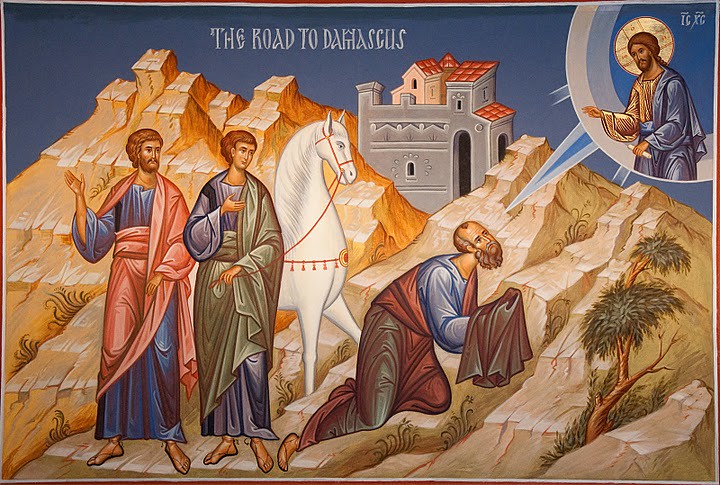
    Our first reading in today’s lectionary is the classic tale from Acts 9 of Saul’s “Damascus road” experience as he encounters the risen Lord: Acts 9:1-6.

    This is the first of three versions of the call/conversion of Saul/Paul in Acts, and they each tell the story a wee bit differently: chapters 9, 22 and 26.

    These variations form part of the narrative art of the author of Luke-Acts, and it is not clear that Paul would have agreed with the ways in which his own “Easter moment” was being portrayed. He was adamant that his ‘gospel’ came direct from God and without any human third parties involved. Acts gets there by the third iteration, but along the way portrays Paul as being nurtured by local runaway Christians in Damascus as he makes sense of his own encounter with the risen Lord.

    We have Paul’s own account in his own words in his letter to the Galatians, a region in southern Turkey. This may be the first piece of Christian literature to have survived and is commonly described as the first of Paul’s letters. It may be dated to 49/50 CE, just 20 years after Easter.

    You have heard, no doubt, of my earlier life in Judaism. I was violently persecuting the church of God and was trying to destroy it. I advanced in Judaism beyond many among my people of the same age, for I was far more zealous for the traditions of my ancestors. But when God, who had set me apart before I was born and called me through his grace, was pleased to reveal his Son to me, so that I might proclaim him among the Gentiles, I did not confer with any human being, nor did I go up to Jerusalem to those who were already apostles before me, but I went away at once into Arabia, and afterwards I returned to Damascus. (Galatians 1:13–17 NRSV)


    Can you imagine a church without Paul?

    It seems that God could not, and for sure the church we now are is deeply indebted to this mercurial figure who was not a follower of Jesus and yet became the most influential of the Apostles.

    The story of Paul encapsulates the Easter miracle, so we can be glad that the lectionary committee has chosen the passage from Acts 9 for us to reflect upon today.

    Of course, as we rejoice in the legacy of Paul, we are reminded that God may be waiting to ambush us—or our church.

    The God of Easter, the God who raised Jesus from the dead, the God who called Paul to serve as the greatest exponent of Christ is also the God calls us to live bravely into the future rather than defend the past.

    A disturbing God.

    The God of Easter.

  • The eternal dance of doubt​ and faith

    Earth Sunday / Easter 2C
    Christ Church Cathedral, Grafton
    28 April 2019

    [ video ]


    Already it has been a week.

    It seems a lot longer, doesn’t it since Easter? Was that really just a week ago? It has been an odd kind of week with ANZAC Day in between and all the other stuff that has happened. It seems a lot longer than just a week ago.

    Like the disciples in the first week of Easter we have made our way through our first week of Easter, wondering how we make sense of it all and what difference—if any—it makes to our lives anyway.

    As we gather in church today to reflect on all that, three major spiritual streams are converging:

    Earth Sunday
    Easter 2
    Baptism

    And all of this in the context of a Eucharist when we gather around the Table of Jesus, take bread made from grain which the earth has given us and drink wine made from the vine sustained by Earth herself.


    Gathering at the Table of Jesus also features in the Gospel readings that we hear during these first weeks after Easter Day.

    The Table of Jesus is a place of identity: who we are is on display here.

    The Table of Jesus is a place of transformation: things of Earth become sacraments of heaven.

    The Table of Jesus is a place of encounter: The earliest disciples recognised Jesus alive among them in the breaking of the bread.

    The Table of Jesus is also a place where faith and doubt dance eternally: They are not either/or choices, but the dynamic of discipleship as we seek to discern and embrace the risen Lord active in our midst.


    So here we are, like the disciples in that Gospel reading which we have just heard, gathered around the Table of Jesus a week after Easter.

    We are a mixed mob. So were they.

    Some of us have faith that is so strong it seems nothing could ever break it. Some of us have doubts that are so strong that faith seems unreasonable. Most of us, perhaps, are somewhere in the middle: partners in the eternal dance of doubt and faith.

    Some of us will think that baptising Jace and Rylee is one of the most important things we can do for them. Others may think it is a quaint old family custom that cannot do much harm. Most of us—myself included—are somewhere in between. We are a mix of doubt and faith, anxiety and hope, strength and weakness; all at the same time, and always.

    It was like that in the Upper Room at Jerusalem as the disciples gathered around the Table of Jesus and wondered what sense to make of the weird rumours they had been hearing all week.

    Yes, Jesus had been dead.

    There was no doubt about that. They saw him on the cross and the Romans did not allow anyone to be rescued before they were dead.

    At least they had been allowed to remove the body of Jesus after he was dead. The Romans did not keep him on the cross as food for the birds and as a warning to other people not to step out of line.

    Seems it was bad luck for the Temple to have dead men on their crosses during Passover.

    Dead and buried, even if done hastily and without all the proper rituals.

    No doubt about that.

    But then the weird stories started.

    Mostly the women. Of course. Always more inclined to drama and fairy tales.

    But then Peter said he had seen Jesus too. Crusty old fisherman Pete. The Rock.

    And James, the brother of Jesus who was not even one of the disciples.

    Then Cleopas and his wife from Emmaus.

    Mary Magdalene was on a campaign. She had always loved Jesus, but now she was insisting he still alive even though everyone knew he was dead.

    Thomas was a tough nut to crack. No women’s gossip for him. He was not going to believe all this Easter stuff until he could see Jesus for himself and touch the wounds from the crucifixion.

    A week later his disciples were again in the house, and Thomas was with them. Although the doors were shut, Jesus came and stood among them and said, “Peace be with you.” Then he said to Thomas, “Put your finger here and see my hands. Reach out your hand and put it in my side. Do not doubt but believe.” Thomas answered him, “My Lord and my God!” Jesus said to him, “Have you believed because you have seen me? Blessed are those who have not seen and yet have come to believe.” (John 20:26–29 NRSV)


    I love that ancient Christian story.

    It reminds me that doubt is a healthy part of faith. Indeed, it reminds me that faith without any questions or doubt may not be very healthy at all.

    That is the eyes-wide-open kind of religion into which we baptise Jace and Ryle this morning.

    Parents and godparents are promising to teach them the steps in the dance of doubt and faith, listening for the sacred music at the heart of the universe, and moving their lives in harmony with the God who says, “Here I am. Come and play.”

    The Cathedral has a part to play in the dance, but the most important roles are those performed by the parents, godparents and extended family.

    How you look at the world will become the way they look at the world.

    How you manage your doubts and your beliefs will become their way as well.


    Being Earth Sunday, we are reminded that this is not just about us and it is certainly not about buying fire insurance to get human souls out of hell.

    At the heart of everything is the fact that the world exists.

    Not only is the Earth here, but Earth has developed the capacity to be aware of itself and to know that it is here.

    We are the Earth coming to conscious awareness.

    Life is not about us over here and Earth over there.

    We are Earthlings, and what counts for us as salvation is also salvation for all of creation: for the Earth itself and the universe as a whole.

    Easter is not just for humans, but for God’s whole created universe.

    At Christmas we celebrate God among us—Emmanuel‚ as sacred Spirit becomes human person; the Creator becomes Earthling.

    At Easter we celebrate the transformation of reality that God’s dance makes possible.

    Again, we find the dance of doubt and faith drawing us into the future, into God herself.

    Have we got this all figured out? No way.

    But this too is what we will be sharing with Jace and Rylee in the days, weeks, months and years to come.


    So, let’s head down to the font and get this dance started …


  • Morsels 2019 March

    An archive of previous “Daily Morsels” published on the Cathedral app. Please note that these versions of the messages are not formatted to reflect line breaks or separate paragraphs, as they are purely an archival set. They also tend not to have any embedded web links from the original Morsel. To receive these message direct to your mobile phone or tablet each day, please download the Cathedral app.


    SUN – 190331

    Title

    Spiritual roots

    Body

    Today will be observed as Mothering Sunday in many Anglican Churches around the world. Originally a day halfway through Lent when servants were allowed a weekend off to go home for worship in their home church, it continues to be widely observed in the UK as their version of Mothers’ Day. Where is your home church? Maybe it is the same one you attend these days, but for many of us it will be in another town or even another country. Mine has been sold and turned into an antique shop. It feels odd to enter that space and see it used in such a different way. And it feels smaller than when I was a child. Today may be a good time to pause and reflect on our spiritual roots in those communities and places where our journey of faith began.


    Sat – 190330

    Title

    The heart of faith

    Body

    In Jewish tradition, the Shema’ (Hebrew for “Hear”) is a key statement of faith: “Hear, O Israel: The LORD is our God, the LORD alone.You shall love the LORD your God with all your heart, and with all your soul, and with all your might.” (Deuteronomy 6:4–5 NRSV) In Christian practice, from the Gospels to Anglican prayer books, we find this proclamation being repurposed within a trinitarian outlook: ‘Hear, O Israel, the Lord our God, the Lord is one; you shall love the Lord your God with all your heart, and with all your soul, and with all your mind, and with all your strength.’ Jesus said: ‘This is the great and first commandment. And a second is like it: you shall love your neighbour as yourself.’ And in Islam, we have a parallel tradition in the Adhan (“Hear” in Arabic): God is the greatest. I acknowledge that there is no deity but God. I acknowledge that Muhammad is the Messenger of God. Hasten to the prayer Hasten to the salvation. Prayer is better than sleep. God is greatest. There is no deity but God. Equally significant differences between Christians and Jews as between Christians and Muslims, and yet so much that we have in common as we each seek to respond to our experience of ‘amazing grace’.

    https://youtu.be/zBNUdeWw-wE


    Fri – 190329

    Title

    Days of obligation

    Body

    Here we are on another Friday, this one occurring two weeks after the massacre at two mosques in Christchurch, New Zealand. Since participation in collective prayers seems to have almost disappeared from Christianity in the West, our renewed awareness of Friday as the day of prayer for Muslims may also be a moment to rethink our commitment to prayer, to gathering, and to our collective identity as people of faith. We are, in the spirit of the Life of Brian, all individuals; many of us increasingly choosing to lives as solitary persons whose connections with others are very weak. The ‘road less travelled’ is not the Way of Jesus. He gathered an intentional community of disciples and taught them to pray as well as to engage collectively in compassionate action (preaching, healing, exorcising). Maybe our Muslim sisters and brothers can evangelise us afresh, so that we take our obligation to form and sustain intentional communities of religious practice more seriously?

    https://youtu.be/KHbzSif78qQ


    Thr – 190328

    Title

    Lenten disciplines, 3: Give, or engagement

    Body

    The third attribute of a balanced Lent program is that we give personal resources to some project beyond our own life. For most people that means a financial contribution to some worthwhile project, but for some people it may mean getting involved to help make something good happen in our local community. As we give away money or time to help someone else we are engaging in God’s own work to make the world a better place. We are becoming part of the answer to our own prayer: ‘your kingdom come, your will be done on earth as in heaven …’


    Wed – 190327

    Title

    Lenten disciplines, 2: Pray, or mindfulness

    Body

    Prayer is a time to pay attention to life and to the quiet presence of God at the very heart of the universe. aka: mindfulness Set yourself some goals for praying. It may be time alone to reflect and be mindful of your situation. It might mean a visit to the Cathedral during the week to light a candle for someone you care about. It may be a good time to resume a personal habit of attending Sunday worship, our group spiritual fitness workout session. Just do it … (as the saying goes)


    Tue – 190326

    Title

    Lenten disciplines 1: Fasting, or embracing

    Body

    As we get close to the midway point for Lent, it may be timely to pause and reflect on our we have been spending this time. The three great spiritual disciplines are fasting, praying, and giving. Fasting If we seek better physical fitness we do something extra, while maybe also cutting back on some unhealthy habits. Our spiritual discipline can be much the same. There may be some bad habits we need to give up. These are more likely to be negative attitudes than chocolate or alcohol. Let go of fear and embrace love. Reinforce those personal habits that make you a more loving person and cut back on the habits that make you a mean-spirited person.


    Mon – 190325 Lady Day

    Title

    Lady Day

    Body

    An angel whispers new possibilities

    surprising developments indeed

    to a young woman

    in a small Galilean village:

    Nazareth.


    An unknown place

    an unknown maiden

    an unknown future:

    a future not defined by the past.


    The girl said, Yes.

    The angel was pleased.

    God smiled.

    Now we all call her, Blessed:

    Mary of Nazareth,

    mother of Jesus.


    We had best listen to the angels more carefully.

    Who knows what new thing they are whispering into our ears?

    —Gregory C. Jenks, 25 March 2019


    SUN – 190324

    Title

    Come and get it …

    Body

    Sacred Wisdom calls us to her table: 1 Ho, everyone who thirsts, come to the waters; and you that have no money, come, buy and eat! Come, buy wine and milk without money and without price. 2 Why do you spend your money for that which is not bread, and your labour for that which does not satisfy? Listen carefully to me, and eat what is good, and delight yourselves in rich food. 3 Incline your ear, and come to me; listen, so that you may live. {Isaiah 55:1–3]


    Sat – 190323

    Title

    A prayer for election day

    Body

    Today voters across New South Wales will vote today to elect the 57th Parliament, including all 93 seats in the Legislative Assembly and 21 of the 42 seats in the Legislative Council.


    WE GIVE THANKS …

    for our robust democracy,

    for all who are standing for public office, and

    for the dedication of our polling officials.


    WE PRAY …

    for those who will be elected to office,

    for those who will form government, and

    for those who lose their seats.


    WE COMMIT OURSELVES …

    to pray for those elected to our parliament,

    to reconcile with those from whom we differ, and

    to help build a resilient and compassionate community.


    Fri – 190322

    Title

    Reconciliation

    Body

    Lord God, bring us together as one, reconciled with you and reconciled with each other. You made us in your likeness, you gave us your Son, Jesus Christ. He has given us forgiveness from sin. Lord God, bring us together as one, different in culture, but given new life in Jesus Christ, together as your body, your Church, your people. Lord God, bring us together as one, reconciled, healed, forgiven, sharing you with others as you have called us to do. In Jesus Christ, let us be together as one. Amen. — A Prayer Book for Australia


    Thr – 190321

    Title

    A prayer for the nation

    Body

    God of hope, in these times of change, unite our nation and guide our leaders with your wisdom. Give us courage to overcome our fears, and help us to build a future in which all may prosper and share; through Jesus Christ our Lord. Amen. —from the Church of England


    Wed – 190320

    Title

    The Peace Prayer

    Body

    Lord, make me an instrument of your peace. Where there is hatred, let me sow love; where there is injury, pardon; where there is doubt, faith; where there is despair, hope; where there is darkness, light; where there is sadness, joy. O, Divine Master, grant that I may not so much seek to be consoled as to console; to be understood as to understand; to be loved as to love; For it is in giving that we receive; it is in pardoning that we are pardoned; it is in dying that we are born again to eternal life. —Attributed to St Francis of Assisi


    Tue – 190319

    Title

    We have two choices

    Body

    The modern Jewish philosopher and social critic, Noam Chomsky, calls us to make a choice about how we spend (invest) our lives: “We have two choices. We can be pessimistic, give up, and help ensure that the worst will happen. Or we can be optimistic, grasp the opportunities that surely exist, and maybe help make the world a better place. Not much of a choice.”


    Mon – 190318

    Title

    A more excellent way …

    Body

    If it is true that “perfect love casts out fear” (1 John 4:18), then this beautiful hymn to love from 1 Corinthians 13 has much to teach us about living without fear: “Love is patient; love is kind; love is not envious or boastful or arrogant or rude. It does not insist on its own way; it is not irritable or resentful; it does not rejoice in wrongdoing, but rejoices in the truth. It bears all things, believes all things, hopes all things, endures all things. Love never ends.” (1Corinthians 13:4–8 NRSV)


    SUN – 190317

    Title

    Their sacrifices were mingled with their blood

    Body

    Today’s Gospel, begins with Jesus responding to news of two recent catastrophes: “… there were some present who told him about the Galileans whose blood Pilate had mingled with their sacrifices. He asked them, ‘Do you think that because these Galileans suffered in this way they were worse sinners than all other Galileans? No, I tell you; but unless you repent, you will all perish as they did. … Or those eighteen who were killed when the tower of Siloam fell on them—do you think that they were worse offenders than all the others living in Jerusalem? No, I tell you; but unless you repent, you will all perish just as they did.’ ” [Luke 13:1–5] Suffering and catastrophe occur in the lives of undeserving people … but Jesus looks beyond the misfortune of the individuals to the underlying sickness (sin) that fuels the violence, nd calls on his listeners to repent. This passage has always troubled me, but in the light of the massacre of Muslim worshippers in the mosques of Christchurch it seems to make more sense. From what do we need to repent if more innocent people are not to find their sacrifices mingled with blood? Fear of the other … delusions of cultural, racial and religious supremacy … religious extremism … rejection of scientific evidence … populist ideology … Turn from hate, turn to the light. Repent.


    Sat – 190316

    Title

    The line between good and evil

    Body

    In light of the mass killings at mosques in Christchurch yesterday, these words of Aleksandr Solzhenitsyn come to mind: “And it was only when I lay there on rotting prison straw that I sensed within myself the first stirrings of good. Gradually it was disclosed to me that the line separating good and evil passes not through states, nor between classes, nor between political parties either — but right through every human heart — and through all human hearts” (Archipelago Gulag II, 615).


    Fri – 190315

    Title

    The home town crowd

    Body

    They know us better than anyone else. Probably better than we know ourselves. If we are truly blessed, they love us despite knowing us so well. They are the home town crowd, or simply our family and friends. Fresh from his spiritual challenges in the wilderness, Jesus heads home to Nazareth and goes to the synagogue for worship on Shabbat. It does not go well. The home crowd is a tough gig. Jesus reflects somewhat ruefully on a dynamic known across the centuries: “Truly I tell you, no prophet is accepted in the prophet’s hometown.” That is one of the rare sayings of Jesus which is is found in all four Gospels. Another temptation perhaps? Living with criticism from those we love?


    Thr – 190314

    Title

    Until next time …

    Body

    “When the devil had finished every test, he departed from him until an opportune time.” (Luke 4:13) Spiritual victories are never complete. There is always next time. Jesus was not given a green pass after his successful completion of the inaugural testing regime. There would be other opportunities to fail. Other moments of vulnerability. There always are. The authentic life is a commitment to persistent and recurring faithfulness, not an easy jog to the finish line after some early successes. We are in this for the long haul. So is the dark one. But so is God.


    Wed – 190313

    Title

    At the temple’s edge

    Body

    Temptation three … Now things are getting a little weird. Let’s see what you are made of Jesus; and whether God really cares about you at all. Come over here to the very edge of the temple in Jerusalem and throw yourself from the highest point. You will be fine, eh? After all, you are special. God will look after you. Jesus would be offered that wrong choice another time: when hanging on the cross. The clergy from the temple say to one another: “Let’s wait and see if God will rescue him, since he claims to be God’s son.” None of us would ever fall for that one, right? We would never think that God exists to keep us safe from our own stupid choices or the hostile actions of other people? We would never treat the planet like it exists for our sake, rather than the other way around? We would never take advantage of other people for our own short term satisfaction? Selfishness may be the worst temptation of them all.


    Tue – 190312

    Title

    Look at what could be yours

    Body

    The second temptation … Come with me to an imaginary mountain from which one can survey the entire world, stretching out in all its immense flatness before us. As far as the eye can see, and then some … Let’s cut a deal. I can make you successful, and powerful. One of a kind. All you need to do is play by my rules. Power is seductive, but Jesus would never take that route. He chooses the path that leads to a cross in the garbage pit outside the walls of Jerusalem, rather than the highway that leads to power. We are not called to be powerful, or successful. It is enough to be faithful.


    Mon – 190311

    Title

    Turn these stones into bread

    Body

    The first temptation … And what can be wrong about a hungry person turning a few desert stones into warm bread rolls? Nothing in itself, but context is everything. The reply Jesus makes to the Satan figure in this story points to a spiritual crisis from which we mostly avert our eyes: “One does not live by bread alone.” The “daily bread” for which Jesus teaches us to pray is not at stake here, but our insatiable appetite to acquire and consume. We want … more … faster … better … impressive … convenience … And we want it now. We are not defined by the baubles for which we compete. We do not live by “bread” alone …


    SUN – 190310

    Title

    40 days and 40 nights

    Body

    The tradition of Jesus spending some time alone in the wilderness being “tested” (tempted) by Satan is found in three of the four Gospels, but is unknown to the Gospel of John. In the so-called “Q Gospel” material preserved only by Matthew and Luke, this meme is developed into a story with three episodes. Many stories in the western cultural canon have three episodes. It is how we like to tell stories, or even construct sermons. “Forty days” is itself a biblical meme that occurs repeatedly in the Scriptures. It indicates an extended period of time during which major developments may occur. For the anonymous Christian storyteller who shaped this story, this is the time when Jesus undergoes the challenges that any ancient hero was expected to survive in order to demonstrate their character and their skill. This story is not a memory of a historical moment, but a meditation on the deeper truth that Jesus constantly had to choose faithfulness to God’s call on his life, rather than be seduced by second-best; an acceptable action in itself but not what God required of him. That is a challenge we all face every day.


    Sat – 190309

    Title

    Love is at the heart …

    Body

    And one more piece of wisdom from Michael Gerson’s sermon: Fate may do what it wants. But this much is settled. In our right minds, we know that love is at the heart of all things.


    Fri – 190308

    Title

    International Women’s Day

    Body

    Wisdom is telling her story in the midst of her people:

    ‘I CAME FORTH FROM THE HEART OF THE MOST HIGH,” SHE SAYS.

    “Alone I searched for a place to rest.

    I LOOKED EVERYWHERE TO FIND A PLACE TO LIVE.

    Then the Creator of all things instructed me:

    ‘PITCH YOUR TENT HERE IN THIS PLACE.’

    So in the beloved community I took up residence.

    I HAVE TAKEN ROOT IN THESE PEOPLE

    I have grown tall as an oak tree,

    I HAVE TAKEN ON MANY COLOURS.

    I have spread out my branches like a candelabra.

    MY BLOSSOMS BEAR THE FRUIT OF OPENNESS AND CARE.

    APPROACH AND TAKE YOUR FILL.”

    Come, let us seek Wisdom at work in all lives,

    AND ESPECIALLY IN THE LIVES OF HER DAUGHTERS!

    (Adapted from Ecclesiasticus 24, with echoes of John 1)


    Thr – 190307

    Title

    Not a force but a face …

    Body

    More wisdom from Michael Gerson: This experience of pulling back the curtain of materiality, and briefly seeing the landscape of a broader world, comes in many forms. It can be religious and nonreligious, Christian and non-Christian. We sometimes search for a hidden door when the city has a hundred open gates. But there is this difference for a Christian believer: At the end of all our striving and longing we find, not a force, but a face. All language about God is metaphorical. But the metaphor became flesh and dwelt among us.


    Wed – 190306 – Ash Wednesday

    Title

    Ash Wednesday

    Body

    As we begin Lent it is timely to focus on three spiritual disciplines we are invited to adopt during this time of preparation for Easter: At the heart of Lent is the invitation to fast, pray and give. Fast If we seek better physical fitness we do something extra, while maybe also cutting back on some unhealthy habits. Our spiritual discipline can be much the same. There may be some bad habits we need to give up. This are more likely to be negative attitudes than chocolate or alcohol. Let go of fear and embrace love. Reinforce those personal habits that make you a more loving person and cut back on the habits that make you a mean spirited person. Pray Prayer is a time to pay attention to life and to the quiet presence of God at the very heart of the universe. Set yourself some goals for praying. It may be time alone to reflect and be mindful of your situation. It might mean a visit to the Cathedral during the week to light a candle for someone you care about. It may be a good time to resume a personal habit of attending Sunday worship, our group spiritual fitness workout session. Just do it … (as the saying goes) Give The third attribute of a balanced Lent program is that we give to some project beyond our personal life. For most people that means a financial contribution to some worthwhile project, but for some people it may mean getting involved to help make something good happen in our local community. As we give away money or time to help someone else we are engaging in God’s own work to make the world a better place. We are becoming part of the answer to our own prayer: ‘your kingdom come, your will be done on earth as in heaven …’


    Tue – 190305 – Shrove Tuesday

    Title

    Mardi Gras

    Body

    Fat Tuesday (Mardi Gras in French) is also known as Shrove Tuesday, Pancake Day or even just Carnival Tuesday. It occurs on the day before the commencement on Lent on Ash Wednesday. This is a day for clearing out the junk: the fat and meat from which people once abstained during Lent, but also the personal junk of spiritual failure and broken relationships. Shrove Tuesday preserve the ancient English custom of making confession prior to the start of Lent, and being forgiven (“shriven”) by the priest. When cleaning out the cupboards don’t forget to sanitise the heart.


    Mon 190304

    Title

    Remembering how to live

    Body

    “Faith, thankfully, does not preclude doubt. It consists of staking your life on the rumour of grace.” Michael Gerson, columnist for the Washington Post [Extract from a sermon at Washington National Cathedral, 17 February 2019. For the complete sermon, see the web link]

    https://www.washingtonpost.com/religion/2019/02/18/i-was-hospitalized-depression-faith-helped-me-remember-how-live/?utm_term=.ecc4b514a267


    SUN – 190303

    Title

    As Epiphany ends …

    Body

    Today we conclude the Epiphany season, the Sundays between the feast of the Epiphany on 6 January and the Sunday before Ash Wednesday. During those 8 weeks we have been reflecting on different ways in which God becomes known to us: the “epiphany” moments when we discern the deeper reality that we often overlook in our busy schedules. This morning we focus on the transfiguration, a significant epiphany moment for the inner circle of Jesus’ followers as well as for Jesus himself. May your day—your week, your year—be transformed by the quiet presence of the Beloved deep within your innermost self.


    Sat – 190302

    Title

    What you give is what you get back

    Body

    “Forgive, and you will be forgiven; give, and it will be given to you. A good measure, pressed down, shaken together, running over, will be put into your lap; for the measure you give will be the measure you get back.” (Luke 6:37–38 NRSV)


    Fri – 190301

    Title

    What goes around comes around

    Body

    “Do not judge, and you will not be judged; do not condemn, and you will not be condemned.” (Luke 6:37 NRSV)

     

  • The God who says YES

    Easter Day
    Christ Church Cathedral, Grafton
    21 April 2019

    [ video ]

    An Easter sermon.

    For us the events of the past few days have been a rollercoaster experience, as we have followed Jesus through high moments of success and deep moments of failure and suffering.


    There were indeed some high points in that final week:

    The dramatic entrance to the city and the rapturous welcome from the crowd …

    Crowds hanging on every word as Jesus taught in the temple precincts …

    The raising of Lazarus and the party a few days later when the family said thank you to Jesus …

    The anonymous supporter in the Essene quarter of the city who made available an upstairs room for what turned out to be their final meal together …

    Jesus washing their feet …


    But it had also been a week of setbacks and then the great disaster:

    Back room deals to eliminate Jesus

    One of the inner circle selling him out …

    The arrest in the garden …

    A trial process that was corrupt from start to finish …

    The crowd choosing Barabbas over Jesus …

    The horror and shame of crucifixion …

    And not even a chance for a proper burial …


    Through it all Jesus seemed calm, almost at peace. Not elated by the praise nor dismayed by the opposition.

    Jesus was preparing to die in the same way that he lived: always faithful to the God who called, and always ready to say, “Yes. Here I am.”

    He was faithful to the end. And what a cruel end.


    Jesus demonstrated total trust in God even to the point of death.

    Never seeking to be a martyr, but always ready to live into whatever God asked of him.

    Jesus said YES to God.


    And God said YES to Jesus.


    Millennia earlier, God said YES to creation and called our universe into being.

    God said YES to freedom and free will.

    God said YES to covenant.

    God said YES to incarnation.

    God said YES to a faithful soul who asked no special favours.


    In God’s YES is our future and our destiny.


    In God’s YES, Jesus passed through and beyond death into the very heart of God’s own being.

    In God’s YES we are invited to embrace love and reject fear, to choose life.


    Are we able to say YES to the God who says YES?

    Are we able to say YES to all those around us who say YES to God?

    With them will we fashion a compassionate community of faith that says YES to life, to hope and to community?

    YES, our doors are open. YES, our hearts are open. YES, our minds are open.

    YES to God, YES to the future, YES to hope …


  • In memory of her

    Christ Church Cathedral Grafton
    Lent 5 (C)
    7 April 2019

    [ video ]

    A woman with a jar of expensive ointment …

    The episode in today’s Gospel is one of my favourite stories.

    It must have been a favourite story 2,000 years ago as well, because it shows up in all 4 Gospels.

    That does not happen very often.

    Lots of our favourite Jesus stories only occur in a single Gospel, while some occur in two or three. But it is quite rare for a story to have been included in all 4 of the Gospels.

    For a list of Gospel episodes ranked by the date of the first document to mention them and then grouped according to the number of independent witness, see the Crossan inventory on the Jesus Database web site.

    Now to be fair—and perhaps as we would expect—the story differs a bit depending on who is telling the tale:

    Where and when: In Mark and Matthew the event happens at Bethany in the house of Simon the leper a few days before the arrest of Jesus. In Luke the event happens at the house of Simon the Pharisee in the Galilee, 100km north of Jerusalem and many months earlier. In John the event is again at Bethany in the last few days before Easter, but this time it is in the house of Lazarus, Martha and Mary,

    What happens: In Mark and Matthew an anonymous woman comes into the house with a jar of very expensive ointment (nard, according to Mark). She pours the oil over the head of Jesus, perhaps as a prophetic sign that he is the anointed one, the messiah. In Luke the anonymous woman is a “sinner” (sex worker perhaps?) who washes Jesus’ feet with her tears, wipes the dry with her hair, and then anoints his feet with the ointment while kissing them continuously. In John’s version of the story, they are hosting a party to celebrate Lazarus having been brought back to life by Jesus after being dead and buried for 4 days. What a party that would have been! Now the woman with the ointment is Mary, the sister of Lazarus, and she anoints his feet with the ointment, then dries them with her hair.

    The onlookers: The disciples in Mark and Matthew object at the waste of money involved in such an action. In Luke the Pharisees thinks to himself that if Jesus were really a prophet he would realise “what sort of woman this is” and not allow her to touch him like that. In John it is Judas who objects to the waste of money.

    The response of Jesus: In Mark and Matthew, Jesus rebukes the disciples while commending the woman and giving her a blessing: “She has done something beautiful for me. Wherever the Gospel is proclaimed what she has done will be told in memory of her.” In Luke Jesus responds by saying that the extreme love being shown by the woman is because she has been blessed so much, and then he assures her that her sins have been forgiven. In John, Jesus accepts the action of Mary as a prophetic sign of his own burial and reminds his listeners that they will always have the poor to help, if they really care so much about them!


    What do we make of a story like that, and especially so close to Holy Week?


    The story in John is set “six days before the Passover” and the day before Palm Sunday.

    Jesus is about to die, but he is having a family party with a guy who was dead before Jesus himself raised the man back to life just a few days earlier (in John chapter 11).

    This is a story that drips with symbolism, and not just with massage oil.

    How do we respond when God is up to something in our lives?

    One option is to revert to the rules. Be sensible. Watch the spending. Avoid extravagance. Act out of fear. Be afraid. Try to protect yourself.

    No good news in that kind of response.

    Another option is to respond with open-hearted generosity, and to throw love around as if there is never going to be any shortage of hope. Cross the boundaries. Spend the savings. Show your feelings. Live in the moment.

    In each version of this story, the woman with the ointment has caught a glimpse of God’s generosity in Jesus and she makes a whole-hearted response. She does not care what the powerful men sitting around the table think about her.

    She wants to say YES to God … and express her thanks for the blessings in her life.

    In the oldest version of this story, the one found in Mark and Matthew, Jesus makes a remarkable comment on her action:

    Everywhere that the Gospel is proclaimed what she has done will be told in remembrance of her … in remembrance of her.

    Those are words that evoke what Jesus said at the Last Supper a few nights later: Do this in remembrance of me … drink this cup in remembrance of me”.

    Careful observance of the rules might be a sensible thing to do, but extravagant acts of random kindness and generosity are at the very heart of our faith as disciples of Jesus.

    That is what we are called to do, and that is the mindset into which we baptise Lachlan this morning …


  • Compassionate Grafton

    These past few days the people of Grafton and the wider Clarence Valley have reeled in shock as we heard about the massacre in two Christchurch mosques and then learned that the assailant was one of our own, a young man who grew up in Grafton.

    Over the weekend I was interviewed by numerous national and international media, and one of the most frequent questions concerned our contacts with the local Muslim community as we prepared for the prayer vigil that was held in Grafton Cathedral last night.

    When I explained that it was proving very hard to make contact with the local Muslim community, as they meet in secret and do not advertise any community contact persons, the immediate question was: Why?

    Why are they afraid of us?

    They are afraid of us because of the spread of an insidious virus in the Australian body politic, evidenced in the rise of right-wing parties such as Pauline Hanson’s One Nation and the Shooters, Fishers and Farmers party.

    This ‘virus’ is not limited to the far right, but also infects major political parties who find that fear fuels electoral support. Even parties which are traditionally left-wing creep to the right to minimise the electoral damage.

    In the nether regions of Australian political life we find overtly white-supremacist groups and even members of parliament blaming Muslim immigration for the rise of Islamophobia and suggesting that the massacre in Christchurch was the result immigration policies that do not privilege white people.

    The dog whistles echo around the media, and especially at a time when we have both state and federal elections.

    It seems that my comments on a local radio station yesterday have upset a local candidate for the Shooters Party, Fishers and Farmers.

    It is controversial to name the elephant in the room, namely the rise of populist political movements with policies that oppose immigration, call for the protection of our ‘western culture’ and seek to reduce or eliminate controls on gun ownership.

    Read their policy documents. I have. [See australia.isidewith.com for a helpful collation of the data]

    For the record, the context of my comments was the sad fact that our small Muslim community in Grafton (and indeed throughout the North Coast) meets secretly for their prayers and had proved impossible to contact as we planned the community prayer vigil at Grafton Cathedral.

    Now why would they be afraid of us? Could it be the rise of populist political movements and the infection of racist atttiudes within so-called mainstream parties?

    More importantly, in my view, how do we make Grafton a compassionate city where everyone feels safe and welcome, including our Muslim neighbours?

    This is not party politics, it is compassion as taught by Jesus. “Love your neighbour as yourself …”

    My prayer is that we come together as the generous communty that we are and use a project such as the Compassionate Communities program to demonstrate our true character to the world, but especially to our Muslim neighbours.

Exit mobile version