Category: Uncategorized

  • Stories that shape worlds

    Stories that shape worlds

    Lent 4C
    St Paul’s Church, Ipswich
    30 March 2025

    [ video ]

    We’ve just heard one of the great stories of our faith, and indeed, one of the great stories of the Western world. I guess, of our whole culture. Stories have the power to shape the world. The stories we tell each other not only tell us who we are, but they form the lens through which we experience each other and interact with the world around us. 

    And as we step into a five week federal election campaign, we’re going to hear a lot of stories, stories about them, stories about us, stories about you, and some of them might even be true, but as we’ve learned in the last several years, we’ve moved, sadly, into a post fact world where this power of the story is more important than its actuality and its truthfulness. 

    And in a sense, it’s always been like that with important stories, the stories that really matter are not stories whose truth is mortgaged to their historicity, and that is never more so than with the parables of Jesus. Of course, they’re true, but they’re made-up stories. We don’t mortgage their spiritual value to their historicity.

    So we’ve just heard one of the great stories. It is a story about love and compassion and good parenting, and it’s a great combination, as it happens, for Mothering Sunday, except it’s not about a mother, it’s about a father! But then it’s pretty hard to find stories in the Bible that celebrate Mothers, actually, because the Bible was mostly written by and for men. 

    So here we have this amazing story which Luke has gathered up and which would otherwise have been completely forgotten. This story is not remembered in Matthew or Mark or John, and of course, there’s not a peep of it in the letters of Paul.

    If we didn’t have the Gospel of Luke in our Bible, we would never have heard this story. So imagine a Christianity without the parable of the prodigal son.

    What Luke has done in this part of his gospel is to gather together three stories about lost things: a lost sheep in the first paragraph, a lost coin and then a very lengthy story about a lost son.

    Or is it two lost sons?

    The first parable—the one with 100 sheep, 99 are doing the right thing, and one goes astray—we also know from Matthew’s Gospel. But the story of the lost coin and the story of the lost boys is only known to us in Luke.

    This year, we particularly listen to the Gospel of Luke because it’s the focus during this third year of our three-year lectionary cycle. 

    So spare some time this week to say thank you to God for Luke and for the incredible riches we have in the Gospel of Luke and the Acts of the Apostles.

    The story seems so familiar to us, and yet it is, of course, a story from another place and another time. While it makes sense to us in our culture and in our time, it doesn’t have quite the same impact when taken out of the cultural context in which it was first given.

    The gifted biblical scholar Kenneth Bailey, who sadly died just a few years ago, has given us a powerful interpretation of this parable, indeed of the whole of Luke chapter 15, that invites us to see and hear what Jesus is saying through ancient Palestinian or peasant eyes and ears. In fact, Ken kept coming back to this chapter in Luke and to the prodigal son in particular. He’s written several books on just this one portion of Luke’s gospel, and has given countless talks on his interpretation of the prodigal I had the privilege of hearing one of those presentations in Bethlehem some years ago now and then over the next few days during the conference, engaging with Ken in conversation. We disagree about all sorts of things, but he was an awesome scholar, and I was particularly impressed with his mastery of Arabic and early Arabic commentaries on the Bible.

    If you look up the web version of this sermon later, there’ll be a link to one of his videos so you can see and hear the kind of wisdom that Ken Bailey offered us. Instead of taking multiple volumes and several hours of videos, let’s try and do it in five minutes. Let’s try and catch an insight into this amazing story of the prodigal father.

    The key character in this parable is, of course, not the younger son, but the father.

    Repeatedly in the parable, it is the farther who plays the role of God, just as the shepherd who goes looking for the one lost sheep and the housewife who goes searching for the one lost coin are metaphors for the God who goes searching for the lost soul. 

    The father in this story is the compassionate rock around whose strong presence we see the ebb and the flow of his two dysfunctional sons. 

    The father is constantly acting in ways that are contrary to the culture of the time, although that’s not immediately obvious to us. And so I think we’re right to think of this as really the parable of the loving father, rather than the prodigal.

    The parable begins. You will recall when the younger son makes a request that is designed to break the father’s heart and bring shame on him and the whole family. He wants his future inheritance right now, why wait for the old guy to die? Let me have it now! That, of course, is not just an ancient dynamic, is it?
    Those of us who live in properties that are accumulating in value and have children and grandchildren that are struggling to pay their mortgages know something of that pressure as well.

    When I was a locum for a period at Byron Bay this was a real thing. People who bought a house at the Bay in the 1950s for a few hundred dollars were now living in properties worth millions and the grandchildren were really keen for them to move into a nursing home. 

    In our world today, we don’t see it, sadly, as such a shameful thing, but in the ancient world and in the Middle East, still, it could not get much worse than what the younger son does to his father.
    In their world, everything is about honor and shame. Honor and shame. The father loses his honor, and the son brings shame, not only on himself, but on his father and on the family, and indeed, on the whole village.

    It was like that in the palace in the eastern Mediterranean. It remains. So today. Identity is not so much the individual, but the family to which the individual belongs. So even today, in Nazareth, if a Palestinian is meeting somebody for the first time, they won’t ask, “So what’s your name and what do you do?”  or even, “Where do you live?”—which in Ipswich might give us a sense of what kind of person you are. Rather, they’re going to say who’s your grandfather? Because if I know your grandfather, I know you. I know where you fit in. I know whether you come from a family with honor or riffraff.

    I had my own taste of that many years ago on the edge of Byron Bay parish, in a little church at a place called Broken Head. My family had gone there one Sunday when we were on holidays. It was a tiny little chapel, a timber chapel. Later on, as I said, I found myself as the locum, and that was one of the churches where I took services. But it was obvious on that first visit that everybody in the building—apart from my family, the four of us—everybody else in the building were obviously from the same family, and it wasn’t our family. They were all a little group of Armstrongs, as it turned out. So after the service, we’re taken across to meet old Mrs. Armstrong. That’s how she was referred to when I met her. So I was introduced to Mrs. Armstrong: “And what’s your name? Where are you from?” And I said, “Well, my name is Greg Jenks. I’m Rector of Holy Trinity Church in Fortitude Valley.” She said, “We had a Jenks in our family once, but he moved to Brisbane and he died.” And I said, “Well, that was my dad.” Old Mrs Armstrong continued: “So your grandmother and me, we used to walk to Coopers School together, and we used to play under the railway line. Welcome.”

    I was slotted in. I belonged. Okay? I possessed an identity and experienced the welcome and the honor of being connected.

    So back to the story of the man with two sons. 

    Rather than retreat into wounded honor and a persistent sense of shame, the father waits expectantly for the day when the troubled boy will come back.

    More public shame is about to befall this old man, but he brings it on himself.

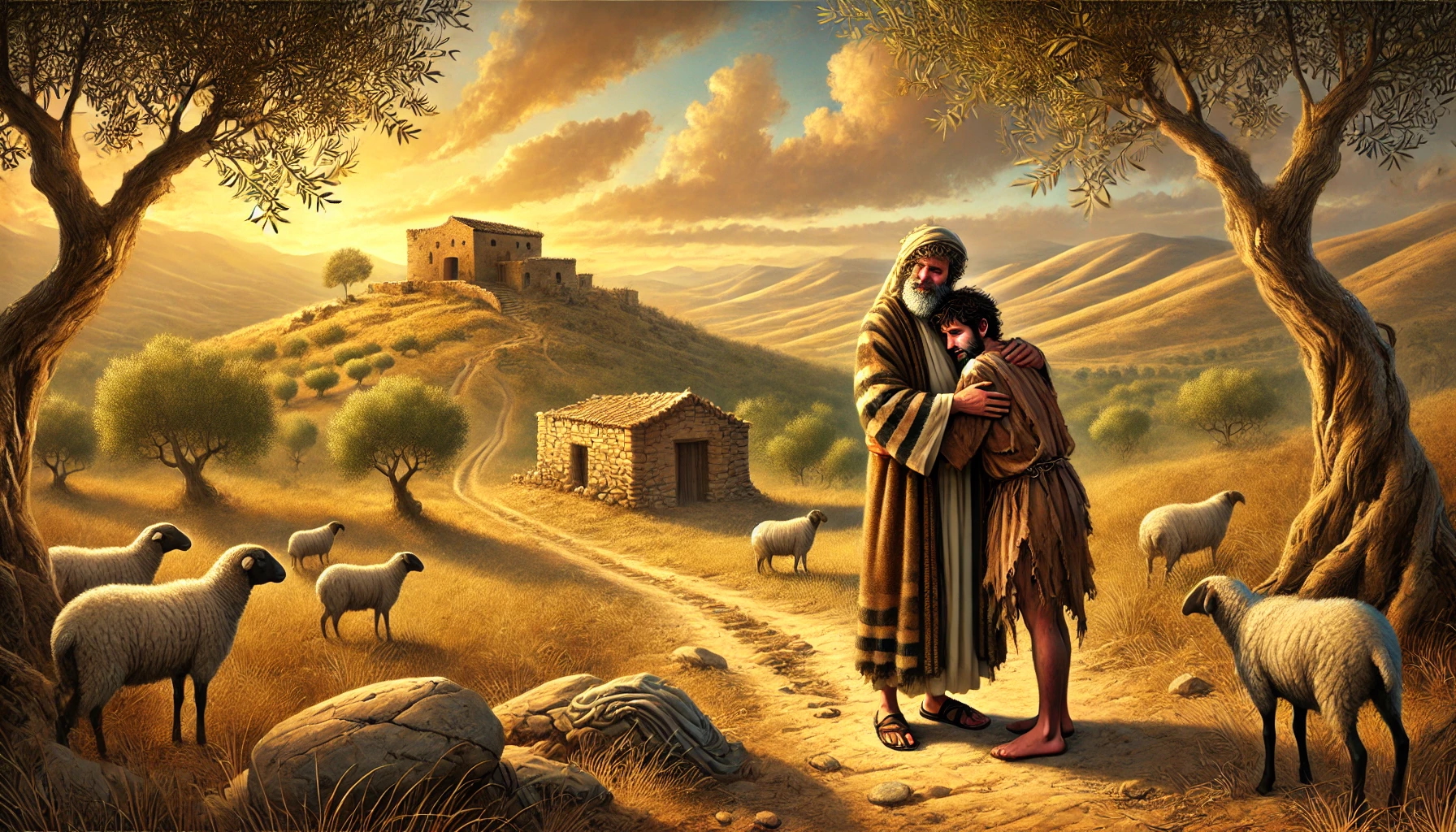
    There comes the day when he spots the bedraggled form of his younger son, barefoot and in rags, creeping through the streets of the village, making his way home. He runs down the street to embrace the boy who had treated him as dead.

    Oh, that sounds nice, doesn’t it, we think, but in that village and in that culture, and at that time, what the father did was shocking.

    Right there in the streets of the village, in front of the neighbors, he runs to the son who has treated him so shamefully. In the peasant world of the eastern Mediterranean—then and now—senior men do not run anywhere. Thank you very much. They walk with dignity and slowly.

    We can easily miss that detail, because that’s not the world we live in. We’re hearing the story, but it’s told for people with different ears and different eyes. You see to run towards his son, the old man has to hitch up his robes because—no more than I can run to the front door with all this gear on—the old farmer can’t run to his son unless he hitches up his robes. 

    Shock, horror, he then exposes his legs.

    That’s a serious costume fail in the villages of the ancient Levant in front of the neighbors. It’s not elegant, and worse, it’s shameful. But the old man doesn’t care. His only concern is for the son who had been dead, but now is alive, back safe and sound.

    In that frail old man running awkwardly down the village street. Jesus paints a picture of God, but he’s also sketching the outlines of what his community of disciples would be like: people of compassion, not holding grudges, not clinging to status, compelled by love.

    So in this story—this familiar, beautiful, misunderstood story—we see a different world, a new world, fashioned and sustained by divine love. 

    And that new world is the reality we are called to create as a community of Jesus people here in the heart of Ipswich. Amen.

  • Be like Luke

    Advent 4C
    St Paul’s Church, Ipswich
    22 December 2024

    IMAGE: http://www.wildwinds.com/coins/ric/city_commemoratives/_thessalonica_RIC_187_arrowhead

    Listening to Scripture and reading our context

    [ video ]

    Throughout this year we shall especially focus on the Gospel tradition attributed to Saint Luke. 

    This is year C in a three-year cycle for the ecumenical lectionary shared by all the major Christian churches. During the past twelve months we have been especially listening to how Mark told the Jesus story, and when we start Advent all over again next November we shall refocus on Matthew’s telling of the Jesus story. But for the next twelve months we listen to Luke.

    Who was Luke?

    Each of the Gospels in the New Testament are traditionally attributed to a particular apostle or close associate of the apostles.

    There is no historical basis to those attributions, and they really do not add anything to our understanding of the documents. We are better advised to pay close attention to the narrative that each Gospel offers us and then discern the different theological emphases that each provides. In other words, we read between the lines as we seek wisdom for everyday life.

    There is an added twist in that the Gospel of Luke and the Acts of the Apostles seem to be volumes one and two of an original continuous account that has been separated into different parts as the NT took shape. The first half was eventually collected and transmitted in the set of Gospels, while the second part was often attached to the collection of Paul’s letters.

    The author/editor is never named, although they speak in the first person in the opening paragraph of each volume.

    Whoever crafted these two documents (which comprise more than 25% of the New Testament), seems to have been a Gentile (i.e., not a Jewish follower of Jesus) and yet someone who was deeply influenced by the Greek version of the Jewish Scriptures, the Septuagint. Whoever this person was, they wrote more of the New Testament than any other person in the early church. Even more than Paul!

    Let’s adopt as a listening strategy the idea that we are listening to the words of a Gentile Christian during the earliest stages of the Jesus movement. This will be somewhere during the last 25 years of the first century and the first 25 years (or so) of the second century. I would suggest later rather than earlier.

    By the time “Luke” is writing his account of things, several people have already written accounts of Jesus. Luke is aware of Mark and Matthew, and perhaps also the Gospel of John. None of this is 100% certain, but it is a reasonable set of assumptions to help us understand what we are going to be hearing in the coming year.

    Interestingly, Luke thinks the earlier accounts were incomplete or inaccurate and he writes to set the record straight!

    What did Luke do?

    Without delving too deeply into the details in a sermon, let me suggest that Luke was doing two things at the same time. Let me also suggest that he is offering us a model that we might well choose to follow.

    Luke is listening to Scripture, and he is also paying attention to his contemporary culture.

    I think that is exactly what we need to be doing as well.

    We see Luke listening to Scripture when he draws on the ancient stories of Samuel to provide colour and detail for his story of Jesus.

    This is especially the case today as we ready the Song of Mary, the Magnificat. This powerful prophetic song which Luke has Mary sing spontaneously after she meets her cousin, Elizabeth, is itself inspired by the song of Hannah from 1 Samuel 2. We read that prophetic song for our psalm portion on 17 November, as we began to turn our minds towards the Kingdom themes during the Sundays after All Saints Day.

    Any ancient reader familiar with the Jewish Scriptures would have easily recognised how Luke’s description of John the Baptist and Jesus echo the biblical stories of Samuel.

    Luke was not alone in searching the Scriptures when seeking to understand their experience of God in and through Jesus. All the early followers of Jesus did the same thing. For example, Matthew’s story of Jesus’ birth draws on themes related to Joseph the dreamer, Moses and the escape from a murderous king.

    But Luke does something that most of his peers failed to do. Luke also paid attention to the cultural context in which he and his readers were located.

    To express that in more contemporary terms (even if slightly outdated now): Luke did not just read the Bible, he also read the newspaper.

    For Luke and everyone else in the Mediterranean world around the end of the first century, the dominant reality was the Roman Empire.

    Rome had its foundation myth, its national story: the legend of Romulus and Remus.

    Luke is writing his account of the Jesus story for people living inside the Roman world.

    Instead of the legend of Romulus and Remus—two brothers—one of whom would become the founder of Rome; Luke tells a story about two boys—John and Jesus—one of whom would become the saviour of the whole world.

    As you prepare for Christmas this week, take the time to read the first two chapter of Luke in one sitting. It is not a very long read, but we mostly hear the story in isolated chunks. Read the whole story as told by Luke in one go, and imagine how his original audience living in the Roman empire around 100 CE would have understood Luke’s message.

    This outline I prepared some time back may be helpful …

    Be like Luke

    The challenge for us is to be like Luke: to be people who read the Scriptures but also pay attention to the cultural world in which we live.

    That is something that comes naturally to us as Anglicans, since our tradition has always valued culture (fine arts, music, scholarship) while remaining firmly grounded in Scripture.

    To repeat the metaphor I used earlier, we need to have the Bible in one hand and the newspaper in the other hand.

    The Scriptures teach us how best to recognise God in everyday life, and our world invites us to express the good news in ways that transform lives and communities.

    That is our task this Advent, and during the year ahead.

  • Foolish generosity

    [IMAGE: https://www.flickr.com/photos/jeepersmedia/49300487777%5D

    This post is part of the ON THE WAY sermon series at St Mark’s Anglican Church, Casino July/October 2022


    The Rich Fool.

    Well, we all know this story.

    It is a story about that self-centred, greedy person who hoarded every success and achievement in life, and did not share any of his success with other people.

    He was a creep.

    We are not like that. Thank God.

    At least, that is what we tell ourselves.

    Yet this parable speaks to us as people, as a nation, and as a church here in Casino.

    This morning, let’s focus on how it speaks to us as a parish.


    During the past week, Parish Council made a brave decision not to be like that ancient farmer.

    We have decided to reopen the OpShop.

    To do that we have agreed to lease the premises at 85 Walker St. Most recently that has been the NORTEC site. Now it will be St Mark’s Downtown.

    The Parish office will be there as well.

    And so will the priest.

    And the Churchwardens, as well as everyone who usually comes into the Parish office during the week.

    There will be Jesus people down there—in and out—every moment of every day.

    We shall all be downtown.

    Downtown.

    Not at the church, but in the Main Street.


    That is a scary choice.

    It may not work out.

    (But how well is the current plan working for us?)

    There are no guarantees of success.

    Rather than build a bigger barn here at St Mark’s, we are going to take our church down to the main street.

    We will create a place of welcome and hospitality.

    The OpShop will help our community recycle preloved goods. That is a great thing to do, in any case. We need to break the cycle of our disposable culture. An opShop helps those who need access to quality items at low cost. It avoids good stuff going into landfill.

    Stuff is able to be recycled.

    People are also able to be recycled. By love. By acceptance. By finding a safe place to talk. By love.

    St Mark’s Downtown will be that kind of place.

    We cannot guarantee it will work, but it is better than building bigger barns and keeping the treasure of God’s love for ourselves. For our friends. For people like us.


    Everyone time that someone feels safe coming into the new OpShop, God’s kingdom has come.

    Every time someone feels welcomed at St Mark’s Downtown, God’s kingdom has come.

    Every time someone opens their heart to another person, God’s kingdom has come.

    Everyone a volunteers enjoys the opportunity to make a difference, God’s kingdom has come.

    Every time that anyone feels valued in the space, God’s kingdom has come.

    Father,
    May your name be held holy.
    Your kingdom come.

  • In the eye of the beholder

    Christ Church Cathedral, Grafton
    Third Sunday after Pentecost
    13 June 2021

    [ video ]

    https://commons.wikimedia.org/wiki/File:Emberiza_calandra_southeast_Turkey.jpg

    We are told that beauty is in the eye of the beholder.

    Actually many different forms of value very much depend on the observer: what seems useful, pleasing and attractive will vary between different people, across time and in different cultures.

    All three of our readings today have at least one common thread which concerns how we see things.

    Last week the religion experts from Jerusalem were warned about the risk that they would not be able to see God at work in their midst because they mistook the Spirit of God doing something new as the work of the Devil.

    This week we build on that theme, and reflect on how we assign (or withhold) value when we are observing what is happening around.

    Samuel goes to Bethlehem

    The prophet Samuel (who was himself overlooked by an elderly priest when he was just a child) sets out for Bethlehem on an undercover mission that puts his own life at risk.

    He is going to look for someone else to replace Saul as king over the tribes of Israel, and if King Saul discovers what sneaky tricks Samuel is up to then his own life will certainly be in peril.

    This is no Christmas story, even though it is in Bethlehem.

    It seems that Samuel has done some research before his trip, because he goes looking for one particular man (Jesse) from among whose children Samuel expects to find the next king.

    As this kind of story often requires, Jesse has lots of children, including eight sons.

    The proud father presents his seven older sons, and Samuel is very impressed. But a little voice in his head keeps saying saying NO to each of these seven impressive young men. When Samuel eventually asks whether Jesse has any other sons, the old farmer admits that there is one not present despite all of the sons having been invited to attend the event.

    He’s just a kid and he is busy looking after the sheep.

    We know how this story is going to end. The youngest boy is called into the party, and to everyone’s amazement he is identified as the person chosen by God to replace Saul as king.

    This is a great example of a story which is true on so many levels even if it did not actually happen.

    Seeing Jesus differently

    Towards the end of our second reading, Saint Paul mentions—almost in passing—that while he might once have looked at Jesus from a human point of view, he does not do that any longer.

    It is certainly possible to look at Jesus from a human point of view.

    Lots of people do that, and people who will never be Christians can still find great meaning for them in paying attention to Jesus.

    But Paul had learned to look at Jesus from another perspective; to appreciate Jesus as the risen Lord, the One who is always present with us through his Spirit, and the One through whom God was choosing to make everything new. He goes on to say:

    So if anyone is in Christ, there is a new creation: everything old has passed away; see, everything has become new! All this is from God, who reconciled us to himself through Christ, and has given us the ministry of reconciliation; that is, in Christ God was reconciling the world to himself, not counting their trespasses against them, and entrusting the message of reconciliation to us. So we are ambassadors for Christ, since God is making his appeal through us; we entreat you on behalf of Christ, be reconciled to God.

    2 Cor 5:17–20

    How we look at Jesus is our choice, but if we look at him in that way then everything changes.

    As parents and godparents, how do we want Sawyer to see Jesus?

    The mustard seed

    Our gospel passage offered another example where how we look determines what we see.

    The parable of the mustard seed is one of the things we can be pretty certain Jesus actually said, although in the several versions of this little parable we can already see people developing the story in different ways.

    For most people this is a story about something that starts out really small (a mustard seed) and grows into a huge tree. “From little things big things grow,” comes to mind!

    If you look at the parable that way you will find yourself among a large crowd of people, but Jesus may not be there as that was almost certainly not what he was seeking to express.

    More likely Jesus had one of the following in mind and perhaps all three of them:

    smallness – the mustard seed is indeed small, but so is the shrub that grows from the seeds and it is never such a large plant that it competes with the ancient trees

    inclusive – the mustard bushes become a haven for birds and other small creatures, who the farmer would much prefer to be somewhere else

    pervasive – these plants are pervasive and will take over the whole field if left unchecked because once they got a established in a small corner of there field they keep on spreading …

    How do you see God’s active presence among us? asks Jesus.

    Do we imagine God as big and powerful, or as small but pervasive, gathering up the marginal people to form communities of hope in a world that runs on fear?

    And how do we see Jesus, and how might we imagine a church that starts again from just a few small seeds? Are we hoping to become once more a large and powerful institution, or shall we be content to be small, inclusive and pervasive?

    And how shall we teach Sawyer to look at things?

  • True vine, authentic holiness

    Fifth Sunday of Easter
    Christ Church Cathedral, Grafton
    2 May 2021

    Ripe grapes close-up in fall. autumn harvest.

    [ video ]

    We are now very much in the second half of the Great Fifty Days of Easter; that “week of weeks” which stretches from Easter to Pentecost.

    Over the first few weeks of Easter we listen to the appearance stories:

    • Easter 1 – Empty Tomb & Mary in the Garden
    • Easter 2 – John 20:19-31 (Doubting Thomas)
    • Easter 3 – Luke 24:36-48 (Emmaus) & John 21:1-19 (Lakeside)

    Then the focus shifts to how the risen Lord is experienced today:

    • Easter 4 – John 10 (Good Shepherd)
    • Easter 5 – John 14 (Home with many rooms), John 15 (True Vine), John 13 (New Commandment to love on another)
    • Easter 6 – John 14:15-21 (Advocate), John 15:9-17 (Love one another), John 14:23-29 (Advocate)
    • Easter 7 – John 17:1-11, John 16:16–24, John 17:20-26 (unity with the Father)

    The True Vine

    Today we encounter a new metaphor in Gospel of John: Jesus as the true or authentic vine. This idea is not found anywhere else in John, and actually is never used by anyone else in the NT. It was not one of Jesus’ regular talking points, but it has been used with great effect about the midpoint of the extended Farewell Discourse in John chapters 13 to 16.

    While this is not a common theme in the NT, it draws on ancient biblical tradition. Sometimes the vine is a symbol for the people of God, but most of the time it is a symbol for life going well. A healthy vine with lots of fruit suggests peace and prosperity, while a sick vine that is struggling to survive suggests hard times.

    All this reminds us how the ancient symbols of our faith are derived from nature and agriculture, and perhaps also how hard it is to find new ways to speak of faith in our world of silicon chips and urban populations.

    This is quite an intimate metaphor. At its heart is the idea of connection with God: of an essential harmony between our spirits and the sacred love at heart of all reality. As such it fits well with the theme of these final weeks of Easter.

    The metaphor of the vine takes us beyond belief and action, to focus on simply being who we are as we allow the life of God to be passing through us for the benefit of others.

    A misunderstood metaphor

    As a teenager this metaphor freaked me out. In my conservative Evangelical church being fruitful meant converting others to believe like us. The pressure was on: to avoid being pruned and burned we needed to go get converts (“bear fruit”)!

    BTW, we were not speaking about bringing people to faith for the first time. This was mostly about persuading Anglicans and Catholics to switch across to our little Evangelical sect, renounce their infant Baptism and their sacraments, and start all over again in the Christian life with us.

    All that made me very uncomfortable. It seemed my spiritual status in that group was on the line, and that God was always looming with pruning shears and matches. 

    Fruit of the Spirit

    Yet when a grapevine is fruitful, we are not expecting it to be multiplying vines. Rather, we expect it to bring reflect the inner vitality of the vine in the form of leaves, buds and grapes. We want lovely sweet grapes from a grapevine, not dreams of expansion.

    Eventually, I came to see that the result of God’s Spirit in us is our own transformation. Healthy holiness is not persuading others to think like me, not poaching people from one church to another, not converting people from other faiths or no faith. It is simply about being the best version of me that I can be with God’s help.

    Paul’s words in Galatians 5 are very helpful, and I deliberately cite them in a longer form than we usually hear them:

    By contrast, the fruit of the Spirit is love, joy, peace, patience, kindness, generosity, faithfulness, gentleness, and self-control. There is no law against such things. And those who belong to Christ Jesus have crucified the flesh with its passions and desires. If we live by the Spirit, let us also be guided by the Spirit. Let us not become conceited, competing against one another, envying one another. [Galatians 5:22–26]

    As these Great Fifty Days draw to us a close may we experience a deepening of our own connection with God, a fresh sense of God’s life flowing through us, a transformation of our character and profound inner renewal.

    May we remain connected to the Vine and may the Father’s gentle touch help us to be even more responsive to the work of God’s spirit within us.

    May we never forget that our task is not convert others, but ourselves.

    Postscript: There is a beautiful poem by Malcolm Guite on the Vine, which a friend shared with me after reading this sermon after it was posted online. I encourage you to read that poem and reflect on its significance during the coming week.

  • Building strong families

    Christ Church Cathedral, Grafton
    Pentecost 12 (B)
    12 August 2018


    [video]

    The great lectionary diversion

    As basic pattern, each year over a three-year cycle, we focus on the witness of one Gospel to Jesus:

    Matthew in Year A
    Mark in Year B
    Luke in Year C

    Mark is much shorter than Matthew and Luke, so round about this time we have a lectionary diversion as we spend a month in John 6. Right now we are at the mid-point of a 5 week series of readings from John 6.

    For preachers, 5 weeks in John 6 can feel a bit like the 40 years in the wilderness. It just seems to go on forever.

    There are many points of interest in these continuous excerpts from John 6, but not much that I feel drawn to preach about.

    I might have preached from the Old Testament, but there we are in another series of readings as the lectionary walks us through the destructive dynamics of the Davidic dynasty. We have abuse of power, sexual abuse, assassination, rebellion, and murder. So much for the Bible teaching good family values!

    There is always the NT reading, and sometimes I would choose that option. These five weeks could have been a good time for a sermon series on Ephesians!

    However, today I want to reflect on some aspects of our life together as a faith community.

    Bread from heaven?

    Let me start, oddly enough, with the Gospel for today.

    You will have noticed there was a tone of conflict in the passage we heard.

    Jesus is portrayed by John as claiming to have come down from heaven, and also to have been around in the times of Abraham and Moses. Naturally, the religious leaders of the day find this to be some kind of weird mix: part nonsense, and part scandal.

    For sure Jesus did not walk around telling people he was 2,000 years old, and then some. He does not do that in Mathew, Mark or Luke. It is a feature of John’s Gospel, and not a memory of how Jesus himself actually spoke.

    Let’s leave aside for now the question of why John will have created this scene. Maybe we can look at this in a Dean’s Forum at some stage. For now, let me pick up the core idea at the heart of the passage: in Jesus we find a wisdom that transforms our life.

    So the first question is whether we really believe that? Is this something we take seriously?

    I am not asking if we take this bread of heaven language literally, but whether we take it seriously?

    If we do take it seriously, then that means we actually believe that we have something of immense value for people’s lives. In Jesus, and in our faith more generally, we find the spiritual wisdom that we need to live as people of hope and compassion.

    Is this wisdom some kind of secret knowledge we hope to keep for ourselves, or are we wanting to share it with anyone who might be interesting in knowing about it?

    If we are wanting to share our faith and see more people joining us in the life of the church, then we are going to have to change how we do church.

    Focus on families and children

    One of the major changes we will need to make is to get the faith out, rather than trying to get the people in.

    This is true for people of all ages, but it is especially so for families with children.

    We are making ministry with families and children a major focus for our work in the next couple of years, and hopefully much longer.

    As I say in this week’s bulletin, this can be done with a mix of gathered events and dispersed experiences, with the objective of increasing people’s involvement in personal religious practices and home-based spirituality.

    In other words, if we can take the faith to them (using our digital technologies) then—in time—some of them will gather for occasional events to celebrate the things they have been learning and doing at home, and some of them will become more active in the life of the parish.

    This will also require us to be genuinely inclusive and to modify our Sunday morning church services to be more accessible to people with very little background in the ways of the church. We have already made a start on this with the 9.00am service time, but will need to keep looking for ways to make our Sunday worship more

    Providing resources for lifelong faith practices in the home and in people’s lives outside of church is a key element of this strategy. If we can develop religious practice in the home and help people to develop their own personal spiritual practices, then we become partners in their lives rather than an institution seeking their time, their energy, and their money.

    The Cathedral website now provides links to selected resources to support parents in shaping the faith dimension of their families as well assisting them in the critical role of effective parenting.


    Conclusion

    Making our “bread from heaven” available and relevant to people in their everyday busy lives is going to take time, wisdom and patience.

    It will be the major focus of the Associate Priest (Children, Families and Youth) that we hope to appoint from January. But it starts now, because right now there are families and children and youth and adults and older people who need this “bread that comes down from heaven”.

    We are starting right now with small baby steps, but with high hopes for the future.

    Come with us on the journey, support us with your gifts and your prayers, and by making this Cathedral the friendliest and most welcoming place it can be.

Exit mobile version