Category: Sabeel

  • Love, actually

    Christ Church Cathedral Grafton
    Advent 4 (C)
    23 December 2018


    [ video ]

    Here we are on the fourth and final Sunday during Advent. We are incredibly close to Christmas as we all realise and indeed tomorrow will be Christmas Eve. We are almost there.

    Over the series of Sundays during Advent we’ve been looking at the major themes associated with each of those days: hope, peace, joy and love. Today we will be focusing especially on the theme of love.

    Most likely many of the earliest Christians, and especially those in churches connected with the ministry of St Paul, were not familiar with the Christmas stories that we find in the Gospel of Matthew and the Gospel of Luke.

    For starters, those two gospels had not yet been written during the lifetime of Paul. Indeed, they represent a stage of early Christianity some decades after Paul: Matthew is perhaps best understood as having been written about 110 while the Gospel of Luke may have reached its final form around 150 CE.

    Whatever the dates for the Gospels and no matter how widely the Christmas traditions had spread around by the beginning of the second century, early Christians were in no doubt that Jesus coming among us was a most remarkable expression of God’s love for all humanity.

    In Romans 5:8 we find Paul dictating these words to Tertius, his accommodating scribe: “But God proves his love for us in that while we were still sinners Christ died for us …”

    A little later, in Romans 8:39, Paul proclaims: “(nothing) will be able to separate us from the love of God in Christ Jesus our Lord.”

    We find a related description in Galatians 4 where Paul writes these words:

    “But when the fullness of time had come, God sent his Son, born of a woman, born under the law, in order to redeem those who were under the law, so that we might receive adoption as children. And because you are children, God has sent the Spirit of his Son into our hearts, crying, “Abba! Father!” (Galatians 4:4–6 NRSV)

    But this idea that the coming of Jesus was a direct result of God’s love for the world is most famously expressed in John 3:16: “For God so loved the world that he gave his only Son, so that everyone who believes in him may not perish but may have eternal life.”

    Love is at the centre of the Christmas story, even when there are no shepherds and no wise men, no journey to Bethlehem and no magical star in the sky. All of these legendary elements add colour and beauty to our celebration of Christmas, but what matters, of course, is the underlying message that Jesus is the love of God for us expressed in a human life.

    Not only is love at the centre of the Christmas story which we will celebrate tomorrow night, it is also at the very centre of the faith that we practice.

    Doubtless we are all familiar with the summary of the law, sometimes called the two great commandments. We often read them near the beginning of our services.

    This core teaching of Jesus is generated by a request by religious authorities in the first-century Jewish community for Jesus to make a ruling on what is the fundamental obligation that we have to God.

    That’s quite an open-ended question, and it is therefore all the more fascinating to reflect for a moment on all the things which Jesus could have listed but chose not to list:

    • Belief
    • Prayer
    • Living a good life
    • Being compassionate
    • Attending worship regularly
    • Contributing money to the church or synagogue
    • Reading the Bible
    • Lighting candles
    • Going on pilgrimages
    • Fasting
    • Kosher food
    • Circumcision
    • Shabbat observance


    Most of the attributes that we tend to think of as being at the core of religious practice are simply ignored by Jesus. When he’s asked to define the core obligations of humans as he understood things, Jesus famously replies:

    “The first is, ‘Hear, O Israel: the Lord our God, the Lord is one; you shall love the Lord your God with all your heart, and with all your soul, and with all your mind, and with all your strength.’ The second is this, ‘You shall love your neighbor as yourself.’ There is no other commandment greater than these.” (Mark 12:29–31 NRSV)

    Love is not just at the centre of Christmas it is also at the centre of our faith.

    ‘Love for God’ means not so much a romantic attachment to some divine figure, but rather us being alert to the depth dimension of life.

    Our heart, our soul, our mind and all our strength are to be brought to bear on the great task of asking why are we here, and what does the Lord require of me? This task will involve our whole person (heart, soul, mind, strength), and it takes our whole lifetime to complete the work.

    First things first: Love for God.

    Everything else flows from that first great commitment to a life lived at depth. Without that commitment, nothing else matters. It is all hollow and empty.

    But notice what does follow—not a traditional list of religious duties, but rather the simple call to love other people.

    Their concerns and their wellbeing are to matter to us just as much as our survival and our own comfort.

    In the car park at the shopping centre …

    While merging in the traffic to get across the bridge …

    When we would rather be somewhere else …

    When we really do not have the time to listen to their story (again) …


    Love is the critical DNA of the Christian person:

    I give you a new commandment, that you love one another. Just as I have loved you, you also should love one another. By this everyone will know that you are my disciples, if you have love for one another. (John 13:34–35 NRSV)

    The benchmark for our love obligation is twofold.

    In the Synoptic Gospels it is the love we have for ourselves: “love your neighbour as yourself”

    In John’s Gospel Jesus is represented as raising the bar rather higher: “… just as I have loved you …”


    So this week as we approach ever so close to Christmas, we are reminded of the primacy of love.

    As we come to the Table of Jesus—the table of love—we feed on that love, we ask God to pour her love into our lives, and we seek courage to be truly loving people in the week ahead:

    Loving God

    Loving others

    Loving this fragile Earth and all its creatures

    Loving even ourselves


  • The Occupation of the Bible

    Wednesday, 20 November, 1100–1230

    Text for an introductory presentation to a panel at the Ninth International Sabeel Conference, Jerusalem on Wednesday, 20  November 2013. [video]

    The conference organisers indicated as follows:

    What are some of the common ways to misinterpret the Bible and how can Christians avoid them? Since we are all ‘prisoners’ of our own epoch, culture, national identity, gender, experiences, etc., how is it possible “to hear the word of the Lord” without bias? Give examples of mistaken hermeneutics and also helpful hermeneutics. Why do biblical hermeneutics matter? Is the Palestinian experience of biblical interpretation unique, and if so, in what sense? And does this mean Palestine must have unique hermeneutics, too? What can non-Palestinians learn from the Palestinian experience for their own interpretation of Scripture? Does the Palestinian Christian experience of scriptural interpretation in its particular socio-political context have something of value to offer to the oppressed Buddhists of Tibet; the Kurds of Iran, Iraq and Turkey; and the Uighurs of China?


    In terms of the place that I come from, one of the things that I have learned to do when speaking in Australia is always to bring greetings from the church—and from the Christian communities—in Palestine. But when I am somewhere else, like other Australians—and especially indigenous Australians—I find myself discovering a deeper sense of our own country, or unique place in the world. I am learning—as someone who has been out of my own ‘country’ for most of my adult life—really to appreciate how the Christian Scriptures, are used (and also misused in may ways) in terms of Palestine, Israel, and the conflict.

    I begin from the assumption, of course, that the Bible has immense authority for this conversation. We have already begun to explore that with the earlier panel this morning.

    Because of the authority that the Scriptures have—however we understand that authority—the Bible will inform and will shape the ways that we address issues of justice, peace, and reconciliation for all the communities that live in this land.

    So far as process is concerned, my working assumption is that this will require an active and open-ended engagement with the sacred texts. It will also require us to be involved with the historical processes that have led to the present situation in this land and, of course, as we have already heard—I think from each of the speakers in the previous panel—we need to be paying attention to our own perspectives, our own locations, and our own point of view.

    I actually think we had a fine example of that in the sermon that Azziz Naim gave yesterday in the Melkite church. However, I want to go out on a limb a little bit and indicate one of the places where I would probably differ significantly from some of the other members of the panel, and particularly the previous panel. I am one of those liberal or progressive scholars who look at the way Scripture functions in terms of the Palestinian/Israel conflict. This is one way of working around the issue of how the Scripture impacts on the claims made for land by both Jewish and Palestinian communities.

    So as the sermon began I made a note to myself: This could be hard. While I love Azziz very much, I could see that he was going to take the story very literally. And that is not what I would do. As the sermon unfolded I was delighted, then more delighted, and more pleased. I found myself drawn along. I loved it and entirely agreed with the way that the text was unfolded. I mention that because saying that I do not begin with the assumption that the Bible is simply a record of something that happened can frighten the camels; it can scare the horses. Choose whichever metaphor works for your culture!  I could be putting myself out on the end of a plank with the pirates about to saw through at the end closer to the ship.

    But even if we start from different positions as we engage with Scripture, my experience has been—and this perhaps goes to the question of the role of the Spirit in this whole process—no matter what position we are starting from, if we are engaging the Scriptures with hearts and minds that are open, then God is able to speak to us.

    So what I saw yesterday was someone taking the Gospel story at face value in a way that I would have difficulty doing, and yet someone who was deftly avoiding some of the traps that I might imagine to be there when people say they are taking the Bible literally, at face value.

    What I saw yesterday, and what I am committed to myself, is a way of engaging with Scripture that offer the Bible the best of our critical engagement. We are called to love God not only with heart and might and strength, but also with our minds. I believe we are called to engage with Scripture in that same diverse way: with the best of our mind, the best of our soul, the best of our heart, and the best of our strength.

    The Bible, I suggest, deserves and requires the best of our critical engagement, rather than naive readings which perhaps are predicated on the assumption that we should defer to Scripture. I think Scripture—like God in the book of Job—is strong enough, powerful enough, and robust enough, to take our questions, to take our confrontation, and then to take us further into the journey that God has for us to make.

    So with all that in mind, I am taking this panel to be an invitation to explore some of the ways that the Bible has been exploited to justify the occupation of Palestine to the benefit of some people and the simultaneous detriment of other people, rather than serving—as I think it could and should—as a prophetic text that might challenge both the occupiers and the dispossessed.

    This gets me thinking about the significance of the location and agenda of the reader when using Scripture in the context of occupation. Clearly a Jewish settler would read the Bible differently than a displaced Palestinian, and neither would read the Bible from the same perspective as me. I am a white, male, Anglican, academic, priest—and a colonialist, or at least a descendant of colonialists and someone one who benefits from the dislocation and displacement of the indigenous peoples of my own country.

    There other variables as well, including those between someone like myself who reads the Bible from a consciously critical and humanistic perspective, and others who may read the same Bible from different perspectives—some of which we have heard this morning. Again, my experience has been that beginning with different perspectives does not prevent us from discovering common ground and hearing common wisdom.

    I would lead into our discussion this morning, by thinking about how the Bible’s three different ‘worlds’ are captured in this occupation of the Bible. The worlds I am thinking of are: the world behind the text (the historical realities that presume to be behind the text, how we imagine the ancient past), the world within the text (the stories, the context of the Bible as it is), and the world in front of the text (those places where we are as we engage with Scripture).

    The World Behind the Text

    I think of the historical dynamics of ancient Palestine that witnessed the emergence of ancient Israel and Judah, and—at some point in that process—the suppression of non-Yahwistic Canaanite communities with their rich human cultural fabric. As an academic, and as a person of Christian faith and a follower of Jesus, I find myself wondering how much of those ghastly stories of ethnic cleansing and religious violence reflect events that actually happened. To what extent, on the other hand, do they represent the imagination of later religious scribes—the Taliban of ancient Jerusalem—who were expressing how they felt about their experience of marginalization and their threatened fragile existence, and found comfort in fantasies about total conquest, excluding the other, ethnic cleansing, and the belief that God gave this land to me and my own kind (and no-one else).

    So there is a whole set of issues about claims that are made and assumptions that are embraced in terms of the historical veracity of the biblical narrative. You might have already picked up, in case I have not made it clear enough, that I am actually a minimalist and I think there is very little historical value to the biblical narratives. (So get the tar and feathers ready!)

    The World Within the Text

    The second world is, of course, the world within the text. This is the story world that Naim and I both find in Luke chapter 4. Whether or not there was a synagogue in Nazareth for Jesus to attend during the first three decades of the first century, and whether Jesus was literate or not, is beside the point. These are narratives by first and second-century Christians, and the sermon created for Jesus by Luke now serves as a sacred text that calls us to faithfulness.

    Real or imagined, the ethnic violence of the Bible—whether we think of the Old Testament or the apocalyptic fantasies of the NT—inscribes and reinforces patterns of fear, suspicion, and violence that are presumed to have divine legitimisation. The Bible drips with blood, whether that be the blood of Jesus (whose death is often understood in Christian tradition as expiating an angry—and potentially violent and dangerous—God), the blood of the little ones who are crushed by empire, or the blood of those whose religion is different from ours and are thus doomed to destruction by our God. The book of Revelation is certainly a classic text in that respect.

    The World Before (in front of) the Text

    Then, of course, there is the world in front of the text. This is the world in which we live, the world in which we attempt to shape lives that are holy and true.

    Looking at the text from where I stand and from among the communities to which I belong, I discover that I am in a very ambiguous space. I belong to a religion that has incarcerated, tortured and killed its opponents, whether they be internal dissidents or external infidels. My religious community has drunk deeply from the well of violence. I am a citizen of a nation that has dispossessed and literally hunted down the indigenous people of my own land. I benefit from an economic system that continues to use violence to sustain itself.

    So neither the text nor this reader of the text is innocent. Yet both are open, all the same, to be used by God, and to serve God’s purposes of justice and peace. The occupation of Bible can come to an end, just as the Bible can encourage us to resist the occupation of Palestine until it also comes to an end.

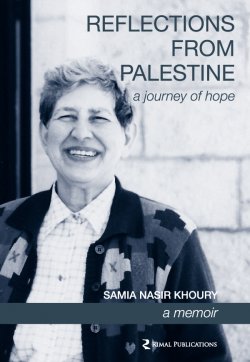
  • Reflections from Palestine

    Reflections from Palestine: A Journey of Hope.
    A memoir by Samia Nasir Khoury.
    Nicosia, Cyprus: Rimal Publications, 2014. ISBN 978-9963-715-11-4

    Samia Nasir Khoury celebrated her eightieth birthday on Sunday, 24 November 2013. This was also the final day of the Ninth International Sabeel Conference. Following a service at the Lutheran Church of the Ascension at Augusta Victoria on the Mount of Olives, the 200 delegates renewed our commitment to justice and peace at Qasr el Yahud, the Baptism site on the Jordan River before going to the Intercontinental Hotel in Jericho. There we were joined by an additional 200 Sabeel members for an afternoon of celebrations to mark the twenty-fifth anniversary of Palestinian Liberation Theology.

    As Samia noted in an email to friends shortly after the conference ended, never had she experienced so many people singing happy birthday to her. It was especially fitting that this book was available for purchase that afternoon as so much of the story goes to the heart of Sabeel’s work in developing and practising Palestinian Liberation Theology.

    Together with her long time friends—Cedar Duaybis and Jean Zaru—Samia Khoury has been one of the founders of Sabeel. These strong women of Palestine have played a leading role in the organization and their lives radiate with the virtue of summud, steadfast persistence. In the face of occupation and never-ending harassment, these women and their millions of anonymous Palestinian compatriots stand firm and refuse to oblige the Zionist dream by fleeing the land of their ancestors.

    This book is both easy to read and hard to read, all at the same time. It is a gentle book as one articulate and passionate woman tells the story of her family through decades of occupation and hardship. It is a confronting book as the unremitting evil of the occupation is parsed out in the details of everyday life under belligerent military rule.

    Yet this is a woman who has raised a family and cared for her grandchildren. I have met one of those grandchildren, and she is every bit as articulate and determined as Samia herself.

    In addition to her life as a wife, mother and grandmother, Samia has served as a founding Trustee of Birzeit University, a founder of Sabeel, and the President of the YWCA in East Jerusalem. Her personal circle of contacts around the world is a testament to her character and stamina, and this book had its genesis in a series of essays written for the magazine, Witness. I am glad that she wrote those essays and even more pleased that she agreed to edit them into this collection of reflections. Her personal integrity shines through these pages. I hope this book is widely read and, more importantly, that it inspires us all to do more to end the occupation that diminishes the humanity of the Israeli occupiers as much as it harms the Palestinians.

  • Does the Bible have a future?

    Thursday, 21 November, 0900–1030

    Text for an introductory presentation to a panel at the Ninth International Sabeel Conference, Jerusalem on Thursday,21  November 2013. [video]

    The conference organisers indicated as follows:

    This panel discussion arises out of the following critical awareness:

    Since the Bible has been used to support highly destructive moments of human history such as theft, slavery, murder, assassination, war, genocide, population transfers, forced conversions, and environmental degradation, perhaps the Bible is too dangerous for the masses. Maybe we should take it away from the laity and only allow it to be read and interpreted by professionals? Yet neither political leaders nor the church’s anointed have been free of biblically justified atrocities. Perhaps the Bible should be counter-balanced by other authorities such as scientific findings and the UN’s Universal Declaration of Human Rights? Can the Bible be redeemed and used as a source for human advancement, and if so, how?


    This panel has its theme, “Does the Bible have a future?” This is a very different kind of topic, and it plays into my own research and writing about the “once and future Bible.” It could be a theological diversion from the challenges of justice and peace, but perhaps it is also about asking what kind of ways we might imagine the Bible contributing to justice and peace, rather than promoting and endorsing violence and oppression.

    Let begin by noting a simple but significant error in the title of our panel and of our conference.

    The title refers to “the Bible,” but there is not ONE BIBLE. Rather there are many Bibles, as Yohanna reminded us yesterday morning.

    There is more than one form of the Bible and one expects there always will be, just as there is more than one expression of church. That diversity of Bible extends beyond the formal differences of content between Anglican, Armenian, Catholic, Coptic, Ethiopian, Jewish, Orthodox, Protestant and Syriac Bibles, since — even when we have the same set of books in our Bible — we may choose to read some parts while ignoring other parts.

    So much of the power talk around the Christian Scriptures speaks as if the Bible was a single thing, that exists in one agreed form and through which God speaks with one voice. I suggest that is simply not so. The Bible is diverse and God speaks through the Bible in many different voices.

    Yet so often our language about the Bible reflects an assumption that we all mean the Protestant Bible, as it emerged in NW Europe at the time of the Reformation. That particular form of the Bible is the Bible most of us know, but it is not the Bible of the Catholic Church nor of the Eastern rite churches. It is the Bible of the North Atlantic Theological Organisation, but it is not the only Bible. It is not the ancient Bible. And it is not the best Bible.

    I suggest, with as much humility and grace as I can muster, that the first thing about the future of the Bible that we need to embrace is that the Bible has always existed in multiple forms and that it will continue to do so. Our desire for certainty seduces us into thinking of the Bible as a single thing that speaks with one voice, and that plays into theological power games that — as we see in this land, but also in other lands — can have unjust outcomes for the people of the land, the am-haaretz, the little ones of God.

    So I have no doubt that Bible has a future, even if I find it hard to predict just what those futures of the Bible may be like.

    A further preliminary response to this topic would to ask why are we discussing this theological topic rather than a real topic? My own response to that comment is that, in my view, an authentic Christian response to occupation, dispossession and violence must be derived from our understanding of Jesus, and for that I need the Bible. Not because I will ever take the Bible literally, but because I must always take it seriously.

    So let me clear at the outset that I have no doubt that the Bible has a future. Indeed, I am sure that the Bible does have a future, but I do wonder whether it will be a future that serves the powers that be or a future in which the Bible functions as a prophetic text, calling us all to repentance, renewal and action?

    Let me also say that how this is future takes shape rests with the communities of faith for which the Bible serves as sacred text. Academics will not determine the future of the Bible. That will be determined by the people of God, in all their diversity.

    While I am sure that that the Bible has a future, I am not sure whether the future of the Bible will be toxic for humanity or a good thing for us all.

    For sure, I suggest, the toxicity of the Bible rises in direct correlation to its integration with the powers that be — whether those powers be inside the church or outside the church.

    Not every reading of the Bible is healthy and good for us. I wish I could promise that the future of the Bible is one characterised by life-affirming readings, but I fear that will not be the case. People of power will always find it expedient to co-opt and exploit the Bible for their own ends, while evading its prophetic claim upon our lives. In this respect, I have found the contributions by Nancy Cordoso Pereira to be challenging and transformative for me.

    As we reflect on this further, I would affirm that the Bible — in its diverse forms and with its diverse voices — is a key text for both victims and perpetrators, and will continue to be so unless we can change the ways in which people read the Bible. This suggests at least two different futures for the Bible: one that assists victims to use it more effectively, and another that disarms the Bible so that it cannot be used as a weapon of fear and hate.

    The trick is not to change or domesticate the Bible, but to change and empower the readers.

    So I invite you to think about the two sides of the coin for the future of the Bible: How to make it work better for the little people, and how to make it work not so well for (and even against) the powerful people.

    Some of the strategies will have both outcomes, so they are high value options.

    These would include:

    • Improving biblical literacy within the churches and in the wider community
    • Accessing contemporary critical biblical scholarship
    • Recognizing diversity within the Bible and attending to the minority voices
    • Acknowledging the dark side of the Bible
    • Celebrating the positive side of the Bible

    One key element will be reading the Bible contextually:

    • In its ancient historical contexts
    • Through its history of interpretation across the centuries
    • In our own contexts now
    • In the context of scientific insights and human rights values
    • In our multi faith context (as one religion among many, not as THE only true religion)

    If we can make progress across these issues, then for sure the Bible will not only have a future but it will be a future that brings healing and hope to all people

  • Study Leave — Week Four

    It is hard to believe, but already I have been in Israel four weeks. That time has certainly gone by very quickly. I guess one of the indicators that this has indeed been the case is my growing familiarity with the roads. After three or four trips to Jerusalem without the aid of my trusty GPS, I am starting to feel like I know the place. Even the process of checking in at the gas station counter for my credit card to be approved before I begin to fill the tank now feels routine.

    The public calendar has been dominated by Shabbat and Pesach (Passover), creating an extended holiday week for many Israelis, whether religious or nor, Jewish or not. The schools are in Spring break, and the roads are busy with holiday traffic.

    I made two trips to Jerusalem this week, and happily missed the worst of the traffic. The absence of trucks on the main tollway has certainly helped in that respect.

    On Sunday I went back to the Israel Museum, but as a paying visitor so that I could see the Herod Exhibition and also spend some time in the archaeology hall. The exhibition is very good, but I was expecting it to be larger than it is. Still, it is well worth the 30–45 minutes needed to see everything, watch the videos, etc. On arrival at the Museum I was reminded how small our world is when I looked up to see Mary Cohloe from Melbourne (but formerly teaching in Brisbane) leading a group of students past the front of my car towards the Museum. We crossed paths later in the day and it was good to catch up with her.

    One of unexpected highlights from this visit was the opportunity to see the White Gold exhibition, featuring the earliest coins that were made from electrum. As it happens the curator of the exhibit was there at the time and asked if I had any questions. When we began to talk I realised that I had seen him in the coin department at IAA a few days earlier when he brought in a book I was needing to consult. It was good to have an opportunity to talk with him about the exhibition.

    On Monday evening I had the opportunity to join a local Jewish family for their Passover Seder. The family are close friends of Judith and Shai from Kibbutz Ginosar, and it was a delight to share the evening with them all. Although the two families are not religious, it was clear that the Seder is a significant occasion for renewing and sustaining their Jewish identity. I was especially impressed by the care taken by Miriam, our hostess, to choose a progressive Haggadah with a focus on social justice and compassion. Her own reflections on the meaning of Pesach and the search for God were beautiful, and would have graced any pulpit.

    Tuesday saw me heading back to Jerusalem for some meetings to set up an on-going arrangement for students from St Francis College to come to Jerusalem for short term placements as interns with the Anglican Church here. Julianne Stewart from Anglican Board of Mission Australia was in town for the week, so it was a good opportunity to meet with her and to discuss the proposal with local stakeholders. Good progress was made, so I am hoping we shall have the scheme up and running for next year.

    Wednesday night I attended an ecumenical prayer service for the Feast of the Annunciation at the chapel of the Clarisse Sisters in Nazareth. Although not dressed in clerical gear, I was placed in a seat in the very front row and given an order of service in Arabic. The singing was beautiful, and the young Italian priest who gave the homily spoke in very good Arabic (raising the bar for me in the eyes of my local friends). Abuna Suheil from the displaced Arab Christian community at Iqrit led some of the prayers. I had met him and the community there last July, and have mentioned them at the beginning of each of the BIBLE360 workshops that I presented over the past six months, so it was good to see him again. All five clergy present for the event joined in the blessing at the end of the service, although I was not required to speak!

    In among all these trips to Jerusalem and other events I have managed to get some further work done on the new book. Research is continuing on the archaeology of ancient Nazareth, but in the last 24 hours I have completed the first draft of a chapter that explores the social location of Jesus and his relationship with John the Baptist. I keep reminding myself that a book is just a series of 5,000 word essays, so a chapter a week should see me have the book ready by the end of my study leave.

  • Study Leave – Week One

    Having been in Israel now for just over a week it may be good to reflect on the first week or so of my study leave. For those family and friends not following the posts to my Facebook account, this is may be the first real update you receive.

    I arrived via Amman on Thursday afternoon (28 February), so really began my study leave on the morning of Friday, 1 March. That was also the day I collected my little red Daihatsu from Nur Car Rentals in Nazareth, and already we have covered many km together.

    Friday and Saturday were very much devoted to settling into the lovely house I have been able to rent for my stay here, including getting to know “Fifi” the dog who comes with the house. There were a couple of trips to Nazareth to catch up with friends there, and time to explore the hills around the lake in their amazing Spring greenery. I am constantly amazed by the rich green on the hills, and delighted to see the very high water levels in the lake—the best for 20 years or more.

    On Sunday I headed south to Jerusalem for a few days. On the way I stopped to enjoy lunch with Hanan Shafir, the photographer at the Bethsaida dig, his wife Hanni, and their granddaughter, Alma. One of the most rewarding aspects of the Bethsaida dig is the rich network of people drawn together from all over the world, and Hanan is one of the most fascinating of them all.

    I spent three nights in Jerusalem, staying at St George’s College—a place with many significant memories for me, and where I still have friends from the early 1990s. I was able to spend much of Monday and Tuesday working in the coin department of the Israel Antiquities Authority, making a good start to the Bethsaida coins project that is my principal reason for being here. In fact I made such good progress that I seem to have enough work to keep me occupied for the next week or more without any need for a return visit just yet!

    Before returning to Tiberias on Wednesday evening, I was able to spend a couple of hours at the Sabeel offices in Jerusalem. There I met with Naim Ateek, founder and director of the Sabeel Ecumenical Liberation Theology Centre. I was also able to spend some time with staff and volunteers preparing for the Global Young Adults Festival in June and the ninth Sabeel International Conference in November. These look like great events, I encourage anyone able to attend to do so.

    Thursday was mostly spent in Nazareth, visiting with local Sabeel people there and stocking up on stationery and other supplies. However, I did find myself photographing the spectacular wild flowers on “Mt Precipice” (just on the edge of Nazareth these days) while waiting to catch up with some of these people. For those interested, the best of the flowers are in the March Gallery, along with other selected shots from this last week.

    By Friday I had completed the first week’s cycle, and was beginning to feel increasingly at home in the special place I have been privileged to visit on so many occasions, and where I shall be for almost five months this year. The local weekend tends to be Friday and Saturday, due to the Jewish Shabbat, so by lunch time on Friday many of the shops in Tiberias are closed and the city is moving into its weekly reflective mode; a dynamic not seen in more secular western societies these days. Fittingly, I ended the day with Judith and Shai Schwartz at Kibbutz Ginosar. We shared a delightful evening over a shared meal, after first lighting the Shabbat Candles and singing the traditional prayers to welcome the Shabbat. As we shared the cup of wine and the portion of bread, I sensed the ancient roots of my own tradition as a Christian.

Exit mobile version