Author: Gregory C. Jenks

  • Confident faith in a post-Christian world

    Confident faith in a post-Christian world

    Reflections for a diocesan clergy retreat
    Cathedral of Christ the King, Grafton
    (17 May 2017)

    In the context of this clergy retreat we have been reflecting together on the text from 2 Timothy 1:7 passage: For God did not give us a spirit of cowardice, but rather a spirit of power and of love and of self-discipline.

    In this session, I want to explore some of the attributes of a spiritually confident Anglican faith community in a post-Christian Australia.

    This is not a prescription for a healthy or successful parish.

    Rather, I am seeking to name and celebrate some of the attributes of a local faith community that has some degree of healthy spiritual confidence.

    As the earlier reflections by Stuart, Mike and Lyndon have already indicated, we have good reasons to be spiritually confident, as individuals, as clergy, and as a church.

    Such confidence is not about being arrogant, or cocky. It encourages neither bigotry, nor that quiet smugness that may be our besetting sin as Anglicans. It is more a matter of deep confidence that our spiritual traditions, first as Christians but also as Anglicans, provides us with good reasons to be people of courage and hope.

    What I am trying to do in this session is imagine what a local church might be like if it embraced the idea that we can put aside any sense of cowardice, and live into our destiny as communities of power (the Greek word here is dynameis), love (agape) and practical wisdom (sōphronismos). That last word is rare, and only occurs this one time in the Bible. It has the sense of making wise choices, acting prudently, exercising self-control.

    A challenging context

    Our recent history as a church—and the increasingly secular context in which we find ourselves—provide good reasons to be anxious about the future. While I do not want to focus on these negative elements, I think we need to name them as serious factors that impact us as people of faith and as faith communities.

    As a church we face some tough realities:

    • loss of influence in society
    • shrinking numbers
    • ageing congregations
    • limited resources
    • shameful failures of care for children and vulnerable adults
    • seeming success of ‘mega-churches’

    In addition to all those factors we are operating in a context that is now more complex than in the past:

    • rising levels of affluence
    • ‘time poor’ couples working to cover the mortgage and maintain their lifestyle
    • accelerating technology-driven change impacting every aspect of life
    • religious pluralism
    • rising secularism
    • advances in the natural and social sciences
    • a new concept of what it means to be alive and to be human

    None of those contextual factors are likely to be reversed, and we ignore them at our peril.

    The major challenge that I discern is the need for us to be nimble and innovative in our response to these emerging challenges. These changes are here to stay, and they will only accelerate in both the pace of change and the scope of their impact. Everything is changing and we had best be prepared for that.

    A community that has not been given a spirit of cowardice, but rather a spirit of dynamic power, selfless love and practical wisdom has the resources to flourish even in these circumstances, and especially in these circumstances. Whether or not we do flourish depends mostly on whether we respond out of fear or hope.

    Let’s now explore some of the attributes of spiritually confident faith communities in a post-Christian Australia that needs us to be all that God calls us to be, but expects very little wisdom for the future to be found among us.


    People of the Book

    We could start at a number of different places, but let’s begin with the Bible.

    A spiritually confident church will be one that genuinely values the Scriptures, without making extreme claims that reflect poorly on both the Bible and the churches. To use a phrase that is commonly heard these days, such faith communities take the Bible seriously, but not literally.

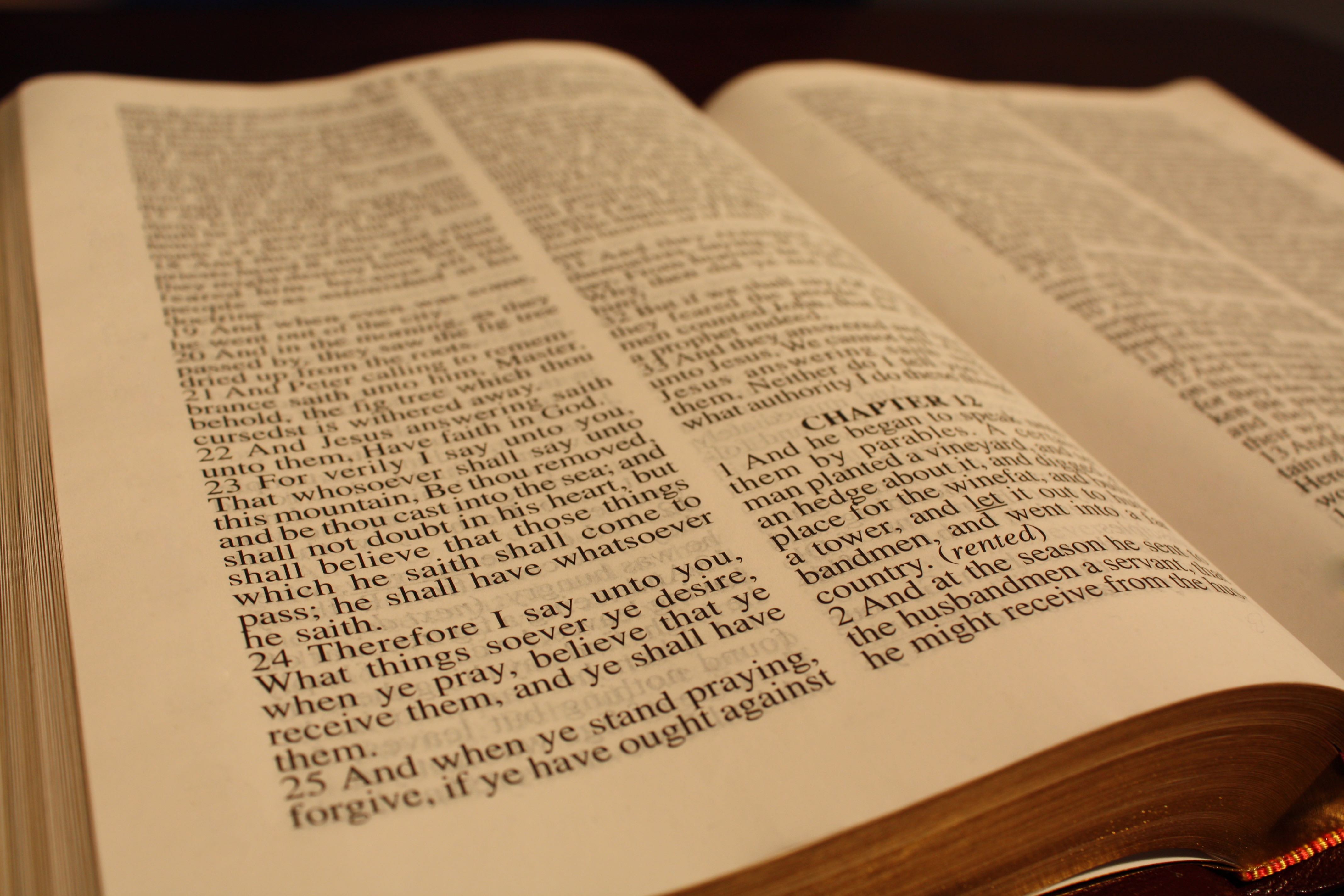
    Every church talks up its respect for the Bible.

    Yet not every church encourages its members to become skilled in using those same Scriptures as responsible spiritual adults.

    A spiritually confident church will invest in the development of its members so that high levels of biblical literacy are found among its people.

    A spiritually confident church will encourage people to read the Bible and also enable them to read it well.

    Such a church will not make those familiar false steps that can be mistaken for promoting Bible knowledge among its people. Much of what passes as Bible study is more about developing Bible trivia skills, and sometimes just reinforces ignorance. Knowing fascinating micro facts about the Bible, even when they are correct, is not the same as developing the skills needed to read the Bible for spiritual wisdom.

    Healthy and confident churches appreciate the Bible as an informal sacrament of the living Word of God, ever active among us. In such a Church, listening to Scripture together is a community exercise as we seek to discern what the Spirit is saying to the church.

    That means not just the priest or the Parish Council, but the entire congregation needs to be skilled at using the Bible and actively engaged in small groups where they can help each other “read, mark, learn and inwardly digest” the words of Scripture.

    Listening to God is the quintessential hallmark of a person of faith.

    Reading the Bible in the company of other people is simply the best way to do that.

    The Bible is not a magic pudding of spiritual knowledge, from which we can cut slice after slice of divine answers to theological and spiritual questions. We do the Bible no credit when we encourage people to engage uncritically with this amazing spiritual resource.

    Its most precious attribute, and the major reason for taking the time to develop good biblical literacy skills, is as a catalyst for spiritual wisdom. When a small group gathers to study the Bible, God blesses us with wisdom. This is true even when our questions are not ones found in the Bible itself.

    Reading the Bible puts us into a sphere of grace where we are more attuned to discern what the Spirit may be saying to the churches.

    We gather at the Table of the Lord to feed on his life, and we gather around the Bible to find the wisdom we need for our daily lives.

    We come to Table with an attitude of faith and thanksgiving as we reach out hands to receive the Body of the Lord. We listen to the Bible with the same attitude of faith and thanksgiving as we open our hearts to hear Word of the Lord.

    As always, the focus stays on the present. We are not seeking to find out what the Bible can tell us about the past, but exploring how the Bible can shed new light on today and tomorrow.

    In all of this our goal is to form disciples, not train scholars. We are reading for wisdom, not offering a master class in ancient history.

    A spiritually confident faith community is one that:

    • Develops the biblical literacy skills of its members
    • Draws deeply and often from the well of Scripture
    • Encourages regular Bible study by individuals and small groups
    • Has a strong preaching ministry in Sunday services, and
    • Engages with the lectionary texts.


    Liturgy

    It seems that humans have a deep need for ritual.

    This may be one reason for the continued observance of ANZAC Day, even though it has also been manipulated by politicians who see benefits to them from such events. The deeper reason is surely our shared sense that as a nation we need such occasions to celebrate our identity and commit ourselves to a shared future.

    This love of ritual is also seen in the big budget rituals of major sporting events, as well as in the weekly assemblies at the local primary school. In those assembles we celebrate success, we build community, and we reinforce our core values.

    A spiritually confident church does liturgy well.

    By that, I do not mean that it perfectly observes all the directions of Ritual Notes 9th edition, nor that it has the finest music, the most eloquent preacher, or the best sound system.

    I mean, of course, that it offers a liturgy that speaks to the human condition, even if not executed to perfection.

    Liturgy that connects the rhythms of our life with the mysteries of the faith.

    Liturgy that becomes, in its better moments, an encounter with God.

    This kind of ‘good’ liturgy is grounded in the experience and the language of the local community. It grows out of, reflects upon, and enriches our shared life with those around us.

    Such liturgy draws on the long tradition of the church, but it also integrates spiritual practices from other traditions.

    It need not be heavy, but it can carry deep meaning.

    It is often less verbal than what often passes for Sunday worship.

    And it engages the whole person and all of our senses.

    The aesthetic qualities of good liturgy are powerful connectors with the participants, and time spent preparing the non-verbal elements of the service is seldom wasted.

    A spiritually confident church will offer people a variety of ritual moments, and teach people how to create rituals within their personal lives. We will go beyond page 119, and tap into the rich resources of the ancient church as well as more recent liturgical wisdom.

    Celtic spirituality may have much to offer here, as it names and claims so much of the everyday, connecting the familiar rhythms of our life with God’s deep presence among us and within us. That kind of spiritually may be a bridge to our neighbours who have little time for church, but a deep longing for connection with God.

    A spiritually confident church will also provide ‘God spaces’ and ‘God moments’ for the wider community. I love it when I drive through Bangalow and see the sign outside All Souls’ Church: ‘Church open for prayer’.

    There are no conditions on how you pray, or even to whom you pray. Just an invitation to step aside and spend some time in the company of God.

    The worship we offer is not just for ourselves.

    Behind our English word, Liturgy, is an ancient Greek word: leitourgia.

    leitourgia was something done as a gift to the community.

    When people of faith gather for worship we are investing in the spiritual fabric of our community. We uphold our community, our nation and the world in our own hearts and in the heart of God. We are standing with the angels, and aligning ourselves with God’s dream of a world shaped by love. We are investing in shalom, deep peace.

    Our Sunday worship is not about keeping the Anglican brand alive in our local area.

    We are calling to mind the depth dimension of life, and we are offering ourselves to serve as instruments of God’s love and peace right here and right now.

    We are connecting with God, connecting with each other, and connecting with our world.

    Each Sunday we come to the ancient well of common prayer, and we draw water from the well of life. We do this for ourselves, of course. We need the spiritual refreshment that this living waters provide.

    But we also do this for our friends and neighbours, who may never come to this well, but may still share in the life that God gives freely to anyone who is thirsty.

    Oasis of Shalom

    I like to think of a spiritually confident faith community as an oasis of Shalom, the perfect peace that God intends for all creation.

    Such a church is open, inclusive, and welcoming.

    People are made welcome, and provided with the space to be themselves. Even, to find themselves.

    In the ancient tradition of the desert, a stranger is made welcome and asked no questions for three days. They are not interrogated about their identity or their history. They are simply made welcome and offered a place to stay for a while.

    A spiritually confident church does not need to check the theological opinions of those who cross our threshold.

    Genuine hospitality is a spiritual virtue that offers deep blessings to both the host and the guest. We can be clear about our own beliefs and values without needing to impose them on those whose paths cross with ours. There will be time enough for dialogue and conversation if the guests choose to stay longer among us.

    For everyone in the community—long term members, short term guests, and those seeking a new community—a spiritually confident church offers a place of safety.

    Children and vulnerable adults will not be exploited or abused in such a church. Beyond that, such a community is also a safe place to experiment, and even to make mistakes. A person’s worth is not derived from their theological views or their personal achievements. These communities nurture experiments in holy living, and the web of community life is the safety net into which we fall when we miss the mark—as we all do.

    A further hallmark of such a healthy and spiritually confident faith community is the ease with which a former member may leave the community. Unlike a sect, a mature and confident church understands that some people will find it necessary to move on from that community as part of their own personal spiritual development.

    Leaving the community, for whatever reason, is not an occasion for pressure or recrimination. The community exists to serve God’s mission of Shalom and human flourishing, and does not seek to extend people’s participation in the community once they have decided they wish to move on. Indeed, their capacity to move on after a period of time with the church may itself be a mark of their new health and maturity.

    If I were to try and express this another way, I would suggest that such a church is a working demonstration of the reign of God among us. Such a community is a place where the Lord’s Prayer is lived, and not just prayed.

    We could take each line of the Lord’s Prayer as a key performance indicator of a spiritually confident faith community:

    Our Father in heaven …
    we are all children of the universe, brothers and sisters of Jesus

    Hallowed be your name …
    May everything we do, and how we do it, reflect your character and purpose

    Your kingdom come,
    your will be done, on earth as in heaven …
    Our priority is serving the mission of God in the world

    Give us today our daily bread …
    May we find bread for the journey, and the grace to share it with others on the way

    Forgive us our sins, as we forgive those who sin against us …
    Make our generosity to others the measure of your treatment of us

    Save us from the time of trial, and deliver us from evil …
    Break the power of evil and let us know your Shalom

    The Whole of Life

    As a final hallmark of the spiritually confident faith community, let me suggest that such a church is concerned with the whole of life, and not just with the religious bits.

    The church is not a franchise for tickets to heaven, or even for some esoteric personal improvement program.

    Our compassion extends from the newborn infant at the font to a frail aged person in the local nursing home. We do local theology, speaking about God in the towns and farms of the Northern Rivers. We are concerned about every person and the whole person.

    Following Jesus we embrace the Shema as the mission statement of the covenant people: loving God with our heart, our soul, our strength, and our minds (an addition by Jesus). The whole person is involved in our response to God, and the good news we have to share is for all people and for the whole of life.

    We do not agree to be relegated as a private recreational activity for those with an interest in spirituality or alternative health practices.

    Without becoming arrogant or intolerant, we believe we have good news that touches on every aspect of the human experience. We know that we have to win the right to be heard, but we do not accept being sidelined as a quaint cultural group with an interesting historical past.

    Our concern for the whole of life is grounded in our incarnational theology, its roots run deep into our beliefs about creation, incarnation, and resurrection.

    A spiritually confident church will affirm our belief that God is the ultimate source of everything that exists. In the ancient creation poem that we inherited from the Jewish people, we read that God calls everything into being. Day after day through the week of creation our world takes shape in response to God’s invitation: Let there be …

    At the end of each day, God looks at what has been created that day and declares it to be good. It is good. That is God’s assessment of our world, and we share that assessment. We do not divide this reality into clean and unclean, light and dark, godly and godless, physical and spiritual. All is of God and all is good.

    This becomes even more powerful for us at the incarnation. God immerses herself in the physical world, taking star dust from an ancient super nova to fashion the human being we know as Jesus of Nazareth. The creator blends with the creature. Immanuel. God with us, among us, as one of us.

    At Easter we see God go even deeper into the divine embrace of creation. Having first made humans to share God’s own immortality, God now allows death to become part of God’s own deep immersion in the human project. We were made in God’s image, but God chooses to embrace our mortality. How else to save us from ourselves?

    God entering death is like a lamp being lit in a dark room. Light shatters the darkness. Always. The deepest darkness is splintered by the tiniest candle. Death is destroyed by the willingness of God to embrace our mortality. The power of death is shattered by the gentle, loving presence of ultimate Life.

    For a robust and spiritually confident church there is no part of the human experience which is out of bounds.

    We embrace everything we can learn about this world from the natural sciences and the social sciences. For a spiritually confident church, science is never the enemy. Fear is the enemy, and perfect love drives out fear.

    Such a church celebrates life, welcomes the new insights generated by researchers, encourages its members to bring the whole of themselves into the quest for knowledge, for justice, and for the healing of our fragile Earth.

    Indeed, we say, God did not give us a spirit of cowardice, but rather a spirit of power and of love and of self-discipline.

    Thanks be to God. Amen.

  • Thin places and deep wells

    Easter 5A
    (14 May 2017)
    St Paul’s Church, Byron Bay

    This is the third sermon in our mini series looking at the attributes of spiritually confident faith communities.

    We have already reflected on the dynamic of spiritual confidence, which is not to be confused with arrogance or bigotry. Rather, as we saw, it is about a deep confidence that our faith tradition offers sound spiritual wisdom for life’s journey.

    Last week we reflected on the significance of the Bible, and our confidence that time spent reading the Scriptures with an attitude of faith and gratitude is an opportunity to deepen our personal spiritual connection with God. As an informal sacrament, the Bible helps us to hear what the Spirit is saying to the church.

    This week we turn our attention to worship, and I want to suggest that we can be confident that our liturgies connect us deeply into the mysteries of our faith.

    Thin places, deep wells

    Come with me to that classic story in John 4, where Jesus encounters a Samaritan woman Jacob’s Well.

    This icon may help you to enter that story more deeply. Pass it around as I am speaking, Feel its weight. Absorb its design. The colour. The interaction between Jesus and the woman. Hold this physical expression of deep faith in your hands. Join your heart with the elderly priest who created this icon in the crypt beside Jacob’s well.

    First of all, notice the location of this story. This was a holy place in the time of Jesus, and it remains a holy place today. This is a quintessential ‘thin place’; a place made sacred as people have come to the site over hundreds and thousands of years, and offered their prayers.

    Our modern world of gadgets and instant entertainment is in desperate need of thin places. Our liturgies and our church buildings are thin places. We just need to learn how to appreciate them.

    Now, notice the well.

    For thousands of years people have come to this well. Mostly they just collected water. But sometimes something deeper happened, as was the case for this woman on that day.

    The woman said to Jesus, “Our ancestor Jacob gave us this well.” I want to steal her words and apply them to our Prayer Book: “Our spiritual ancestors gave us this book …” She had a bucket to draw from the ancestor’s well, and we have a Prayer Book to draw up the living waters of the holy tradition.

    When we step inside this building and when we open our prayer books, we are on holy ground and we have in our hands a most amazing spiritual treasure.

    Ritual runs deep

    It seems that humans have a deep need for ritual.

    This may be one reason for the continued observance of ANZAC Day, although I am sure that it has also been manipulated by politicians who see benefits to them from such events. The deeper reason is surely our shared sense that as a nation we need such occasions to celebrate our identity and commit ourselves to a shared future.

    This love of ritual is also seen in major sporting events, as well as in the weekly assemblies at the local primary school. In those assembles we celebrate success, we build community, and we reinforce our core values.

    A spiritually confident church does liturgy well.

    By that, I do not mean that it perfectly observes all the directions of Ritual Notes 9th edition, nor that it has the finest music, the most eloquent preacher, or the best sound system.

    I mean, of course, that it offers a liturgy that speaks to the human condition, even if not executed to perfection. Liturgy that connects the rhythms of our life with the mysteries of the faith. Liturgy that becomes, in its better moments, an encounter with God.

    This kind of ‘good’ liturgy is grounded in the experience and the language of the local community. It grows out of, reflects upon, and enriches our shared life with those around us.

    Such liturgy draws on the long tradition of the church, but it also integrates spiritual practices from other traditions.

    It need not be heavy, but it can carry deep meaning.

    It is often less verbal that what often passes for Sunday worship.

    And it may engage the whole person and all of our senses.

    The aesthetic qualities of good liturgy are powerful connectors with the participants, and time spent preparing the non-verbal elements of the service is seldom wasted.

    A spiritually confident church will offer people a variety of ritual moments, and teach people how to create rituals within their personal lives. We will go beyond page 119, and tap into the rich resources of the ancient church.

    Celtic spirituality may have much to offer here, as it names and claims so much of the everyday, connecting the familiar rhythms of our life with God’s deep presence among us and within us. That kind of spiritually may be a bridge to our neighbours who have little time for church, but a deep longing for connection with God.

    A spiritually confident church will also provide ‘God spaces’ and ‘God moments’ for the wider community. I love it when I drive through Bangalow and see the sign outside All Souls’ Church: ‘Church open for prayer’.

    There are no conditions on how you pray, or even to whom you pray. Just an invitation to step aside and spend some time in the company of God.

    Common Prayer for the Common Good

    As a spiritually confident faith community we will do our best to make our worship special.

    The liturgy deserves our best: the best music we can arrange, the best preparation we can give to our different parts in the service, the best personal preparation we can make as we prepare to gather in this sacred space to begin our week in worship.

    The worship we offer is not just for ourselves.

    Behind our English word, Liturgy, is an ancient Greek word: leitourgia.

    A leitourgia was something done as a gift to the community.

    When people of faith gather for worship we are investing in the spiritual fabric of our community. We uphold our community, our nation and the world in our own hearts and in the heart of God. We are standing with the angels, and aligning ourselves with God’s dream of a world shaped by love. We are investing in shalom, deep peace.

    Our Sunday worship is not about keeping the Anglican brand alive in the Bay.

    We are calling to mind the depth dimension of life, and we are offering ourselves to serve as instruments of God’s love and peace right here and right now.

    We are connecting with God, connecting with each other, and connecting with our world.

    Each Sunday we come to the ancient well of common prayer, and we draw water from the well of life. We do this for ourselves, of course. We need the spiritual refreshment that this living waters provide.

    But we also do this for our friends and neighbours, who may never come to this well, but may still share in the life that God gives freely to anyone who is thirsty.

  • People of the Book

    Easter 4A
    7 May 2017
    St Paul’s Church, Byron Bay
    St Columba’s Church, Ewingsdale

    This is the second in a series of sermons that are seeking to explore some of the attributes of spiritually confident faith communities.

    We began the series by thinking about what “spiritual confidence” might mean.

    Now we can look at several attributes of a local church that has some degree of spiritual confidence. We begin by looking at the way such churches encourage all their members to engage deeply with the Bible.

    Taking the Bible seriously

    The Bible has a very special place in our faith as Christians.

    While it is not the focus of our faith, the Bible exercises an extremely important role within the life of the church and without own our lives as people of faith.

    Sometimes people use the analogy of a telescope and the moon. A good telescope is an essential tool for anyone who wants to study the moon. But no-one mistakes the telescope for the moon. We look through the telescope to see the moon. Likewise, we read the Bible in order to deepen our faith, but we do not mistake the Bible as the object of our faith.

    Interestingly, at least in the Anglican and Roman Catholic churches, one does not need to believe anything about the Bible in order to be a member of the church. People wishing to serve as clergy and lay leaders need to assent to some very general statements about the Bible, but beliefs about the Bible are not core elements of our faith.

    The same applies to beliefs about the church, or about the sacraments. Such matters are important, but they do not lie at the heart of our faith.

    Despite that odd gap, in the Anglican Church the Bible is taken very seriously and given a place of great significance. For example, unless a particular belief can be demonstrated as having a solid basis in Scripture, it cannot be required of any member of the church. If it is not in the Bible then it is not mandatory.

    Our Prayer Book is heavily influenced by the Bible. The whole of the Psalms are included in an Anglican Prayer Book, but almost every page has either direct quotations from the Bible or words that evoke a biblical passage.

    I love the classic Anglican move to encourage lay people to read the Bible at the time of the Reformation. For the first time, a Bible in English was to be placed near the front of every church and anyone who could read was encouraged to read sections of the Bible out aloud for their neighbours unable to read the words for themselves.

    That nicely captures the Anglican commitment to making the Scriptures available to people in their own language, and encouraging every member of the church to read the Bible as best they could.

    Developing biblical literacy

    “As best they could” is a key phrase in that last sentence.

    Not everyone in England could read in the days of Henry VIII. So making the Bible available in English was not enough, by itself, to ensure that people were able to read the Bible.

    That remains a serious challenge for the church, and a spiritually confident church is one that has found a way to overcome that challenge.

    It is not so much that people cannot read these days, although that may be more of a problem than we realise. It is more than people lack biblical literacy skills to read well.

    A spiritually confident church does not just talk about the importance of the Bible. It also takes steps to assist people develop the skills needed to read the Bible, and to read it well.

    Research in the Diocese of Brisbane a few years ago showed that Anglicans there lacked the confidence to read the Bible themselves. I suspect we would find similar results if we did the same research here in this Diocese.

    One response to that research finding was to develop the BIBLE360 project, which it was my privilege to design and implement across the Diocese for a couple of years.

    The idea was simple but challenging.

    In a single one-day program, we wanted to make a difference so that:

    1. people felt more confident about reading the Bible;
    2. we helped them choose a Bible and a reading plan that suited them; and
    3. they would join—or start—a small group in their parish to read the Bible together.

    The Bible is different from almost any other book we will ever pick up. But with the support of friends who join us in a small group to read the Bible together, we can find immense spiritual support from reading this ‘book of books’.

    The key seems to be forming small groups of people committed to getting together every week to read the Bible together, and reflect on its meaning to our context here and now.

    This is not an academic exercise, even if it can be enriched by some access to the work of Bible scholars, historians, and theologians.

    We avoid teaching information about the Bible—and the world ‘back then’—so that we focus on what God has to say to us about our context here and now.

    To do that we need (1) some basic biblical literacy skills, (2) access to a Bible suitable for our needs, and (3) the company of a small group of friends to share the journey with us.

    Why bother?

    For a church to be healthy and spiritually confident, it needs to be deeply grounded in the Scriptures. That means not just the priest or the Parish Council, but the entire congregation needs to be skilled at using the Bible and actively engaged in small groups where they can help each other “read, mark, learn and inwardly digest” the words of Scripture.

    Listening to God is the quintessential hallmark of a person of faith.

    Reading the Bible in the company of other people is simply the best way to do that.

    The Bible is not a magic pudding of spiritual knowledge, but reading the Bible puts us into a mindset where we are more attuned to discern what the Spirit may be saying to the churches.

    While we are primarily seeking wisdom rather than gathering information when we read the Bible in this way, it is also true that the Bible is our primary source for information about the beginnings of our faith. This is especially true for our knowledge of Jesus. Without the Gospels we would know almost nothing about Jesus.

    I like to think of the Bible as a marvellous collection of memories from the earliest days of our faith, stretching deep back into the religious history of ancient Israel. It is a bit like finding a shoebox full of photographs and other memorabilia from our grandparents.

    Its most precious attribute, and the major reason for taking the time to develop good biblical literacy skills, is as a catalyst for spiritual wisdom. When a small group gathers to study the Bible, God blesses us with wisdom. This is true even when our questions are not ones found in the Bible itself.

    We gather at the Table of the Lord to feed on his life, and we gather around the Bible to find the wisdom we need for our daily lives.

    Reading the Bible is a skill worth developing, and a habit worth forming.

    As always, the focus stays on the present. We are not seeking to find out what the Bible can tell us about the past, but exploring how the Bible can shed new light on today and tomorrow.

    Developing healthy Bible reading habits

    If we were a movie club, we would share tips from movie critics and develop the skills of watching a move with a deeper appreciation of the film maker’s craft. If we were an art school, we would offer classes on art appreciation.

    Since we are a church, we need to help our people develop their Bible reading skills.

    In all of this our goal is to form disciples, not train scholars. We are reading for wisdom, not offering a master class in ancient history.

    As a church we need to cover a range of issues, including:

    • Choosing the right Bible for our needs
    • Making best use of the reference tools that come with our Bible
    • Choosing a Bible reading plan
    • Forming and sustaining healthy small group to read the Bible
    • Mastering different types of spiritual reading disciplines
    • Developing a strong preaching ministry, including making sermons available in digital and print forms—maybe even live streaming
    • Engaging with the Sunday lectionary texts as the basic diet of Scripture for the church
    • Offering occasional workshops to deep our knowledge of the Bible

    This all takes time, and certainly cannot be achieved during a brief locum ministry. But some of it we can do, and indeed some if it we have already been doing.

    It is also something we can build into our planning for the future. As we prepare our strategic plans in the next few weeks, let’s be sure to include specific plans to develop the biblical literacy skills of our church members.

  • Spiritual confidence

    23 April 2017
    Second Sunday of Easter
    St Paul’s Anglican Church
    Byron Bay

    My usual practice is to preach on the texts of the day, and especially the Gospel passage. However, during the extended Easter season—our ‘week of weeks’ celebrating resurrection—I want to preach a series of sermons with almost no link to the readings of the week.

    There is a reason for this aberration.

    In late May the clergy of our diocese will gather for a spiritual retreat together. Rather than engage a retreat leader from somewhere else, the Bishop has decided to invite a number of clergy serving in the Diocese to share the teaching component of the retreat.

    The theme of the retreat is to reflect together on this text from 2 Timothy 1:7:

    For God did not give us a spirit of cowardice,
    but rather a spirit of power and of love and of self-discipline.

    I am one of the people involved in this way, and my task is to lead a session on the attributes of spiritually confident faith communities in the twenty-first century.

    So I plan to road test my ideas with you in the sermons each week for the next month or so. You can be my study buddies, as we explore these ideas together. That will assist me to form the ideas clearly in my own head, and the whole process may be helpful for us here in the Bay as we reflect on the mission to which God calls us.

    As it happens, there is a vague link with the Gospel this week. The well-known story of Thomas refusing to believe the accounts of Jesus’ resurrection until he could see (and indeed touch) Jesus for himself, does at least resonate with themes of spiritual confidence and collective self-doubt.

    Neither arrogance nor bigotry

    First of all, let’s be very clear that we are not talking about the kind of confidence that comes across as arrogant, cocky, or bigoted. There is too much of that in some expressions of Christianity, and I think it is essential to maintain the core Christian virtue of humility as one dimension of our spiritual confidence.

    Being confident that I can trust my religion tradition does not mean for one moment that I need to imagine I have the best religion or the only true religion. Again, our history as Christians has too many examples of such hubris.

    Let me illustrate it this way.

    I have confidence in my ageing Camry to get me safely up and down the highway. That does not mean that I imagine it is the best car on the highway. It is clearly not. Nor is it the worst car on the road. It better than some, but pretty average over all. But I trust it to get me to my destination. To date my confidence in that car has been validated.

    In a similar fashion, I have confidence in my circle of family and friends. They are a mixed bunch of people, not least because I am included in the mix. My friends are not better than your friends, but they are my friends and we have each other’s backs.  My family for most part was not even chosen by me, but would I ever consider switching them with someone else’s family? Of course not. A crazy idea,. These are the people who know me best and like me regardless. I trust them. I appreciate them. I depend on them. And they on me.

    Challenges to confidence

    Spiritual confidence is not about superiority or exclusivity, but it does mean we can stop apologising for who we are, what we believe, and how we act as Anglicans.

    There are plenty of factors to shake our confidence:

    • loss of influence in society
    • shrinking numbers
    • ageing congregations
    • limited resources
    • shameful failures of care for children and vulnerable adults
    • seeming success of ‘mega-churches’

    In addition to all those factors we are operating in a context that is now more complex than in the past:

    • rising levels of affluence
    • ‘time poor’ couples working to cover the mortgage and maintain their lifestyle
    • accelerating technology-driven change impacting every aspect of life
    • religious pluralism
    • rising secularism
    • advances in the natural and social sciences
    • a new concept of what it means to be alive and to be human

    Some people find these new insights enriching their faith and even strengthening their spiritual confidence. Others find their faith compromised and challenged, and especially when their own faith formation has encouraged them to live within a pre-modern worldview that is no longer sustainable.

    There is no future for Christianity as a religious version of the anti-vaxers or the climate change deniers. Here, in particular, as Anglicans we have a proud history of ‘eyes-wide-open’ engagement with the best of science, and a willingness to embrace evidence-based knowledge into our faithful living.

    Grounds of our confidence

    It is appropriate that we are having this conversation the Sunday after Easter. Easter, after all, is the ultimate ground of our confidence as Christian people.

    Easter

    We can understand Easter in many different ways, but its essential message is one of hope and flourishing, divine shalom. This is not simply resetting the system and returning to the status quo ante, like a cosmic reboot. Easter is about moving on to God’s new world order, into life beyond death, towards creation as God wishes it to be.

    If that is the heart of our Christian faith, then we have the most substantial grounds for deep spiritual confidence.

    But the grounds for our confidence are deeper and wider even than that.

    God

    Easter is essentially a particular instance of what God is about all the time, in every place and in every life, and always has been. Our confidence is ultimately grounded, as the theologians might say, in the Ground of All Being, in God and God’s mission.

    In the end—at the End—we can have total confidence that God will succeed in bringing to perfect fulfilment God’s own dream for all creation. This will be bigger than Anglicanism, or even Christianity. It will express the generosity of the God who calls all into being and draws all things to the perfect goal that God has had in mind since before time began.

    To have even a small share in that amazing cosmic project is to have a solid basis for spiritual confidence.

    it is not about us. It does not depend on us. But we get to play a part in making God’s dream come true.

    Church

    We can also draw some confidence from the recognition that the Church represents almost 2000 years of continuous experience of profound spiritual wisdom. Beyond that lies another 1000 plus years of Jewish spiritual wisdom, which has–of course–continued to run in parallel with Christian wisdom for the past two millennia.

    In its own wisdom the church recognises that it is always in need of reform. We have done so much badly, and failed spectacularly at times. The church, it seems, is at its best when it has no political power to wield.

    That alone may offer us some fresh grounds for hope, as our traditional social power vanishes. Like Pope Francis, we might look forward to a poor church that has lost most of its privileges except the privilege of serving uni rage poor.

    But the church is also a treasure house of holiness. There is a legacy of prayer, spirituality, mission, compassion, philosophy, and practical wisdom that we ignore to our own peril.

    The church, our ancient church that seems so out of touch with the latest trends, is a mix of resilience and flexibility. That is another source of our spiritual confidence, but not one to be confused with the tribal smugness that Anglicans sometimes exhibit in our relationships with other Protestant faith communities.

    Experience

    In addition to these factors, we also have own own personal experience of the church as a positive spiritual community.

    We know that this has not always been everyone’s experience of the church. In recent years we have faced the darkness of those people who betrayed the trust we placed in them and abused others in their care.

    But despite the horrors of those cases—statistically rare but still too frequent—we also know that the church can be, and has been, a community of grace and a place where our own lives are nourished.

    Jesus is supposed to have said that where two or three are gathered, he will be in their midst. Much of that time this has been our experience. In the gathered community of the church we have experienced the Risen Lord among us.

    Looking ahead

    This week, I encourage you to reflect on those aspects of church that give you hope. What is it about your experience of church that feeds your spiritual confidence?

    In the weeks ahead I will try to tease some of them out for you. No doubt the list could be longer than what follows, but this at least is the beginning of a list as we ‘count our blessings, and name them one by one’:

    • Bible
    • Prayer Book
    • Sacraments
    • Prayer
    • Music and the Arts
    • Education
    • Health Care
    • Social Justice

    We have no grounds for fantasies of religious superiority, but we do have good reasons to be spiritually confident. However, as always, those reasons must be a mixed with a generous serve of humility.

  • Through resurrection eyes

    16 April 2017
    Easter Eucharist
    St Pauls’ Church, Byron Bay

    THIS past week we have walked the road to Calvary:

    • Palm Sunday
    • Maundy Thursday
    • Good Friday
    • Holy Saturday

    Today we begin our Easter celebrations. They will stretch through the next 50 days. Long after the shops have removed the hot cross buns—along with the ANZAC biscuits and the Mother’s Day cards—the church will still be celebrating Easter. Our paschal candle will burn brightly at every service from today until Pentecost: the Great Fifty Days of Easter.

    This ‘week of weeks’ is a symbol of prophetic fulfilment and cosmic abundance, with roots going deep back in time to the annual grain harvest in Palestine.

    Across Jerusalem and throughout Palestine this morning, the faithful are greeting one another with the Easter proclamation:

    almaseeh qaam / haqaan qaam
    Christ is risen / Risen indeed

    Here in the Antipodes, far from the empty tomb, we join the worldwide celebrations.

    Through resurrection eyes

    Let’s take this opportunity to reflect on the meaning of Easter, to look at life through resurrection eyes.

    What difference does Easter make: for Jesus? for the world? for the churches here in the Bay?

    In very broad terms, let me suggest that in the events of Easter we glimpse God’s hopes and dreams for the future of the world, indeed for the entire universe.

    What God did for Jesus, God does for us. What God did for Jesus, God wishes to do for everyone. What God did for Jesus, is what God intends to achieve for all creation, and nothing will stop God’s love from achieving that outcome.

    This is the good news that lies at the heart of our Holy Saturday celebrations last night.

    When Jesus walked out of Hell on Easter morning, no-one was left behind.

    To summarise the message from last night, let me repeat just a few lines from that sermon:

    In the end, when God’s love has penetrated even the darkest recess of Hell, no-one will be left behind. God’s love will bring everyone with Jesus into the future God has prepared for his creation.

    No-one is left behind.

    The risen Lord

    At Easter Jesus passed through and beyond death. There was no detour for him, just as there will be no detour around death for us. To experience what lies beyond death Jesus had to pass through death.

    But his cry of dereliction on the cross—”My God, my God, what have you forsaken me?”—was met and matched by God’s eternal vindication.

    The fear and hatred directed at Jesus did not have the final word.

    In the end, love won. It always does.

    The ancient Christian hymn already known by Paul and the Christians at Philippi, includes these lines:

    … and being found in human form,
    he humbled himself
    and became obedient to the point of death
    —even death on a cross.
    Therefore God also highly exalted him
    and gave him the name that is above every name … (Philippians 2:7–9 NRSV)

    Some scholars have tried to express the difference Easter made to Jesus by speaking of “Jesus before Easter” and the “post-Easter Christ”.

    Jesus before Easter speaks of God’s kingdom, which is in deep opposition to Empire (about which I shall say more in a moment). After Easter, we recognise the risen Lord as not just the prophet of the kingdom but also, in some sense, the one who gives us access to the reign of God, the empire of love.

    At Christmas we traditionally think of Jesus as IMMANUEL, God with us. But the Immanuel dynamic of the incarnation is matched and fulfilled by the Immanuel dynamic of Easter. God was in Christ, and that is the great Immanuel insight at the heart of our faith as Christians.

    Here I think we can learn something very important from the Eastern Christians. For them, salvation is best expressed not as life beyond death, but as the divinization of humankind. God becomes human in Christ, so that all of us can become divine in Christ. Immanuel.

    That changes everything, and not just for Jesus.

    A world beyond empire

    Empire killed Jesus.

    It was nothing personal. Empire kills anyone it cannot control. Jesus would not march to the beat of empire’s drum, so Jesus had to die.

    By empire we mean that system of power which allows a privileged elite to exploit and control others for the advantage of the elite. Empire is about domination and privilege. It exploits the poor and the powerless, and distracts us with bread and circus.

    These days the ‘bread and circus’ that keep us quiet in the face of such injustice may take the form of superannuation and sport, or maybe it is Facebook. Whatever its form, it works well to keep us acquiescent—until Jesus opens our eyes.

    Easter demonstrates that the Empire is broken.

    Empire’s awesome projection of absolute power over us is flawed. The golden statue has earthen feet. Easter has exposed the ultimate inability of Empire to define us or our future.

    Jesus was right to proclaim the kingdom of God, the basileia tou theou. We can choose whether to remain enthralled by Empire, or to embrace the reign of God, the commonwealth of love.

    We can opt out of Empire.

    Empire remains powerful. It killed Jesus and may kill us. It is not just a metaphor, as the victims in Syria have again reminded us so tragically in the past few days.

    In the end, Empire need not define us.

    In the end, Love wins.

    If that is true—and Jesus staked his life on it being true—then the world would be a different kind of place, if only we took it seriously.

    Empire will seek to stop us. Empire will seek to intimidate us. Empire will seek to silence us.

    But Jesus has defeated Empire. Jesus has broken the power of death. Jesus has set us free to imagine a new kind of world.

    Gospel communities

    Let make all this lofty rhetoric local. How might Easter make a difference to the way that the Christian churches operate here in the Bay?

    For starters, we would stop worrying about survival, since we would realise deep within our bones that God has the future under control. In the end love wins. We are on the winning side of history. It does not all depend on us. Recall the Immanuel principle. God is among us and working to achieve God’s own dream for the universe. In the end love wins.

    What if we transferred our best emerges from fear to hope? What might be some of the core attributes of a church—regardless of its tradition—that took Easter seriously?

    We would focus on building and sustaining communities of faith where ordinary people are valued, respected and loved. We would be safe communities: communities where it is safe to be vulnerable, and communities where no one is ever abused. Ever.

    We would be forming communities of radical hospitality where acceptance is not mortgaged to conformity. Our churches will be places where everyone is welcome, and they do not have to dress like us, think like us, or love like us, in order to feel welcome and at home among us. The diversity of the people in our pews would reflect the diversity of the people in our streets.

    We would become centres of resistance to Empire as we focus on what matters to God, and not what matters to the powerful and the wealthy. We would be communities that are passionate about social justice, about refugees, about world peace, and about community well-being. We might even find ourselves in trouble with the authorities because of our courageous action to make the world a better place.

    We would reclaim our original vocation as stewards of creation. In the ancient creation stories in Genesis, humans are fashioned out of the earth and our primary task is to care for the garden. The integrity of creation matters to God, and churches that take Easter seriously will be communities that care deeply about the environment. Here in this beautiful part of Australia, our passion for creation may mean that we find ourselves in coalition with people of very different beliefs, but with a common concern for the world that we believe is also a beneficiary of God’s game changer at Easter.

    Each of these kingdom of God communities will be an oasis of authentic spirituality. We will be a community of practice that moves beyond affirmation to action, helping each other to shape lives that are ‘holy’ and ‘true’. We will work alongside people of different faiths, and Christians from different traditions, confident that—in the end—love wins.

    What a blessing we would be to the local community here in the Bay, if we redirected our best energies from institutional survival to a passion for human flourishing.

    Imagine a church like that.

    Imagine a world blessed by such an expression of Easter faith.

  • None left behind

    15 April 2017
    Easter Eve Vigil Eucharist
    St Oswald’s Church, Broken Head

    TONIGHT we begin our Easter celebrations. they will stretch through the next 50 days. This ‘week of weeks’ is a symbol of prophetic fulfilment and cosmic abundance, with roots going deep back in time to the annual grain harvest in Palestine.

    As a vigil service, this liturgy invites us to reflect on the role of ritual in our faith, but also in our personal lives. Ritual enhances, deepens and magnifies the inner reality that we are observing.

    A candlelit dinner is not about a suitable lumen count. It is a ritual that suggests intimacy and love.

    On this night we dig deep into the church’s treasure chest to choose some rituals that we hope are especially apt for the occasion.

    A Vigil

    In the Jewish calendar the new day begins on the previous sunset, so in biblical time we are already in the early hours of Sunday, the first day of the week. We observe such “eves” in the liturgical life of the church, but they mostly pass unnoticed. Christmas Eve is well known, but the Eve of All Hallows (All Saints), is not so easily recognised in its contemporary guise as Halloween.

    Sunday

    Despite our digital calendars that prioritise the weekend, Sunday is actually the first day of the week. In the Bible it is also the first day of creation, as well as the eighth day in Jewish thinking about the end of time! As the eighth day, Sunday hints at resurrection and cosmic fulfilment.

    Fire

    Without iPhones and electric lights, nights were long and dark in the ancient past. Fires were lit to keep the darkness at bay, and to warm the cool evening. The community gathered around the fire, to share stories, and to deepen their life together. The light of the fire shattered the darkness, perhaps evoking memories of a burning bush or a pillar of fire.

    Saving Adam
    In the Orthodox tradition Adam plays a bigger role at Easter than in our Western traditions.

    Golgotha, the ‘place of the skull’, is understood to be the place of Adam’s burial. You will see his skull below the cross in most Orthodox icons of the crucifixion. As Jesus, the second Adam, dies on the cross, his blood brings new life to old Adam.

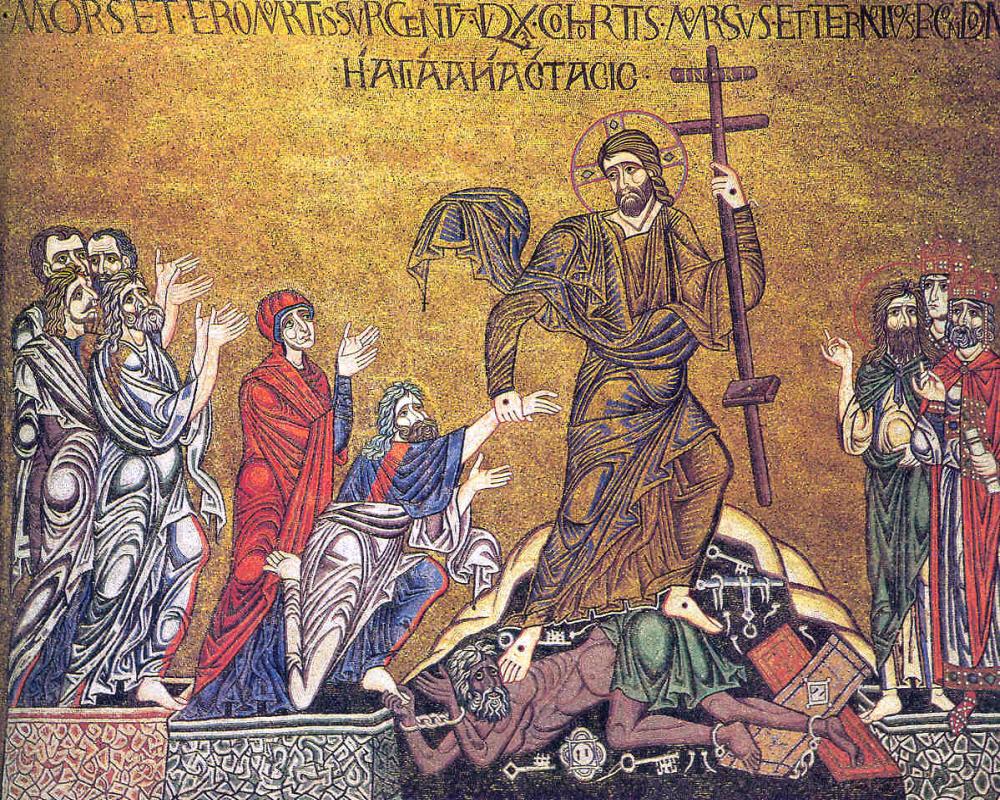
    We also see this expressed beautifully in the icons of the Anastasis, the Resurrection, as the triumphant Christ raises Adam and Eve from their grave as he himself rises from the dead.

    These are poetic ways of doing theology, but if we have ‘eyes to see’ then we can discern the deep truths in these ancient symbols. As the Second Adam, Christ brings new life to Adam and Eve, and to us all as their children.

    Harrowing of hell

    There is another Easter tradition that is especially relevant to today, Holy Saturday.

    We find this tradition preserved in 1 Peter 3:

    For Christ also suffered for sins once for all, the righteous for the unrighteous, in order to bring you to God. He was put to death in the flesh, but made alive in the spirit,in which also he went and made a proclamation to the spirits in prison,who in former times did not obey, when God waited patiently in the days of Noah, during the building of the ark … (1 Peter 3:18–20 NRSV)

    It is also preserved in the Apostles’ Creed, as well as in a number of ancient extra-canonical Christian texts.

    This idea has largely dropped out of favour in the West, but it preserves another way of thinking about Easter. In this tradition, Jesus uses the time between Good Friday and Easter Day to visit Hell, and while there he destroys the place. On Easter Day, Christ marches out of Hell followed by a great procession of people from all times and places who he has set free from death.

    No-one is left behind.

    What a powerful antidote to the religion that exploits fear of being ‘left behind’ to pressure people into particular expressions of Christianity.

    In the end, when God’s love has penetrated even the darkest recess of Hell, no-one will be left behind. God’s love will bring everyone with Jesus into the future God has prepared for his creation.

    No-one is left behind.

    Of course, none of these rituals and poetic myths are essential. Knowing them does not make one a better person, and observing them does not make one a better Christian. But they enrich our lives and enhance our faith. They may even touch us in ways that words fail to do.

    Rather than asking how much of this stuff we really need to observe, we are better to respond with grateful hearts. We can choose to put aside a compliance mentality that seeks the minimum required to gain a passing grade. We can choose instead to embrace the rituals that speak to us, those that touch us—and transform us—most deeply.

    What matters most is not that we get the ritual right this evening, but that we have the life of the risen Christ within us.

    Christ is risen!
    He is risen indeed.

Exit mobile version